
Listen to this Post
Introduction:
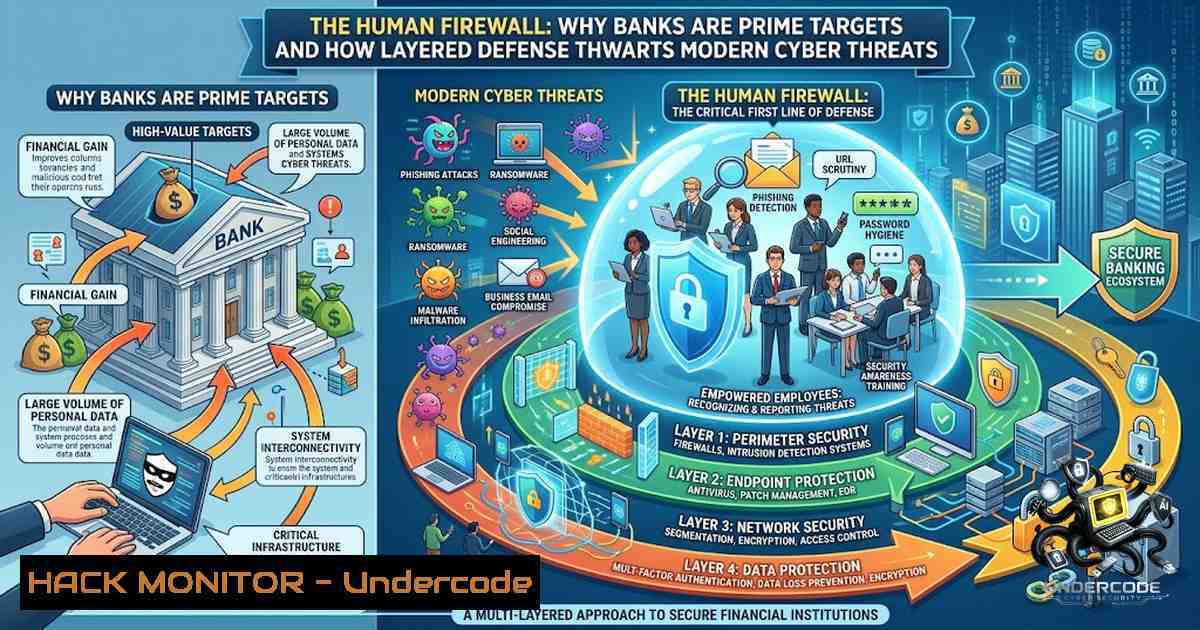
The global banking sector remains the most heavily targeted industry by cybercriminals, not merely because of the vast financial assets under management but because financial institutions are the custodians of societal trust and sensitive data. Modern banking cyber threats have evolved beyond brute-force technical attacks, pivoting toward sophisticated psychological manipulation and hybrid exploitation that merges social engineering with malicious code. The core challenge lies in the human element, where a single uninformed action can inadvertently dismantle layers of technical security, making comprehensive cyber awareness as critical as advanced encryption.
Learning Objectives & Secrets:
- Objective 1: Understanding Phishing Mechanics – Learn to dissect malicious emails and URLs through header analysis and sandboxing to preempt credential theft.
- Objective 2 (Secret Tip): Behavioral Exploitation – Leverage the “urgency principle” in social engineering tests; attackers often use fear of account lockout. Always cross-validate via out-of-band communication.
- Objective 3 (Secret Tip): Zero-Trust Isolation – Implement micro-segmentation in banking networks; even if a user is compromised, lateral movement is blocked by strict Identity and Access Management (IAM) policies and just-in-time access.
You Should Know:
1. Phishing Defense and Email Header Analysis
Phishing remains the primary vector for credential compromise in banking. Attackers disguise malicious emails as legitimate bank communications, luring employees into entering credentials on fake login portals. The first line of defense is technical verification.
Step‑by‑Step Guide – Analyzing Suspicious Emails:
- Step 1: View the full email headers in your email client (Gmail: Show Original; Outlook: View Message Details).
- Step 2: Identify the `Received` fields to verify the source IP against the bank’s legitimate mail server.
- Step 3: Analyze the `Authentication-Results` header for SPF, DKIM, and DMARC alignment.
- Step 4: Verify embedded URLs without clicking by using `curl -v
` (Linux) or using online sandboxes like VirusTotal.</li>
<li>Command (Linux): `echo "Subject: Urgent Request" | sendmail -v [email protected]` (testing mail flow).</li>
</ul>

<h2 style="color: yellow;">Windows Command (PowerShell) for URL Safety:</h2>

[bash]
Resolve-DnsName -1ame "malicious-link.com" -Type A
This command retrieves the IP address of a suspicious domain to check reputation against threat intelligence feeds.
2. Endpoint Protection and Malware Silencing
Malware in banking environments—such as TrickBot or Emotet—often targets transaction verification systems. Effective defense involves proactive detection.
Step‑by‑Step Guide – Implementing Windows Defender Attack Surface Reduction (ASR):
– Step 1: Open PowerShell as Administrator and set ASR rules to block Office macros from running.
– Step 2: Deploy Microsoft Defender for Endpoint to enable behavior monitoring.
– Step 3: Run offline scans usingStart-MpScan -ScanType BootSector.
– Command (Windows): `Set-MpPreference -AttackSurfaceReductionRules_Ids 5beb7efe-fd9a-4556-801d-275e5ffc04cc -AttackSurfaceReductionRules_Actions Enabled`
– Command (Linux – Debian): `sudo clamscan -r –remove /home` for basic malware scanning.3. Social Engineering Exploitation and MFA Bypass
Cybercriminals often use vishing (voice phishing) to exploit bank employees. The secret to mitigation is the “Human Firewall” training.
Step‑by‑Step Guide – Simulating Social Engineering Resistance:
- Step 1: Conduct regular internal phishing campaigns (e.g., using Gophish).
- Step 2: Monitor MFA push fatigue attacks; implement number matching in authenticator apps.
- Step 3: Enforce strict “No PII Over Phone” policies.
- Code for MFA Logging (API Security): Use `cat /var/log/auth.log | grep ‘FAILED LOGIN’` on Linux to audit authentication attempts.
4. Zero Trust Network Architecture (ZTNA) Hardening
Banks rely on Zero Trust to ensure that trust is never assumed.
Step‑by‑Step Guide – Setting Up Micro-Segmentation with iptables:
- Step 1: Block lateral movement from compromised workstations.
- Command (Linux): `sudo iptables -A FORWARD -s 192.168.1.0/24 -d 192.168.2.0/24 -j DROP`
– Step 2: Enforce TLS 1.3 for all internal API communications. - Step 3: Implement `auditd` to monitor changes in
/etc/passwd. - Windows Command: `New-1etFirewallRule -DisplayName “Block_RDP” -Direction Inbound -Protocol TCP -LocalPort 3389 -Action Block`
5. Cloud and API Security in Banking Environments
Modern banking relies on APIs. Misconfiguration often exposes customer data.
Step‑by‑Step Guide – Securing REST APIs with JWT:
- Step 1: Validate all JWT tokens on the backend using RSA signing.
- Step 2: Implement rate limiting using `iptables` or cloud WAF rules.
- Step 3: Use `jq` to parse and validate JSON payloads on Linux.
- Command (Linux): `curl -X GET https://api.bank.com/v1/accounts -H “Authorization: Bearer [bash]” -v` (for testing with verbose logging).
6. Insider Threat Mitigation
Given that trust is the most valuable asset, monitoring privileged access is non-1egotiable.
Step‑by‑Step Guide – Privilege Escalation Detection:
- Linux: Monitor `sudo` access logs: `grep ‘sudo’ /var/log/auth.log`
– Windows: Enable auditing for privilege use via `auditpol /set /subcategory:”Privilege Use” /success:enable`
– Command (Windows): `Get-WinEvent -LogName Security | Where-Object { $_.Id -eq 4672 }` (detects special privileges assigned).
What Undercode Say:
- Key Takeaway 1: Technology cannot compensate for human ignorance. Financial institutions must embed security into the organizational culture, treating every employee as a critical node in the defensive perimeter.
- Key Takeaway 2: Cyber resilience is built on layered defense. While firewalls and encryption protect the “castle walls,” continuous security awareness and rigorous incident response drills protect the “people inside.”
Analysis: The emphasis on trust in banking creates a unique vulnerability: reputation damage from a breach can be as devastating as financial loss. Attackers exploit this by targeting customer service representatives with social engineering to bypass technical verification. The most effective countermeasure is the implementation of strict identity verification protocols that require physical or biometric re-authentication for high-value transactions, combined with employee training on psychological triggers.
Prediction:
- +1: The adoption of AI-driven defense systems will drastically reduce phishing success rates by 60% through real-time linguistic analysis of email content, fostering a more proactive cyber posture.
- -1: The rise of “Deepfake Vishing” will create unprecedented trust-breaking scenarios in banking, rendering traditional voice authentication obsolete by 2027.
- -1: Insider threats will increase by 40% as economic pressures mount, necessitating behavioral analytics tools that monitor abnormal access patterns.
- +1: Regulatory bodies will enforce global “Security Culture” standards, requiring third-party audits of human factor training.
- -1: Cybercrime-as-a-Service (CaaS) will lower the barrier to entry, enabling more sophisticated hybrid attacks that combine malware and social engineering against legacy banking infrastructure.
▶️ Related Video (76% Match):
🎯Let’s Practice For Free:
🎓 Live Courses & Certifications:
Join Undercode Academy for Verified Certifications
🚀 Request a Custom Project:
Secure, high-velocity infrastructure and disruptive technological engineering. Contact our engineering team for high-tier development and proprietary systems:
[email protected]
💎 Smart Architecture | 🛡️ Secure by Design | ⭐ Trusted by ThousandsIT/Security Reporter URL:
Reported By: https://lnkd.in/p/e7-GahRS – Hackers Feeds
Extra Hub: Undercode MoN
Basic Verification: Pass ✅🔐JOIN OUR CYBER WORLD [ CVE News • HackMonitor • UndercodeNews ]
📢 Follow UndercodeTesting & Stay Tuned:


