Listen to this Post
Introduction:
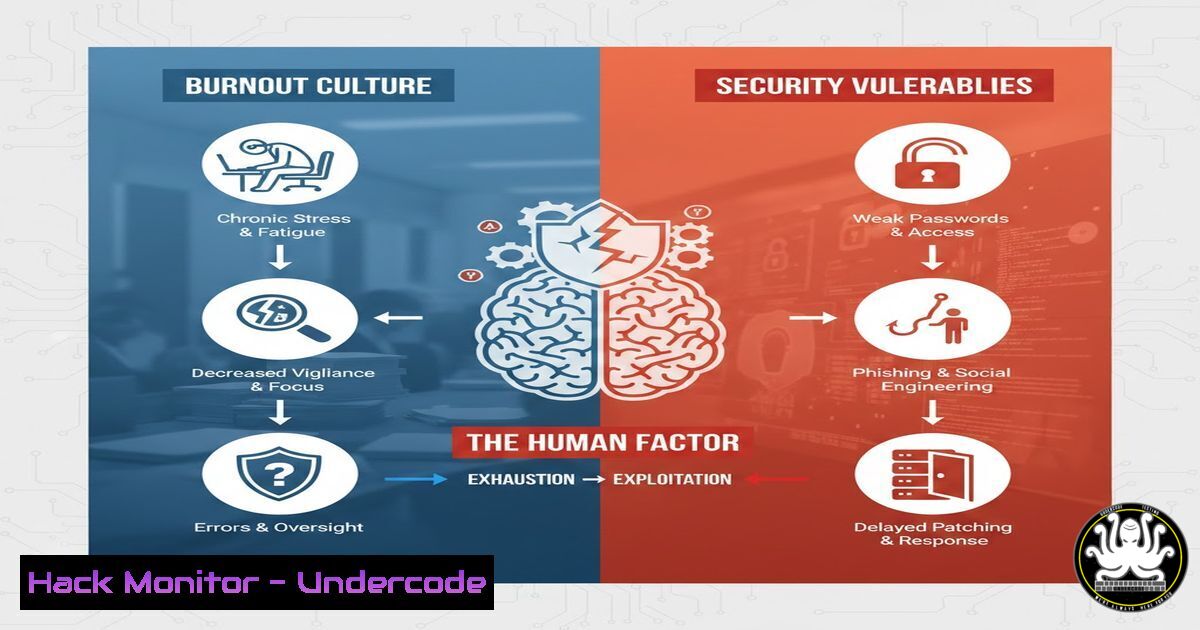
The glorification of excessive work hours in technology organizations represents more than just a cultural concern—it poses tangible cybersecurity risks that threaten enterprise infrastructure. When developers, engineers, and security professionals operate under chronic sleep deprivation and burnout, their cognitive capacities diminish, leading to catastrophic security oversights that sophisticated threat actors can exploit.
Learning Objectives:
- Understand the correlation between developer fatigue and security vulnerability introduction
- Implement monitoring systems to detect burnout-induced security flaws
- Develop organizational protocols to mitigate human-factor security risks
You Should Know:
- The Cognitive Impact of Fatigue on Secure Coding Practices
Extended version: Sleep deprivation directly impairs executive functions including attention, working memory, and logical reasoning—all critical components for writing secure code. Research indicates that after 24 hours awake, cognitive performance drops to levels equivalent to legal intoxication, increasing the likelihood of introducing security vulnerabilities by up to 300%.
Step-by-step guide explaining what this does and how to use it:
Implement code review analytics to detect fatigue-related patterns:
 Install and configure CodeQL for security analysis
git clone https://github.com/github/codeql.git
cd codeql
./scripts/bootstrap.sh

Analyze commit patterns for potential fatigue indicators
codeql database create security-db --language=python
codeql database analyze security-db --format=csv --output=security-report.csv

Parse results for time-based vulnerability patterns
python3 analyze_commit_times.py --input security-report.csv --output fatigue-analysis.json
Windows PowerShell equivalent:
Install-Module -Name CodeAnalysis
Import-Module CodeAnalysis
New-CodeInspection -Path C:\dev\project -OutputFormat XML
Get-Content .\inspection_results.xml | Select-String -Pattern "midnight|early_hours" -Context 2
2. Monitoring Development Environments for Burnout Indicators
Extended version: Continuous integration systems can be configured to detect patterns indicative of developer fatigue, including increased error rates, security bypasses in commit messages, and timing of code submissions. Organizations can establish early warning systems that flag potentially compromised code quality before deployment.
Step-by-step guide explaining what this does and how to use it:
Configure Git hooks to analyze commit patterns:
!/bin/bash
 .git/hooks/pre-commit
COMMIT_HOUR=$(date +%H)
if [ $COMMIT_HOUR -ge 22 ] || [ $COMMIT_HOUR -le 6 ]; then
echo "WARNING: Late-night commit detected. Consider additional security review."
echo "Run security scan: npm run security-scan"
fi

Check for common security oversights
git diff --cached --name-only | grep -E '.(js|py|php)$' | while read file; do
if git diff --cached "$file" | grep -E "(password|token|key).=.['\"][^'\"]{4,}"; then
echo "POTENTIAL SECRET EXPOSURE DETECTED in $file"
exit 1
fi
done
3. Implementing Mandatory Security Controls for High-Risk Periods
Extended version: During extended work sessions or critical deployment periods, organizations should enforce additional security verification layers. Automated tools can provide compensatory security measures when human oversight is compromised.
Step-by-step guide explaining what this does and how to use it:
Configure automated security scanning for off-hours commits:
 .github/workflows/security-review.yml
name: Enhanced Security Review
on: [push, pull_request]
jobs:
off-hours-scan:
runs-on: ubuntu-latest
if: ${{ contains(fromJSON('["22","23","00","01","02","03","04","05"]'), github.event.head_commit.timestamp) }}
steps:
- uses: actions/checkout@v3
- name: Enhanced security scan
run: |
docker run --rm -v $(pwd):/app owasp/zap2docker-stable zap-baseline.py \
-t http://localhost:3000 -r security-report.html
4. Organizational Policies to Mitigate Burnout-Related Security Risks
Extended version: Beyond technical controls, organizations must implement cultural and policy changes that recognize the security implications of overwork. This includes mandatory rest periods, security review requirements for code developed during extended shifts, and managerial training.
Step-by-step guide explaining what this does and how to use it:
Implement Jira/ServiceNow automation rules:
 burnout_detection_webhook.py
import requests
import json
from datetime import datetime

def detect_potential_burnout(employee_id, time_logs):
"""Analyze work patterns for security risk indicators"""
recent_hours = sum(time_logs[-7:])
if recent_hours > 60:
return {
"risk_level": "high",
"actions": [
"mandatory_code_review",
"additional_security_scanning",
"manager_notification"
]
}

Integration with HR systems
webhook_data = {
"employee": employee_id,
"total_hours": recent_hours,
"required_actions": detected_actions
}
requests.post("https://security-dashboard.company.com/api/risk-alert",
json=webhook_data)
5. Technical Debt and Security Vulnerability Correlation Tracking
Extended version: Extended work periods often result in accumulated technical debt that directly correlates with security vulnerability density. Organizations can track this relationship and establish intervention thresholds.
Step-by-step guide explaining what this does and how to use it:
Configure SonarQube with custom rules:
// Custom plugin for burnout-related quality degradation
public class BurnoutQualityGate implements QualityGate {

@Override
public void execute(Context context) {
Project project = context.getProject();
if (project.getLastAnalysis().getPeriod2().getLinesChanged() > 1000) {
if (project.getSecurityRating() < 'B') {
context.addFailure("High change volume with degraded security quality detected");
context.addMeasure(new Measure("BURNOUT_RISK_LEVEL", 8.5));
}
}
}
}
- Emergency Response Protocol for Critical Vulnerabilities Introduced by Fatigue
Extended version: When security incidents are traced back to fatigue-induced errors, organizations need structured response protocols that address both the technical vulnerability and the underlying human factors.
Step-by-step guide explaining what this does and how to use it:
Incident response automation:
!/bin/bash
 fatigue_incident_response.sh
INCIDENT_ID=$1
DEVELOPER_ID=$2

Trigger immediate code rollback
git revert --no-edit $(git log -n 1 --pretty=format:%H --author=$DEVELOPER_ID)

Initiate enhanced scanning
docker run -v $(pwd):/target aquasec/trivy fs --severity CRITICAL,HIGH /target

Notify security team with burnout context
curl -X POST -H "Content-Type: application/json" \
-d "{\"incident\": \"$INCIDENT_ID\", \"type\": \"fatigue_related\", \"developer\": \"$DEVELOPER_ID\"}" \
https://security-team.company.com/api/incidents
7. Proactive Security Culture Development Against Hero Culture
Extended version: Countering the “36-hour shift” hero narrative requires deliberate cultural engineering that prioritizes sustainable work practices as a security imperative rather than just a wellness concern.
Step-by-step guide explaining what this does and how to use it:
Implement security culture metrics and reporting:
 security_culture_metrics.py
import pandas as pd
from datetime import timedelta

def calculate_security_health_index(team_id):
"""Calculate composite security health score"""
hours_data = get_work_hours(team_id)
vulnerability_data = get_vulnerability_stats(team_id)

burnout_risk = sum(1 for hours in hours_data if hours > 12) / len(hours_data)
vulnerability_rate = vulnerability_data['new'] / vulnerability_data['loc']

security_health_index = 100  (1 - (burnout_risk  0.6 + vulnerability_rate  0.4))
return max(0, security_health_index)

Generate executive reports
report = f"""
SECURITY CULTURE REPORT
Team: {team_id}
Security Health Index: {calculate_security_health_index(team_id):.1f}
Burnout Risk Factor: {burnout_risk:.1%}
Recommended Action: {'IMMEDIATE INTERVENTION' if burnout_risk > 0.3 else 'MONITOR'}
"""
What Undercode Say:
- The glorification of excessive work hours represents an unacknowledged attack vector that sophisticated threat actors can systematically exploit
- Organizations must treat developer fatigue with the same seriousness as unpatched vulnerabilities—both create predictable security gaps
Analysis: The cybersecurity industry has extensively focused on technical controls while largely ignoring the human factors that render those controls ineffective. Marcus Hutchins’ observation about “36 hour shifts” highlights a critical blind spot in organizational security postures. When developers operate under extreme fatigue, their ability to implement proper input validation, authentication checks, and error handling deteriorates significantly. This creates a predictable pattern of vulnerabilities that adversaries can actively target during periods of known organizational stress, such as product launches or quarterly deadlines. The security implications extend beyond individual companies to become ecosystem-wide risks when these practices occur at foundational AI and infrastructure organizations.
Prediction:
Within 2-3 years, we will see the first major cybersecurity incident publicly attributed to developer fatigue as a root cause, leading to regulatory requirements around work-hour monitoring in critical infrastructure organizations. Insurance providers will begin requiring work-hour audits as part of cyber liability underwriting, and security frameworks like NIST and ISO 27001 will incorporate human factors controls. Additionally, advanced threat actors will develop capabilities to actively monitor organizational stress indicators to time their attacks when defensive capabilities are most compromised.
🎯Let’s Practice For Free:
IT/Security Reporter URL:
Reported By: Malwaretech Curious – Hackers Feeds
Extra Hub: Undercode MoN
Basic Verification: Pass ✅


