Listen to this Post
Introduction:
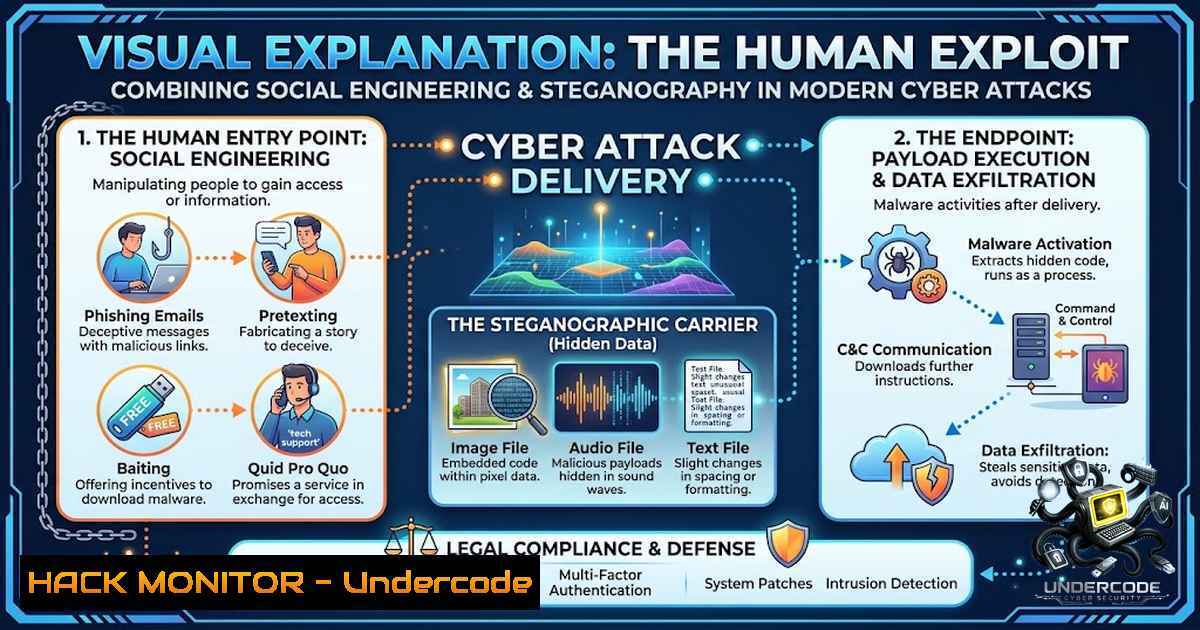
The cybersecurity industry has long focused on technical defenses—firewalls, intrusion detection systems, and patch management—yet the most persistent vulnerability remains the human element. According to Proofpoint’s “Human Factor 2025” report, which analyzed 3.4 billion emails and 21 billion URLs, more than 90% of Advanced Persistent Threat (APT) campaigns based on pure social engineering use collaboration or professional engagement pretexts to establish initial contact. The 2025 Data Breach Investigations Report confirms that 90% of all successful breaches now follow three specific patterns, with social engineering ranking first. Firewalls and patched systems become irrelevant when a human clicks the wrong link. This article explores the psychology behind social engineering attacks, practical steganography techniques used for covert data exfiltration, and actionable countermeasures for security professionals.
Learning Objectives & Secrets:
- Objective 1: Master Social Engineering Attack Vectors – Understand the psychological triggers—urgency, authority, fear, and isolation—that attackers exploit to bypass technical controls. Learn to identify and audit human-level vulnerabilities within an organization.
-
Objective 2 Secret Tip: The “Check and Click” Defense – Before clicking any link, hover to reveal the actual destination URL. Verify the sender through an out-of-band channel (e.g., phone call or separate email thread). Attackers rely on rushed decisions; slowing down is your strongest defense.
-
Objective 3 Secret Tip: Steganography Detection – Hidden data in images and audio files bypasses traditional content filters. Use statistical analysis tools like StegExpose or Aletheia to detect LSB (Least Significant Bit) anomalies in media files. Monitor for unusual outbound traffic patterns that may indicate data exfiltration via covert channels.
You Should Know:
- Anatomy of a Phishing Attack – The Psychological Playbook
Modern phishing campaigns rarely rely on technical exploits alone. Attackers construct convincing narratives that manipulate cognitive biases. The mock phishing email described in the CEH lecture employed four key levers:
- Urgency – Subject lines like “URGENT” or “Priority: HIGH” trigger a reactive mental state, bypassing critical thinking.
- Authority – Impersonating a “Security Operations Team” exploits the innate human tendency to defer to perceived authority figures.
- Isolation – Instructions like “avoid forwarding this message outside the authorized team”切断 the target from colleagues who might verify the request.
- Disguised Links – Text reading “Google Account” hides a malicious destination underneath.
Step‑by‑Step Guide to Phishing Analysis:
- Inspect the Email Header – In Gmail, click “Show original” (or in Outlook, “View > Message Options”). Examine the `Received` and `Return-Path` fields for mismatched domains.
- Hover Over Links – On desktop browsers, hover your cursor over any hyperlink without clicking. The actual destination appears in the status bar or as a tooltip.
- Verify the Sender – Check the sender’s email address against the display name. `[email protected]` (with a numeral “1”) is not Google.
- Look for Red Flags – Poor grammar, generic greetings (“Dear User”), and requests for sensitive information are classic indicators.
- Report and Delete – Forward suspicious emails to your security team or use the built-in report phishing button in your email client.
-
Steganography in Practice – Hiding Data in Plain Sight
Steganography is not a novelty trick—it is a real exfiltration and covert communication technique used by threat actors to smuggle data past filters that scan only for obviously malicious content. OpenStego, a Java-based steganography application, provides two primary functionalities: data hiding within cover files (e.g., images) and digital watermarking.
Step‑by‑Step Guide Using OpenStego (Command Line):
Installation:
- Download the OpenStego JAR file from the official repository.
- Ensure Java Runtime Environment (JRE) is installed.
- On Windows, double-click
openstego.bat; on Linux/macOS, run./openstego.sh.
Embedding a Secret Message:
 Basic embed - hide message.txt inside cover.png, output as stego.png
openstego embed -mf message.txt -cf cover.png -sf stego.png

Embed with AES-128 encryption and password protection
openstego embed -mf secret.txt -cf cover.png -sf stego.png -e -p MySecurePassword

Specify max bits per channel (increase for larger messages, default=3)
openstego embed -mf data.txt -cf photo.jpg -sf output.png -b 4
The `-mf` flag specifies the message file, `-cf` the cover image, and `-sf` the output stego file.
Extracting a Hidden Message:
 Extract to current directory
openstego extract -sf stego.png -xd .

Extract with password
openstego extract -sf stego.png -xd ./output -p MySecurePassword
The `-xd` flag specifies the extraction directory.
Supported Cover Formats: PNG, BMP, GIF, JPEG, WBMP. PNG is recommended as JPEG’s lossy compression may corrupt embedded data.
3. Alternative Steganography Tools – SilentEye and DeepSound
Beyond OpenStego, attackers and penetration testers frequently use SilentEye and DeepSound.
SilentEye – A cross-platform GUI tool that hides text or files inside BMP, JPEG, and WAV files using LSB techniques. It supports AES encryption, zlib compression, and drag-and-drop functionality.
DeepSound – Hides secret data inside audio files (MP3, WAV, FLAC). The application also enables extraction of secret files directly from audio files or audio CD tracks.
Step‑by‑Step Guide Using DeepSound (Windows GUI):
1. Launch DeepSound and click Open carrier files.
- Select an audio file (MP3 or WAV recommended).
- Click Add secret files and choose the data to hide.
4. Set an optional password for encryption.
- Click Hide Data to generate the output audio file containing the hidden payload.
4. Detecting Steganographic Exfiltration
Detection requires a multi-layered approach combining file analysis and network monitoring.
Command-Line Steganalysis Tools:
 StegExpose - statistical analysis for LSB steganography
stegExpose -i suspicious.png

Aletheia - open-source steganalysis toolbox
aletheia --detect -i image.png -a lsb

Stegdetect - detect hidden data in JPEG images
stegdetect -t i -s 10.0 suspicious.jpg
Network Monitoring for Covert Channels:
- Monitor IP ID sequences for non-random or patterned behavior, especially across unfragmented packets.
- Use extended Berkeley Packet Filter (eBPF) to detect covert communications targeting IPv6 conversations.
- Correlate file creation/modification events with outbound network traffic, especially when paired with lateral movement or exfiltration behavior.
5. Building a Human Firewall – Countermeasures
According to CEH v13 curriculum, social engineering countermeasures include:
- Security Awareness Training – Regular, behavior-focused training that covers phishing, pretexting, vishing, and physical security.
- Simulated Phishing Campaigns – Run internal phishing exercises to measure and improve employee vigilance.
- Incident Response Plan – Establish clear procedures for reporting suspicious communications.
- Principle of Least Privilege – Limit access rights to reduce the blast radius of successful compromises.
- Verification Protocols – Implement out-of-band verification for sensitive requests (e.g., financial transactions, password resets).
6. Linux and Windows Commands for Security Auditing
Linux – File Integrity Monitoring:
 Monitor for new or modified image files in /tmp
inotifywait -m /tmp -e create -e modify | grep -E '.(png|jpg|jpeg|gif|bmp)$'

Check for hidden data using binwalk (extract embedded files)
binwalk -e suspicious.png

Examine file entropy (high entropy may indicate encrypted/compressed data)
entropy suspicious.png
Windows – PowerShell Steganalysis:
 Calculate file hash for baseline comparison
Get-FileHash -Path .\suspicious.png -Algorithm SHA256

Compare file sizes (significant increase may indicate embedded data)
(Get-Item .\cover.png).Length
(Get-Item .\stego.png).Length

Extract metadata using ExifTool (available via Chocolatey)
exiftool suspicious.png
7. Cloud and API Security Considerations
Steganography is increasingly used to exfiltrate data from cloud environments. Attackers may embed stolen credentials or API keys within innocuous-looking images uploaded to cloud storage.
Mitigation Strategies:
- Implement Data Loss Prevention (DLP) policies that scan media files for anomalies.
- Use cryptographic provenance protocols like VectorPin, which pins each embedding to its source content via Ed25519 signatures.
- Restrict outbound traffic to known, trusted destinations.
- Enable logging and monitoring for all cloud storage operations.
What Undercode Say:
- Key Takeaway 1: Security is not just firewalls and patches—it is psychology, attention, and habit. The best exploit is still a convincing story. Verify the sender, hover before you click, and slow down when a message tries to rush you.
-
Key Takeaway 2: Steganography is a real, operational threat—not a theoretical curiosity. Threat actors use tools like OpenStego, SilentEye, and DeepSound to smuggle data past traditional filters. Defenders must adopt steganalysis techniques and monitor for anomalous file and network behavior.
Analysis: The CEH lecture at Corvit highlights a critical gap in cybersecurity education: technical skills alone are insufficient. The ~90% statistic is not hyperbole—it reflects a fundamental shift in attack vectors. Organizations that invest exclusively in technical controls while neglecting human factors remain vulnerable. The “Check and Click” trap and steganography demonstration serve as practical, hands-on reminders that security professionals must think like attackers. Understanding the psychology of manipulation and the mechanics of covert communication is essential for building resilient defenses. The integration of AI-generated phishing content further escalates this threat, making continuous awareness training and behavioral analytics non-1egotiable components of modern security programs.
Prediction:
- +1 Security awareness training will become as critical as firewall configuration in enterprise security budgets, with organizations allocating 30–40% of cybersecurity spending to human-centric defenses by 2027.
-
-1 The democratization of steganography tools via open-source repositories will enable a new wave of low-skill, high-impact data exfiltration attacks targeting small and medium businesses that lack advanced detection capabilities.
-
+1 AI-powered steganalysis tools, such as HSDetect-1et, will achieve detection accuracy exceeding 90%, providing defenders with automated, scalable solutions to counter covert channels.
-
-1 Generative AI will enable hyper-personalized phishing campaigns that defeat traditional awareness training by mimicking individual writing styles and contextual knowledge, making verification protocols more essential than ever.
-
+1 The integration of steganography detection into Next-Generation Firewalls (NGFW) and Secure Web Gateways (SWG) will become a standard feature, closing the gap between file-based and network-based threat detection.
-
-1 Nation-state actors will increasingly leverage audio steganography (via tools like DeepSound) to exfiltrate classified data through voice and music streaming platforms, bypassing traditional DLP filters that focus on images and documents.
▶️ Related Video (86% Match):
https://www.youtube.com/watch?v=1gO2bC5xLlo
🎯Let’s Practice For Free:
🎓 Live Courses & Certifications:
Join Undercode Academy for Verified Certifications
🚀 Request a Custom Project:
Secure, high-velocity infrastructure and disruptive technological engineering. Contact our engineering team for high-tier development and proprietary systems:
[email protected]
💎 Smart Architecture | 🛡️ Secure by Design | ⭐ Trusted by Thousands
IT/Security Reporter URL:
Reported By: https://lnkd.in/p/ejuzcJfd – Hackers Feeds
Extra Hub: Undercode MoN
Basic Verification: Pass ✅


