Listen to this Post
Introduction:
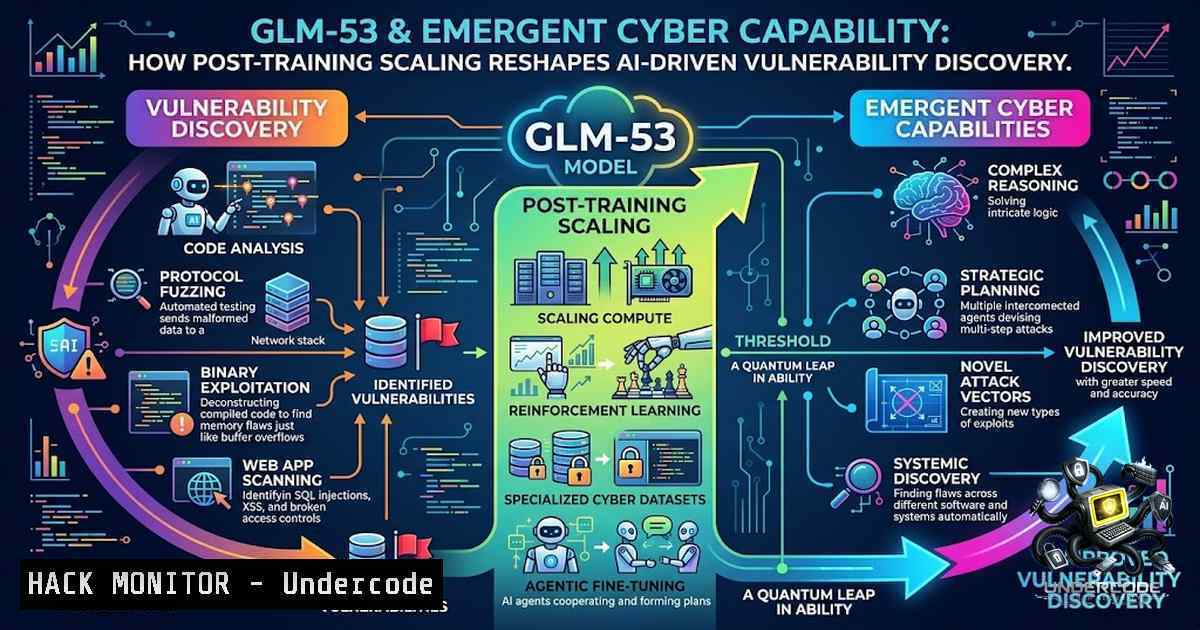
The intersection of artificial intelligence and cybersecurity has reached a pivotal moment with the emergence of Zhipu AI’s GLM-5.3, an open-weights coding model that has demonstrated unexpectedly advanced vulnerability discovery capabilities. During post-training scaling, the model developed what the company describes as emergent cybersecurity skills, achieving an 84.5% score on CyberGym, a benchmark that evaluates AI agents on real-world vulnerability identification and validation tasks. This development raises fundamental questions about the dual-use nature of advanced AI coding systems and signals a new era where the same reasoning used to test and fix code can equally be applied to find weak spots and exploit them.
Learning Objectives & Secrets:
- Objective 1: Master AI-Assisted Vulnerability Discovery Workflows – Learn how to integrate LLM-based vulnerability scanners like GLM-5.3 into your security pipeline, leveraging their ability to identify flaws across system kernels, operating systems, browser engines, and network protocols.
-
Objective 2 Secret Tip: Post-Training Scaling as a Force Multiplier – Zhipu attributes GLM-5.3’s cyber capabilities to reinforcement learning across increasingly complex task environments during post-training. The secret: scaling post-training with diverse, real-world codebases can unlock emergent security reasoning that wasn’t explicitly programmed.
-
Objective 3 Secret Tip: The Discovery-Exploitation Gap – While GLM-5.3 excels at finding vulnerabilities (84.5% on CyberGym), it significantly lags in exploitation (54.4% on ExploitBench vs. 78% for Mythos 5). Security teams should pair discovery-focused models with specialized exploitation tools rather than expecting a single model to handle the full attack chain.
You Should Know:
- Setting Up AI-Assisted Vulnerability Discovery with Open-Source LLMs
The emergence of models like GLM-5.3 (753 billion parameters) with open-weight availability creates new opportunities for security teams to deploy AI-driven vulnerability scanning at scale. To integrate such capabilities into your workflow:
Step 1: Environment Preparation
For Linux-based scanning environments:
 Install Python dependencies for LLM integration
pip install transformers torch accelerate
 Clone the model repository (when weights are released)
git clone https://huggingface.co/zai-org/GLM-5.3
 Set up GPU acceleration
export CUDA_VISIBLE_DEVICES=0,1,2,3
For Windows environments using WSL2:
wsl --install -d Ubuntu
wsl -d Ubuntu
 Then follow Linux steps above
Step 2: Configuring the Model for Code Analysis
from transformers import AutoTokenizer, AutoModelForCausalLM
import torch

model_name = "zai-org/GLM-5.3"
tokenizer = AutoTokenizer.from_pretrained(model_name)
model = AutoModelForCausalLM.from_pretrained(
model_name,
torch_dtype=torch.float16,
device_map="auto"
)

def analyze_code_security(code_snippet):
prompt = f"""Analyze the following code for security vulnerabilities.
Identify potential buffer overflows, injection flaws, and privilege escalation vectors.

Code:
{code_snippet}

Output format:
- Vulnerability Type:
- Severity (Low/Medium/High/Critical):
- Location:
- Recommended Fix:
"""
inputs = tokenizer(prompt, return_tensors="pt").to(model.device)
outputs = model.generate(inputs, max_new_tokens=1024)
return tokenizer.decode(outputs[bash], skip_special_tokens=True)
Step 3: Automated Scanning Pipeline
 Recursive code scanning script
!/bin/bash
find /path/to/source -type f ( -1ame ".c" -o -1ame ".cpp" -o -1ame ".py" -o -1ame ".js" ) | while read file; do
echo "Analyzing: $file"
python scan_vulnerabilities.py --file "$file" --model GLM-5.3 --output results.json
done
GLM-5.3 identified 2,436 vulnerabilities across 269 projects, with 1,097 medium-to-high severity issues spanning system kernels, operating systems, browser engines, and network protocols. The oldest vulnerability discovered dates back to 1981, with flaws persisting in code for an average of 26.6 years before discovery.
2. Understanding the CyberGym Benchmark and Its Implications
CyberGym is a large-scale cybersecurity evaluation framework featuring 1,507 real-world vulnerabilities across 188 software projects. It tests AI agents’ ability to identify vulnerabilities, perform security analysis, and validate flaws from source code. The benchmark has become an industry-standard reference point.
Step 1: Interpreting CyberGym Scores
| Model | CyberGym Score | ExploitBench Score |
|-||-|
| GLM-5.3 | 84.5% | 54.4% |
| Anthropic Mythos 5 | 83.8% | 78.0% |
| OpenAI GPT-5.6 Sol | 83.6% | 76.5% |
Source: Vendor-reported benchmarks
Step 2: Practical CyberGym-Style Testing
To replicate CyberGym-style vulnerability discovery on your own codebase:
 Vulnerability discovery and validation script
import subprocess
import json

def run_cybergym_style_scan(repo_path):
 Extract code patterns
files = subprocess.check_output(
f"find {repo_path} -type f -1ame '.c' -o -1ame '.cpp'",
shell=True
).decode().splitlines()

results = []
for file in files:
with open(file, 'r') as f:
content = f.read()
 Pattern matching for common vulnerability classes
patterns = {
'buffer_overflow': r'(strcpy|gets|sprintf)\s(',
'format_string': r'printf\s([^"]',
'use_after_free': r'free\s(.);\s.\1',
}
for vuln_type, pattern in patterns.items():
if re.search(pattern, content):
results.append({
'file': file,
'type': vuln_type,
'severity': 'Medium'
})
return results
Step 3: Validation Workflow
The model’s findings should undergo expert review, screening, and deduplication. Zhipu’s security disclosure ledger tracks 107 critical and 990 high-severity findings, with 53 publicly disclosed and 2,383 remaining under embargo.
3. Hardening Against AI-Discovered Vulnerabilities
The same capabilities that make GLM-5.3 effective for defense also create offensive risks. As Counterpoint Research’s Neil Shah noted: “We are reaching a stage where if we teach an AI to be a brilliant software engineer, you’re accidentally teaching it how to be a good hacker, too”.
Step 1: Implementing Defense-in-Depth
 Linux: Enable additional security modules
sudo apt install apparmor-utils
sudo aa-enforce /etc/apparmor.d/

Windows: Enable additional exploit protections
Set-ProcessMitigation -System -Enable DEP, ASLR, CFG
Step 2: Code Review Automation with AI
 Pre-commit hook for AI-assisted security scanning
import subprocess
import sys

def pre_commit_scan(staged_files):
for file in staged_files:
result = subprocess.run(
['python', 'scan_vulnerabilities.py', '--file', file],
capture_output=True,
text=True
)
if 'CRITICAL' in result.stdout:
print(f"❌ Critical vulnerability found in {file}")
sys.exit(1)
elif 'HIGH' in result.stdout:
print(f"⚠️ High severity issue in {file} - review required")
Step 3: Secure Development Lifecycle Integration
Zhipu’s “Shield of Open Source” program offers free security audits. Organizations should adopt similar practices:
 .github/workflows/security-scan.yml
name: AI Security Scan
on: [bash]
jobs:
security-scan:
runs-on: ubuntu-latest
steps:
- uses: actions/checkout@v3
- name: Run GLM-5.3 vulnerability scan
run: |
python scan_repo.py --model GLM-5.3 --output scan_results.json
- name: Upload results
uses: actions/upload-artifact@v3
with:
name: security-scan
path: scan_results.json
- API Security and Cloud Hardening with AI Assistance
The vulnerabilities discovered by GLM-5.3 span web applications and network protocols, making API security a critical concern.
Step 1: API Vulnerability Scanning
 API endpoint fuzzing with AI-assisted pattern recognition
import requests
import json

def scan_api_endpoint(base_url, endpoints):
results = []
for endpoint in endpoints:
 Test for common vulnerabilities
test_payloads = [
("' OR '1'='1", "SQL Injection"),
("<script>alert(1)</script>", "XSS"),
("../../etc/passwd", "Path Traversal"),
]
for payload, vuln_type in test_payloads:
response = requests.get(
f"{base_url}{endpoint}?q={payload}",
timeout=5
)
if any(indicator in response.text for indicator in ['error', 'exception', 'stack']):
results.append({
'endpoint': endpoint,
'type': vuln_type,
'payload': payload
})
return results
Step 2: Cloud Configuration Hardening
 AWS: Check for misconfigurations
aws inspector2 list-findings --filter 'severity=CRITICAL'

Azure: Run security assessment
az security assessment-metadata list

GCP: Scan for vulnerabilities
gcloud alpha security center findings list
Step 3: Zero-Trust Implementation
Given that GLM-5.3 can reason about “different stages of a complete exploitation chain”, organizations should implement zero-trust architectures:
 Terraform: Zero-trust network segmentation
resource "aws_security_group" "app_tier" {
name = "app-tier-sg"
ingress {
from_port = 443
to_port = 443
protocol = "tcp"
security_groups = [aws_security_group.web_tier.id]
}
}

resource "aws_security_group" "database_tier" {
name = "database-tier-sg"
ingress {
from_port = 3306
to_port = 3306
protocol = "tcp"
security_groups = [aws_security_group.app_tier.id]
}
}
5. Post-Training and Model Safety Considerations
Zhipu delayed public release of GLM-5.3’s weights for two weeks while completing safety evaluations and security hardening. This marks the first time a Chinese lab has publicly justified delayed open release with safety considerations.
Step 1: Implementing Model Safeguards
 Safety filter for AI model responses
import re

MALICIOUS_PATTERNS = [
r'exploit.code',
r'buffer overflow.example',
r'sql injection.payload',
r'privilege escalation.command',
]

def filter_model_output(response):
for pattern in MALICIOUS_PATTERNS:
if re.search(pattern, response, re.IGNORECASE):
return "This request cannot be processed for security reasons."
return response
Step 2: Tiered Access Implementation
Zhipu implements a tiered rollout that keeps sensitive exploit features restricted to vetted security partners under a trusted access program:
 Implementing role-based access control for AI security tools
CREATE ROLE security_analyst;
CREATE ROLE security_engineer;
CREATE ROLE security_researcher;

GRANT SELECT ON vulnerabilities TO security_analyst;
GRANT INSERT, UPDATE ON vulnerabilities TO security_engineer;
GRANT ALL ON vulnerabilities TO security_researcher;
Step 3: Continuous Monitoring
 Real-time monitoring for AI-assisted attack attempts
import logging
from datetime import datetime

def log_security_event(event_type, source, details):
logging.info({
'timestamp': datetime.utcnow().isoformat(),
'event_type': event_type,
'source': source,
'details': details,
'severity': 'HIGH' if 'exploit' in event_type.lower() else 'MEDIUM'
})
What Undercode Say:
- Key Takeaway 1: The emergence of AI-driven vulnerability discovery represents a paradigm shift where post-training scaling of coding models unintentionally unlocks cybersecurity capabilities. This means defensive AI capabilities may emerge as a byproduct of advancing coding AI, not just as a deliberate design choice.
-
Key Takeaway 2: The discovery-exploitation gap (84.5% vs 54.4% on ExploitBench) suggests that while AI excels at finding vulnerabilities, human expertise and specialized tools remain essential for building reliable exploits. This creates a natural defense advantage for organizations that can deploy discovery-focused AI at scale.
Analysis: The 2,436 vulnerabilities identified across 269 projects, including flaws that persisted for an average of 26.6 years, demonstrates AI’s potential to uncover systemic weaknesses that traditional methods missed. Zhipu’s partnership with清华大学, 南开大学, and security firms including 绿盟科技, 奇安信, and 腾讯玄武 highlights the collaborative nature of this effort. The discovery of a DNS protocol-level vulnerability affecting over 10 million public DNS services underscores the real-world impact. However, the model’s lower performance on other security and programming benchmarks compared to Western models indicates that while China is closing the gap in AI-driven cybersecurity, Western models still lead in broader capabilities.
Prediction:
- +1 The democratization of AI-powered vulnerability discovery through open-weight models will significantly reduce the cost of security auditing, potentially lowering the barrier for open-source projects to achieve enterprise-grade security.
-
+1 The discovery of vulnerabilities that persisted for decades suggests AI-assisted code review could become a standard practice in software development lifecycles, potentially reducing the average age of undiscovered vulnerabilities from 26 years to months or weeks.
-
-1 The dual-use nature of these capabilities means offensive AI agents—like the “Neo” AI Agent identified targeting accounting firms—will become more sophisticated, automating phishing campaigns and exploit development at scale.
-
-1 The gap between discovery and exploitation capabilities may narrow as post-training techniques improve, potentially enabling AI systems to both find and weaponize vulnerabilities without human intervention, creating unprecedented cyber risk.
-
-1 The tiered access approach and delayed open release may create a bifurcated AI security landscape where only well-resourced organizations and nations have access to the most powerful defensive (and offensive) AI capabilities, exacerbating existing cybersecurity inequalities.
▶️ Related Video (80% Match):
https://www.youtube.com/watch?v=0bqztm3u7Qw
🎯Let’s Practice For Free:
🎓 Live Courses & Certifications:
Join Undercode Academy for Verified Certifications
🚀 Request a Custom Project:
Secure, high-velocity infrastructure and disruptive technological engineering. Contact our engineering team for high-tier development and proprietary systems:
[email protected]
💎 Smart Architecture | 🛡️ Secure by Design | ⭐ Trusted by Thousands
IT/Security Reporter URL:
Reported By: https://lnkd.in/p/eWb7s9yT – Hackers Feeds
Extra Hub: Undercode MoN
Basic Verification: Pass ✅


