Listen to this Post
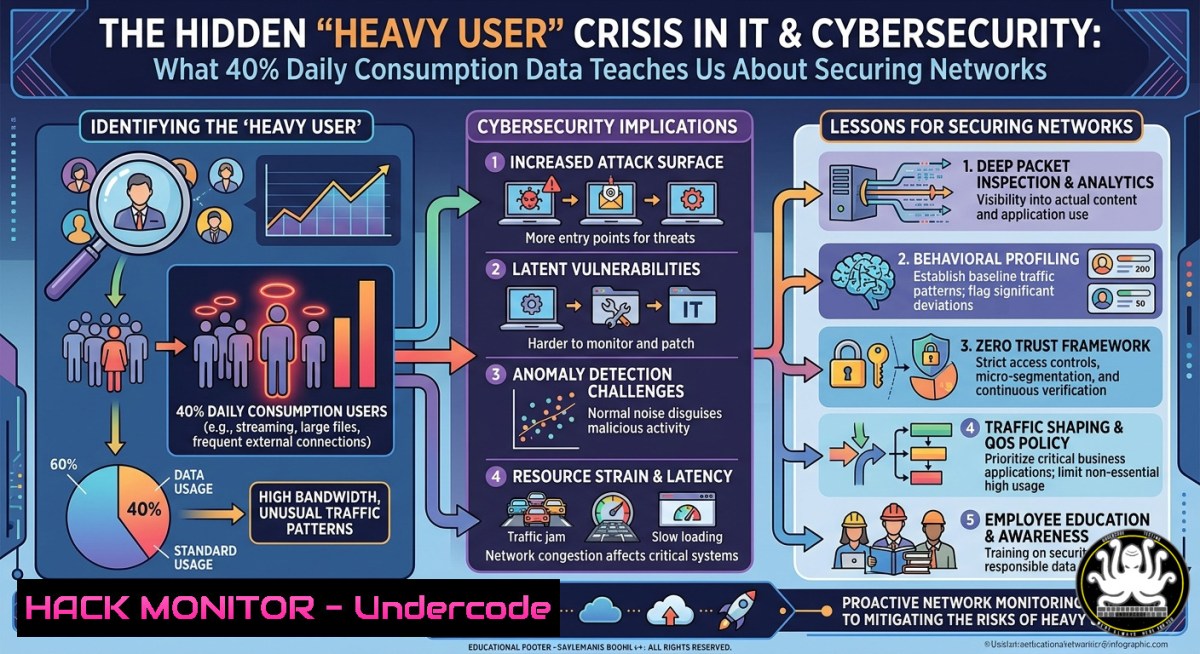
Introduction:
Recent analysis by Carnegie Mellon University’s Jonathan Caulkins, highlighted in a Wall Street Journal piece on marijuana policy, reveals a critical pattern: “A good 40% of current cannabis users are using it daily or near daily, a pattern that is more associated with tobacco use than typical alcohol use”. This insight—that a minority of heavy users drive the majority of market activity—translates directly to cybersecurity, IT resource management, and AI system governance. Just as policy must target heavy consumption patterns, network security and cloud cost optimization must focus on outlier users and anomalous traffic to prevent breaches and budget overruns.
Learning Objectives:
- Implement usage-based alerting to detect “heavy user” anomalies in network logs and cloud billing data
- Apply rate limiting and throttling to prevent system abuse by power users or compromised accounts
- Leverage AI-driven analytics to distinguish between normal heavy usage and malicious behavior
You Should Know:
- The 40% Rule: Why Your Heavy Users Are Your Biggest Risk
In cannabis policy, the critical failure is focusing on casual users while heavy consumers drive the illicit market and health outcomes. In cybersecurity, the same principle applies: the “heavy users”—whether legitimate power users, misconfigured services, or compromised accounts—generate disproportionate traffic, API calls, and data transfers that often fly under the radar. Monitoring average usage is insufficient; you must identify and govern the outliers.
Step‑by‑Step Guide:
Below are commands and code snippets to identify heavy users in your environment.
Linux: Detect Top Network Consumers with `nethogs`
 Install nethogs (Debian/Ubuntu: sudo apt install nethogs, RHEL/CentOS: sudo yum install nethogs)
sudo nethogs eth0
 Monitor real-time bandwidth usage per process. Identify processes consuming over 40% of total bandwidth for extended periods.
Linux: Log and Alert on High Traffic with `iftop` and `cron`
 Capture top talkers every minute and log to file
/1     /usr/sbin/iftop -t -s 60 -L 10 >> /var/log/heavy_users.log
 Parse the log for thresholds, e.g., any connection exceeding 100Mbps
awk '/Total send rate:/ {if ($5 > 100000) print $0}' /var/log/heavy_users.log
Windows PowerShell: Track Outlier Processes by CPU/Memory
 Get all processes, sort by CPU, highlight top 5% heavy users
Get-Process | Sort-Object CPU -Descending | Select-Object -First ([bash]::Ceiling((Get-Process).Count  0.05))
 Set an alert for any process consuming >40% CPU for 5 minutes
$threshold = 40; while($true){ Get-Process | Where-Object {($_.CPU -gt $threshold)} | Out-File -Append heavy_alerts.txt; Start-Sleep -Seconds 300}
- API Rate Limiting: Your Cloud’s Heavy User Defense
API abuse often originates from a small number of keys or IPs generating high request volumes. Applying per-user rate limiting protects backend services from accidental or malicious DDoS. Modern API gateways (e.g., Kong, AWS API Gateway, Tyk) support token bucket or sliding window algorithms.
Step‑by‑Step Guide:
Configure rate limiting with NGINX as a reverse proxy.
NGINX Rate Limiting Configuration
 Define a shared memory zone to track requests per IP
limit_req_zone $binary_remote_addr zone=mylimit:10m rate=10r/s;

server {
location /api/ {
 Apply rate limit: burst of 20, delaying excessive requests
limit_req zone=mylimit burst=20 nodelay;
limit_req_status 429;  Return 429 Too Many Requests
proxy_pass http://backend;
}
}
Cloud‑Native Rate Limiting (AWS API Gateway)
- Navigate to API Gateway → Usage Plans → Create.
- Set throttling levels: 10,000 requests per day (average) but burst limit of 200 requests per second (to catch heavy spikes).
- Associate API keys and monitor `ThrottledRequests` metric in CloudWatch.
3. AI‑Driven Anomaly Detection: Beyond Static Thresholds
Static thresholds miss emerging heavy usage patterns. AI/ML models trained on historical traffic can detect when a user or system deviates from its baseline, even if absolute usage is not extremely high. Isolation Forests, LSTMs, or simple time‑series forecasting (e.g., Facebook Prophet) can be implemented.
Step‑by‑Step Guide with Python (Isolation Forest)
import pandas as pd
from sklearn.ensemble import IsolationForest

Load network flow logs (source_ip, bytes_transferred, packets, duration)
df = pd.read_csv('netflow.csv')
features = ['bytes', 'packets', 'duration']

Train Isolation Forest (contamination=0.05 for 5% outliers)
model = IsolationForest(contamination=0.05, random_state=42)
df['anomaly'] = model.fit_predict(df[bash])

Flag heavy users (anomaly == -1)
heavy_users = df[df['anomaly'] == -1]
heavy_users.to_csv('suspected_heavy_users.csv')
Automated Alerting Integration
- Pipe the flagged IPs to a SIEM (e.g., Splunk, ELK) or cloud security tool.
- Use AWS Lambda or Azure Functions to automatically apply rate limiting or quarantine for flagged sources.
- Cloud Cost Governance: The Heavy User Financial Bleed
Uncontrolled cloud spending mirrors the cannabis market distortion: a few heavy users (or runaway services) consume most resources. Without granular tagging and budgeting, financial overruns are inevitable. AWS Cost Explorer, Azure Cost Management, and GCP’s Cloud Billing provide usage breakdowns, but proactive measures are required.
Step‑by‑Step Guide:
Implement resource tagging and budget alerts.
Tagging Strategy (Terraform example for AWS)
resource "aws_instance" "heavy_workload" {
ami = "ami-0c55b159cbfafe1f0"
instance_type = "m5.4xlarge"

tags = {
Name = "data-processing"
CostCenter = "analytics"
Environment = "prod"
UserType = "heavy"
}
}
Budget Alert (AWS CLI)
 Create a budget for analytics team (threshold: $5,000)
aws budgets create-budget --account-id 123456789012 --budget file://analytics-budget.json
aws budgets create-notification --account-id 123456789012 --budget-name "Analytics-Budget" --notification file://notification.json

Notification JSON example: {"ComparisonOperator":"GREATER_THAN_THRESHOLD","Threshold":80,"ThresholdType":"PERCENTAGE","NotificationType":"ACTUAL"}
- Vulnerability Exploitation: How Attackers Mimic Heavy User Behavior
Advanced persistent threats (APTs) and DDoS attackers often generate traffic patterns that resemble legitimate heavy usage to bypass rate limiting and anomaly detection. They gradually increase volume, mimicking a “daily user” ramping up to heavy consumption. Countermeasures include:
- Behavioral baselining over extended periods (e.g., 30 days) to catch slow‑rise attacks.
- User and entity behavior analytics (UEBA) to correlate activity across multiple dimensions (time of day, geolocation, device fingerprint).
- Deploying deception tokens that, when accessed by a heavy user, trigger alerts regardless of request rate.
Step‑by‑Step Guide with ModSecurity (Web Application Firewall)
 ModSecurity rule to detect heavy request patterns over a sliding window
SecAction "id:900200,phase:1,nolog,pass,setvar:tx.allowed_methods=GET POST HEAD PUT DELETE,setvar:tx.allowed_request_content_type=application/x-www-form-urlencoded|multipart/form-data|text/xml|application/xml|application/x-amf|application/json"
 Rule for 100+ requests from same IP in 10 seconds
SecRule IP:REQUESTS "@gt 100" "phase:1,id:100001,drop,status:403,msg:'Heavy user blocked'"
What Undercode Say:
- Key Takeaway 1: The “40% daily user” insight forces a paradigm shift from average-based security to outlier-focused monitoring. Most breaches originate from a small number of compromised high‑privilege or high‑activity accounts.
- Key Takeaway 2: Compliance and regulation (like GDPR’s data minimization or HIPAA’s access logs) must explicitly address heavy data consumption patterns, not just data at rest. Audits should request “top 1% of users by access volume” reports.
Analysis: Applying Caulkins’ consumption data to cybersecurity reveals that traditional defenses are optimized for “casual attackers” (e.g., script kiddies). However, sophisticated threats—and even legitimate heavy use—operate in the long tail. Organizations must implement multi‑layered, adaptive controls that scale detection based on usage intensity. This includes combining static rate limits with ML anomaly detection, regular reviews of top talkers, and dynamic isolation of suspicious high‑volume sources. Neglecting the heavy‑user cohort leaves a critical blind spot where both cost overruns and advanced attacks thrive.
Prediction:
As AI agents and automated workloads proliferate, “heavy user” patterns will become the norm for machine‑to‑machine communication. Future security frameworks will move away from per‑user quotas toward continuous risk scoring based on consumption velocity and resource entropy. We will likely see the emergence of “usage‑based insurance” in cybersecurity, where premiums are calculated on the 90th percentile of user activity, and automated, real‑time policy enforcement becomes standard for all cloud and API infrastructure.
▶️ Related Video (70% Match):
🎯Let’s Practice For Free:
IT/Security Reporter URL:
Reported By: Jonathan Caulkins – Hackers Feeds
Extra Hub: Undercode MoN
Basic Verification: Pass ✅


