Listen to this Post
Introduction:
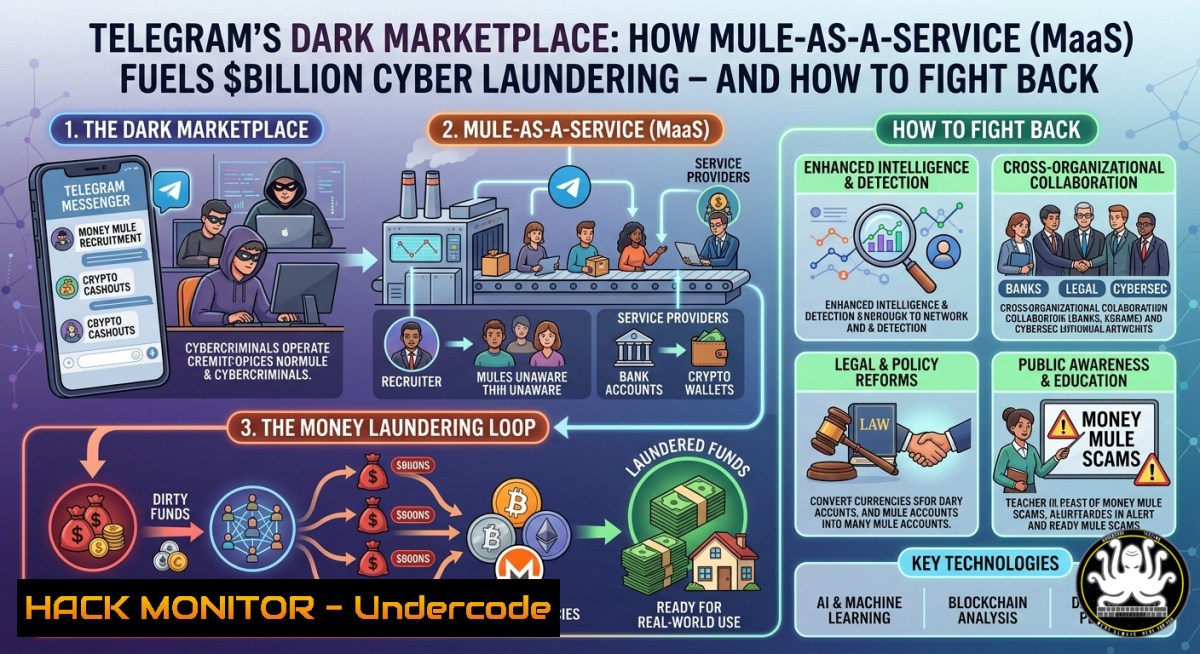
The rise of encrypted messaging platforms, particularly Telegram, has given cybercriminals a frictionless marketplace to trade verified bank and fintech “mule” accounts as a service. This Mule-as-a-Service (MaaS) model allows attackers to outsource money laundering at scale, turning stolen funds from ransomware, BEC, and phishing campaigns into clean cash. Understanding how these operations work – and how to detect, disrupt, and defend against them – is now critical for security teams, financial institutions, and IT forensic analysts.
Learning Objectives:
- Analyze the operational structure of Mule-as-a-Service (MaaS) ecosystems on Telegram and encrypted platforms.
- Identify technical indicators (IOCs) and behavioral patterns associated with money mule account creation and usage.
- Apply Linux and Windows forensic commands, API security checks, and cloud hardening techniques to detect and mitigate mule account abuse.
You Should Know:
- How Telegram-Based MaaS Operates – And How to Track Account Creation Artifacts
Cybercriminal Telegram channels advertise “verified” mule accounts – often pre-loaded with synthetic identities, matching device fingerprints, and even completed KYC (Know Your Customer) verification. These accounts are sold as part of MaaS bundles, complete with setup guides and transaction laundering steps.
Step‑by‑step guide – Detecting mule account creation artifacts on Windows and Linux:
Windows (Registry & Event Logs – detect rapid identity changes)
 Check for recent user account creation (potential mule account)
Get-WmiObject Win32_UserAccount | Where-Object {$_.LocalAccount -eq $true} | Select Name, SID, Status, Disabled

Audit logon events (4624 = successful logon, 4720 = user created)
Get-WinEvent -FilterHashtable @{LogName='Security'; ID=4720,4624} | Format-List TimeCreated, Message

Detect abnormal browser profile creation (Telegram Web or banking logins)
Get-ChildItem "$env:LOCALAPPDATA\Google\Chrome\User Data\" -Directory | Select-Object Name, CreationTime
Linux (forensic user account and shell history analysis)
 List recently created user accounts (UID >= 1000)
lastlog | tail -10
grep -E "useradd|adduser" /var/log/auth.log | tail -20

Check for atypical shell histories (e.g., automated banking API calls)
cat /home//.bash_history | grep -E "curl|wget|api|transfer|bank"

Extract Telegram Desktop cache for channel artifacts
find ~/.local/share/TelegramDesktop/tdata -name ".json" -exec grep -l "bank|mule|transfer" {} \;
What this does: These commands help forensic analysts spot mass account creation, unusual logon patterns, and stored Telegram data that may indicate a compromised endpoint being used as a money mule workstation.
- API Security Failures That Enable Mule Account Validation
MaaS operators often exploit weak API security in fintech apps – such as missing rate limiting or permissive CORS – to automate the testing of stolen or synthetic identities against bank verification endpoints.
Step‑by‑step guide – Testing API endpoints for mule‑enabling vulnerabilities:
Using curl and Burp Suite techniques (Linux / WSL)
 Enumerate API endpoints with rate-limit testing (100 requests)
for i in {1..100}; do
curl -X POST https://target-bank.com/api/verify-account \
-H "Content-Type: application/json" \
-d '{"account_no":"test123", "routing":"021000021"}' \
-w "%{http_code}\n" -o /dev/null -s
done | sort | uniq -c

Check for IDOR (Insecure Direct Object Reference) to access other users' mule status
curl -X GET "https://target-fintech.com/api/mule-status?user_id=1001" \
-H "Authorization: Bearer [bash]"
Windows (PowerShell + REST API hardening)
 Simulate API brute-force of mule account validation endpoint
$headers = @{"Authorization"="Bearer eyJ0eXAiOiJKV1QiLCJhbGciOiJIUzI1NiJ9"}
1..100 | ForEach-Object {
$body = @{account="user$_"; routing="021000021"} | ConvertTo-Json
Invoke-RestMethod -Uri "https://target-bank.com/api/verify" -Method Post -Body $body -ContentType "application/json" -Headers $headers
}
Mitigation commands for cloud hardening (AWS / Azure):
 AWS: Enable WAF rate-based rules against /verify endpoints
aws wafv2 create-rule --name "MuleAPIRateLimit" --scope REGIONAL \
--statement '{"RateBasedStatement":{"Limit":10,"AggregateKeyType":"IP"}}' \
--action "BLOCK"

Azure: Block suspicious IPs from Telegram ASNs
az network nsg rule create --name "BlockTelegramASN" --nsg-name bank-nsg --priority 100 \
--source-address-prefixes "149.154.0.0/16" --access Deny --protocol "" --direction Inbound
- Detecting Money Mule Behavioral Patterns with SIEM Queries (Splunk / ELK)
Mule accounts exhibit distinct transaction patterns: rapid in-and-out transfers, small test deposits, and logins from known proxy IPs (e.g., TOR, residential proxy services). The following queries help hunt these patterns.
Splunk query (Windows Event Logs + NetFlow)
index=windows EventCode=4624 Account_Name!=SYSTEM
| lookup proxy_ip_list.csv IP as Source_IP OUTPUT type
| where type="tor" OR type="residential_proxy"
| stats count by Account_Name, Source_IP, ComputerName
| where count > 5
ELK (Elasticsearch) – Linux auditd logs
GET /auditbeat-/_search
{
"query": {
"bool": {
"must": [
{"term": {"process.name": "curl"}},
{"regexp": {"process.args": ".(bank|transfer)."}},
{"range": {"@timestamp": {"gte": "now-24h"}}}
]
}
},
"aggs": {
"suspicious_users": {"terms": {"field": "user.name", "size": 10}}
}
}
Step‑by‑step guide – Deploying a honeypot mule account to capture attacker TTPs:
1. Create a decoy bank account with low balance and realistic transaction history.
2. Instrument it with canary tokens (https://canarytokens.org) inside the user-agent strings and cookie values.
3. Forward all logs to a SIEM with real‑time alerting on any access.
4. Use `tcpdump` on Linux to capture traffic to/from the honeypot:
sudo tcpdump -i eth0 host [honeypot-ip] -w mule_honeypot.pcap -G 3600 -C 100
5. Analyze captured PCAPs for mule‑specific TTPs (e.g., automated Selenium scripts, headless browsers).
- Disrupting MaaS Payments – Blockchain & Cryptocurrency Tracing
Many MaaS operators demand payment in cryptocurrency (USDT on Tron, Monero). Using blockchain forensic tools, defenders can trace payments back to exchange accounts.
Command-line blockchain analysis with `blockr` and `electrum` (Linux)
 Install blockr for address clustering
pip3 install blockr-python

Trace USDT (ERC-20) transactions from a known mule-payment address
blockr trace --address 0xdAC17F958D2ee523a2206206994597C13D831ec7 --depth 3 --format csv

Check for common mixing services (e.g., Tornado Cash)
curl -s "https://api.chainalysis.com/api/risk/address/0x...?api_key=YOUR_KEY" | jq '.risk_score'
Windows PowerShell – OSINT on Bitcoin addresses
 Query blockchain explorer API for transaction volume
$btcAddr = "1A1zP1eP5QGefi2DMPTfTL5SLmv7DivfNa"
$response = Invoke-RestMethod -Uri "https://blockchain.info/rawaddr/$btcAddr"
$response.txs | Where-Object {$_.out.value -gt 100000000} | Select-Object hash, time
5. Hardening Bank/Frontend Applications Against Mule Account Creation
Attackers bypass KYC using AI-generated deepfake IDs and automated browser frameworks (Puppeteer, Selenium). Defenders can deploy bot detection and behavioral biometrics.
Step‑by‑step guide – Implementing device fingerprinting + anti-bot middleware (Node.js example)
// Express middleware to detect headless browsers and tampered fingerprints
const fingerprint = require('express-fingerprint');
const puppeteerDetect = require('puppeteer-extra-plugin-stealth');

app.use(fingerprint({
parameters: [
fingerprint.useragent,
fingerprint.acceptHeaders,
fingerprint.geoip,
fingerprint.canvas
]
}));

app.post('/api/open-account', (req, res) => {
const fp = req.fingerprint;
if (fp.useragent.includes('Headless') || !fp.canvas) {
// Block likely bot/mule account creation attempt
res.status(403).json({ error: 'Suspicious device environment' });
// Log to SIEM
console.log(<code>Mule attempt blocked: ${fp.components}</code>);
}
});
Linux iptables rule to block mass account creation source IPs:
 Rate-limit /open-account endpoint per IP
iptables -A INPUT -p tcp --dport 443 -m string --string "/open-account" --algo bm -m recent --set --name MULE_LIMIT
iptables -A INPUT -p tcp --dport 443 -m string --string "/open-account" --algo bm -m recent --update --seconds 60 --hitcount 3 --name MULE_LIMIT -j DROP
6. Training & Awareness for Cybersecurity Teams
To combat MaaS, organizations must train SOC analysts, forensic investigators, and application security engineers on financial crime detection.
Recommended free training courses:
- Financial Cybercrime Investigation – INTERPOL e-Learning (URL: https://www.interpol.int/en/Crimes/Financial-crime)
- Blockchain Forensics – CryptoCurve (GitHub: https://github.com/cryptocurve/forensics)
- Telegram OSINT – Technisette’s Telegram Scraper (GitHub: `git clone https://github.com/technisette/telegram-osint-toolkit`)
Hands‑on lab: Simulate a mule account takeover using Metasploit (Linux only, authorized environment)
 Start Metasploit and target a test banking app
msfconsole
use auxiliary/scanner/http/bank_mule_cred_bruteforce
set RHOSTS test-bank.local
set USER_FILE /usr/share/wordlists/financial_users.txt
set PASS_FILE /usr/share/wordlists/rockyou.txt
set THREADS 5
run
What Undercode Say:
- Key Takeaway 1: Mule-as-a-Service is no longer a niche crime – it’s a commoditized layer in the cybercrime supply chain, directly enabling ransomware and BEC actors to cash out without laundering expertise. Defenders must shift from reactive fraud monitoring to proactive mule account prevention using behavioral analytics and API rate limiting.
- Key Takeaway 2: Open-source intelligence (OSINT) on Telegram, combined with simple forensic commands (PowerShell, grep, tcpdump), can uncover mule infrastructures before they cause damage. Organizations should integrate Telegram channel monitoring and SIEM correlation of proxy IPs as standard threat intelligence.
Analysis (10 lines): The MaaS model shows how cybercriminals have industrialized money laundering – just as RaaS (Ransomware-as-a-Service) lowered the barrier to deploying ransomware, MaaS lowers the barrier to converting stolen funds. Fintech APIs are the weakest link, often lacking proper rate limiting, device fingerprinting, or KYC replay attack defenses. Defenders can leverage free OSINT tools to scrape Telegram channels for mule account advertisements and track cryptocurrency payments back to exchanges. The commands provided – from Windows Event Log analysis to blockchain tracing – give blue teams immediate tactical capabilities. However, the cat-and-mouse game continues: attackers now use AI to generate deepfake KYC documents and residential proxy networks to bypass IP blacklists. The most effective long‑term defense is a combination of API hardening, behavioral biometrics, and cross‑industry information sharing on mule account hashes (e.g., via FS‑ISAC). Without these measures, MaaS will only grow as Telegram remains lightly moderated and cryptocurrencies enable anonymous payouts.
Prediction:
Within 12–18 months, Mule-as-a-Service will merge with AI‑driven identity generation, producing fully automated laundering pipelines that can spin up thousands of verified accounts per day. Telegram will respond with limited channel takedowns, but operations will migrate to self‑destructing groups and alternative encrypted apps (SimpleX, Session). Financial regulators will mandate real‑time API threat detection for all fintechs, and AI‑based anomaly detection (graph neural networks on transaction flows) will become standard. Organizations that fail to adopt the forensic and hardening techniques outlined here will see a 300‑400% increase in successful mule‑enabled fraud by 2026. The only effective countermeasure is proactive, automated detection – not reactive manual reviews.
▶️ Related Video (76% Match):
🎯Let’s Practice For Free:
IT/Security Reporter URL:
Reported By: Mayura Kathiresh – Hackers Feeds
Extra Hub: Undercode MoN
Basic Verification: Pass ✅


