Listen to this Post
Introduction:
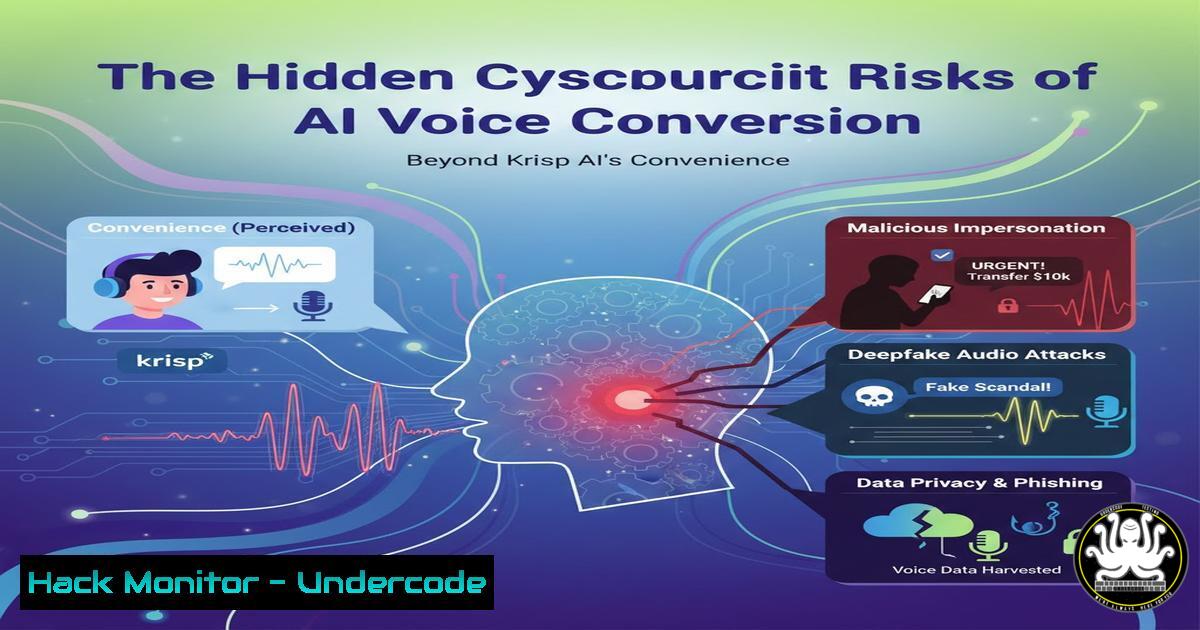
AI-powered voice modulation tools like Krisp AI are revolutionizing professional communication by offering real-time accent conversion. However, this convenience introduces significant attack surfaces in corporate environments, from data exfiltration and consent bypass to sophisticated social engineering attacks. Security teams must now analyze these tools not just as productivity aids, but as potential vectors for insider threats and data privacy violations.
Learning Objectives:
- Understand the data flow and potential security vulnerabilities in AI voice tool implementations.
- Learn to configure enterprise-grade monitoring and network policies to govern such applications.
- Identify the ethical and legal implications of voice data processing and synthetic audio generation.
You Should Know:
- How Krisp AI Works & Its Data Handling Model
The core function involves capturing audio input, sending it to a cloud processing API (or processing locally), and returning a modulated stream. The security risk lies in the data pipeline.
Step‑by‑step guide explaining what this does and how to use it.
Data Capture: The application hooks into your OS audio subsystem. On Windows, this is done via APIs like `Core Audio` or WASAPI. On Linux, it often uses `PulseAudio` or ALSA.
Processing Location: Critical distinction. Local processing (on-device) is more secure. Cloud processing sends audio snippets to external servers.
Verification & Monitoring:
Linux (Monitor Audio Processes): Use `lsof` to see what files and network connections the Krisp process has open.
ps aux | grep -i krisp
 Find PID, then:
lsof -p <PID>
 Look for network connections (ESTABLISHED) and files being written.
Windows (Networking Check): Use `netstat` in an administrator Command Prompt to see if Krisp is making external calls.
netstat -ano | findstr "ESTABLISHED" | findstr "<Krisp_PID>"
Mitigation: Enforce a policy that only permits corporate-vetted tools with transparent, on-device processing. Use a Next-Generation Firewall (NGFW) to block unauthorized audio/video streaming services.
2. Enterprise Integration & API Security Posture
Krisp may integrate with collaboration platforms (Zoom, Teams) via APIs, creating another credential and session management vector.
Step‑by‑step guide explaining what this does and how to use it.
OAuth Token Risk: The tool requests permissions to access your microphone and meeting applications. A compromised token could grant an attacker access to live meetings.
Security Configuration:
- Audit OAuth Apps: In platforms like Microsoft 365 Admin Center, regularly review consented applications and their permissions.
- Principle of Least Privilege: Ensure the tool has only the minimum necessary permissions (e.g., “Send audio” not “Read all user information”).
- Network Segmentation: Place devices using such tools on a restricted network segment that only allows necessary traffic to approved SaaS endpoints, blocking all else.
- API Monitoring: Use SIEM rules to alert on anomalous volumes of data transfer from client machines to new external IPs associated with the tool’s ASN.
3. The Data Privacy & Compliance Quagmire
Voice biometrics are sensitive personal data under GDPR, CCPA, and other regulations. Recording and converting accents creates a compliance audit trail.
Step‑by‑step guide explaining what this does and how to use it.
Data Mapping: You must answer: Where is voice data processed? Is it stored? Who is the sub-processor (Krisp’s cloud provider)? Is it used for model training?
Actionable Compliance Steps:
- Review the Privacy Policy: Specifically, the data processing addendum (DPA) and Sub-processor list for the vendor.
- Enable Local Processing: If available, mandate the “on-device” or “local AI” mode in the application settings to prevent data transfer.
- Log Data Processing: Implement a Data Loss Prevention (DLP) rule to log attempts to send audio files to external services. In a corporate environment, tools like `Microsoft Purview` or `Symantec DLP` can be configured for this.
4. Voice Cloning & Social Engineering Attack Enrichment
The underlying technology is a double-edged sword. The same AI that “neutralizes” an accent for clarity can be used to clone voices for phishing (vishing).
Step‑by‑step guide explaining what this does and how to use it.
Threat Model: An attacker with a short audio sample of an executive (e.g., from a public webinar) could use open-source AI tools to clone their voice and authorize fraudulent transactions.
Defensive Tutorial – Detection: Train staff and implement technical controls.
Awareness: Mandate training that voice alone is no longer a valid authentication factor.
Verification Protocol: Establish a secondary, out-of-band verification channel (e.g., a confirmation code in a secured internal chat) for any sensitive voice request.
Technical Analysis of Audio Artifacts: While advanced, deepfake audio can sometimes be detected by spectral analysis tools looking for inconsistencies. Research tools like `Arizona State University’s “Deepfake Detection”` frameworks.
5. System Hardening for Endpoint Security
The application requires deep system integration, increasing the device’s attack surface (drivers, hooks).
Step‑by‑step guide explaining what this does and how to use it.
Linux Hardening:
Run the tool in a restricted container or Firejail profile to isolate its access to the microphone and network.
firejail --noprofile --net=none --device=/dev/snd/pcmC0D0c <path_to_krisp_binary>
 This creates a sandbox with no network and only access to a specific audio capture device.
Windows Hardening:
Use Windows Defender Application Control (WDAC) or a third-party solution to create a deny-list or allow-list policy, restricting the Krisp process from writing to unexpected directories or spawning child processes.
Audit with Sysinternals Suite: Use `Process Monitor` (procmon) to log all file, registry, and network activity of the Krisp binary during a simulated meeting to establish a baseline of normal behavior.
What Undercode Say:
- Key Takeaway 1: AI voice tools are data pipelines, not just apps. Each pipeline—audio capture, network transit, cloud processing, and return—must be mapped, secured, and monitored as a potential data exfiltration or privacy violation channel.
- Key Takeaway 2: The ethical risk precedes the technical one. Mandating accent conversion normalizes the use of voice cloning technology, lowering organizational defenses against the very same technology when weaponized for vishing and fraud.
The adoption of tools like Krisp AI represents a classic trade-off between productivity and security. The immediate benefit of clearer communication is tangible, but it quietly trains an organization to treat voice as a malleable digital artifact, eroding a fundamental layer of human trust. Security protocols must evolve to assume voice authenticity is compromised, enforcing multi-factor authentication that is resilient to AI-generated audio. Furthermore, compliance officers must grapple with the legal precedent set by processing and altering voice biometrics, a uniquely sensitive personal identifier. The future battlefield will be synthetic media; organizations that implement these tools without parallel investments in deepfake detection and zero-trust verification protocols are unknowingly weakening their last line of human-centric defense.
Prediction:
Within 2-3 years, we will witness the first major corporate fraud or data breach directly orchestrated using voice clones trained on audio samples collected from enterprise communication tools, including AI accent converters. This will trigger stringent regulatory action, classifying certain types of real-time voice modification software as dual-use technology, requiring strict internal governance, audit trails, and possibly export controls. Enterprise contracts for such tools will be dominated by indemnity clauses and security liability agreements, shifting the market from consumer-friendly apps to heavily audited, on-premise enterprise solutions.
▶️ Related Video (84% Match):
🎯Let’s Practice For Free:
IT/Security Reporter URL:
Reported By: Tushar Desai – Hackers Feeds
Extra Hub: Undercode MoN
Basic Verification: Pass ✅


