Listen to this Post
Introduction:
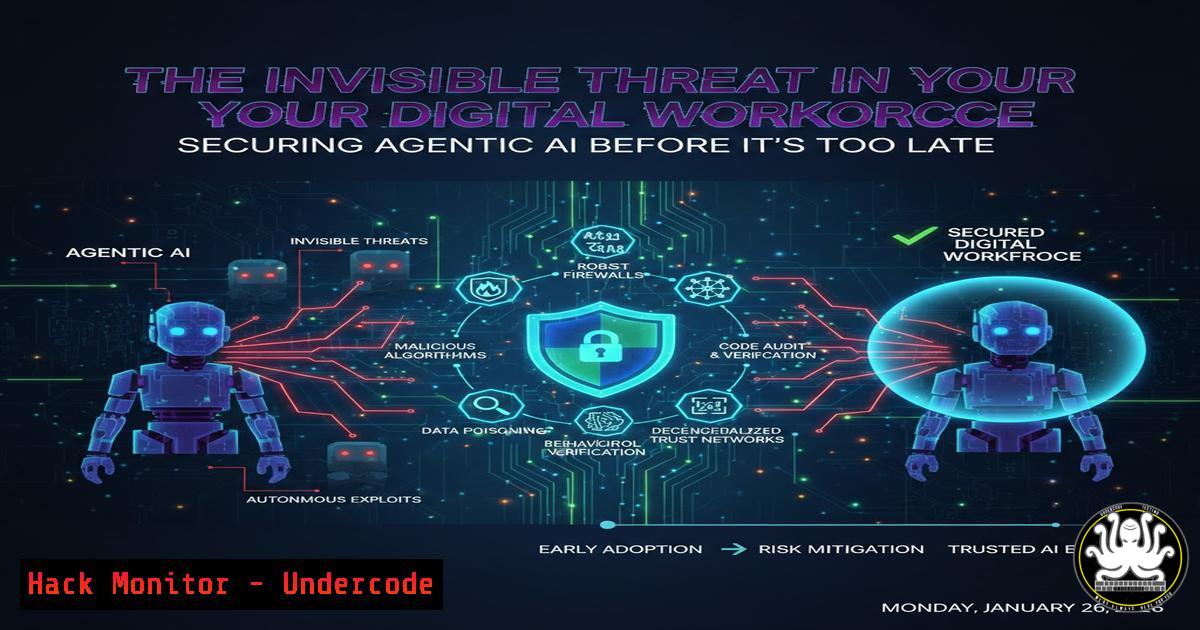
The rapid adoption of Agentic AI, autonomous digital employees capable of executing complex tasks, is revolutionizing enterprise operations. However, this powerful new layer of the tech stack introduces a vast, AI-powered attack surface that traditional cybersecurity measures are ill-equipped to handle. This guide outlines the critical security protocols necessary to deploy these agents without compromising your entire digital estate.
Learning Objectives:
- Understand the unique threat model introduced by autonomous AI agents interacting with enterprise systems.
- Implement a zero-trust architecture and robust access controls specifically for AI agents.
- Harden the APIs, data pipelines, and orchestration frameworks that power Agentic AI operations.
You Should Know:
1. Threat Modeling Your Agentic AI Deployment
Before writing a single line of code, you must map the potential attack vectors. An AI agent with access to CRM, email, and document systems can be a powerful force multiplier for an attacker if compromised.
Step‑by‑step guide explaining what this does and how to use it.
Step 1: Asset & Data Flow Mapping. Diagram every system (Salesforce, ERP, internal APIs) the agent will access. Use tools like `draw.io` or Miro to visualize data flows.
Step 2: Identify Trust Boundaries. Mark where the agent transitions between different security zones (e.g., from a sandboxed environment to a production database).
Step 3: Adversarial Simulation. Ask: “If an attacker poisoned the agent’s instructions or hijacked its session, what is the worst thing they could do?” Document these scenarios as your primary mitigation targets.
2. Architecting a Secure & Sandboxed Runtime Environment
Never run Agentic AI agents directly on production infrastructure. They require isolated, observable, and controllable environments.
Step‑by‑step guide explaining what this does and how to use it.
Step 1: Containerized Deployment. Deploy each agent instance within its own container. Use Docker with restricted capabilities.
 Example Docker run command with security constraints
docker run --read-only --cap-drop=ALL --network=agent-network --memory=512m agent-image:latest
Step 2: Mandatory Logging & Auditing. Ensure all agent actions, decisions, and API calls are logged to a secured, immutable log system. Integrate with your SIEM (e.g., Splunk, Elastic Stack).
Step 3: Network Segmentation. Place the agent’s runtime in a dedicated subnet with firewall rules that only permit outbound connections to explicitly authorized services and block all inbound traffic.
3. Implementing Least-Privilege Access for Non-Human Identities
AI agents should not use shared service accounts or human user credentials. They require dedicated identities with meticulously scoped permissions.
Step‑by‑step guide explaining what this does and how to use it.
Step 1: Create Service Principals/Identities. In Azure, create a Managed Identity. In AWS, create an IAM Role for the agent. In GCP, use a Service Account.
Step 2: Apply Role-Based Access Control (RBAC). Grant permissions only to specific APIs and resources. For a sales agent, this might be `Salesforce:Read/Write on Leads Object` but never Billing:FullAccess.
 Example AWS IAM Policy Snippet (Highly Restrictive)
{
"Version": "2012-10-17",
"Statement": [{
"Effect": "Allow",
"Action": ["s3:GetObject"],
"Resource": ["arn:aws:s3:::marketing-docs/"]
}]
}
Step 3: Credential Vaulting. Never store API keys or secrets in code. Use HashiCorp Vault, AWS Secrets Manager, or Azure Key Vault. The agent’s runtime must dynamically fetch short-lived credentials.
- Hardening the AI Orchestration Layer & API Security
The frameworks that orchestrate agent logic (e.g., LangChain, AutoGen, custom Python) and the APIs they consume are prime targets.
Step‑by‑step guide explaining what this does and how to use it.
Step 1: Validate & Sanitize All Inputs. Assume any instruction or prompt can be malicious. Implement strict input validation for the agent’s triggering mechanisms (e.g., webhooks, queue messages).
Step 2: Secure API Gateways. Place all agent-originated API calls behind an API gateway. Enforce rate limiting, JWT token validation, and schema validation for requests/responses.
Step 3: Secure LLM Interactions. If using an LLM, guard against prompt injection. Use a pre-prompt security context that cannot be overridden and implement output classifiers to detect exfiltration attempts or malicious code generation.
- Continuous Monitoring for Agent Drift & Anomalous Behavior
Unlike static software, AI agents’ behavior can “drift.” Continuous monitoring is not optional; it’s a core security control.
Step‑by‑step guide explaining what this does and how to use it.
Step 1: Define Behavioral Baselines. Establish normal metrics: number of API calls/hour, data volume accessed, typical error rates.
Step 2: Deploy Anomaly Detection Rules. In your SIEM or a dedicated tool, create alerts for deviations (e.g., “Agent ‘SalesBot’ made 10x more database queries than baseline”).
 Example Splunk SPL Alert Search
index=agent_logs agent_id=SalesBot action=db_query | timechart span=1h count | eval threshold=50 | where count > threshold
Step 3: Implement a Human-in-the-Loop (HITL) Kill Switch. For high-risk actions (e.g., sending bulk emails, updating financial records), require explicit human approval. Ensure there is an immediate and auditable way to deactivate any agent.
What Undercode Say:
- Agentic AI Security is Identity and Access Management (IAM) on Steroids. The core challenge is not the AI, but governing what the AI is allowed to do. A breach of an over-permissioned agent is a breach of every system it can touch.
- The “Shift-Left” Mandate is Now Absolute. Security must be integrated into the prompt engineering, workflow design, and testing phases of agent development. Bolting it on post-deployment is a catastrophic strategy.
Prediction:
The first major enterprise breach of 2025-2026 will not be through a phishing link or unpatched server, but through a compromised Agentic AI digital employee. Attackers will exploit weak prompt isolation, steal agent credentials with broad permissions, or use adversarial prompts to turn business automation into data exfiltration pipelines. This will trigger a massive industry shift towards “AI Agent Security Posture Management” (AI-ASPM) tools and mandatory compliance frameworks, turning the current focus on model security into a broader focus on agent runtime security. Organizations that build secure, auditable agent foundations now will gain a significant competitive and trust advantage.
▶️ Related Video (80% Match):
🎯Let’s Practice For Free:
IT/Security Reporter URL:
Reported By: Ashok Kumar – Hackers Feeds
Extra Hub: Undercode MoN
Basic Verification: Pass ✅


