Listen to this Post
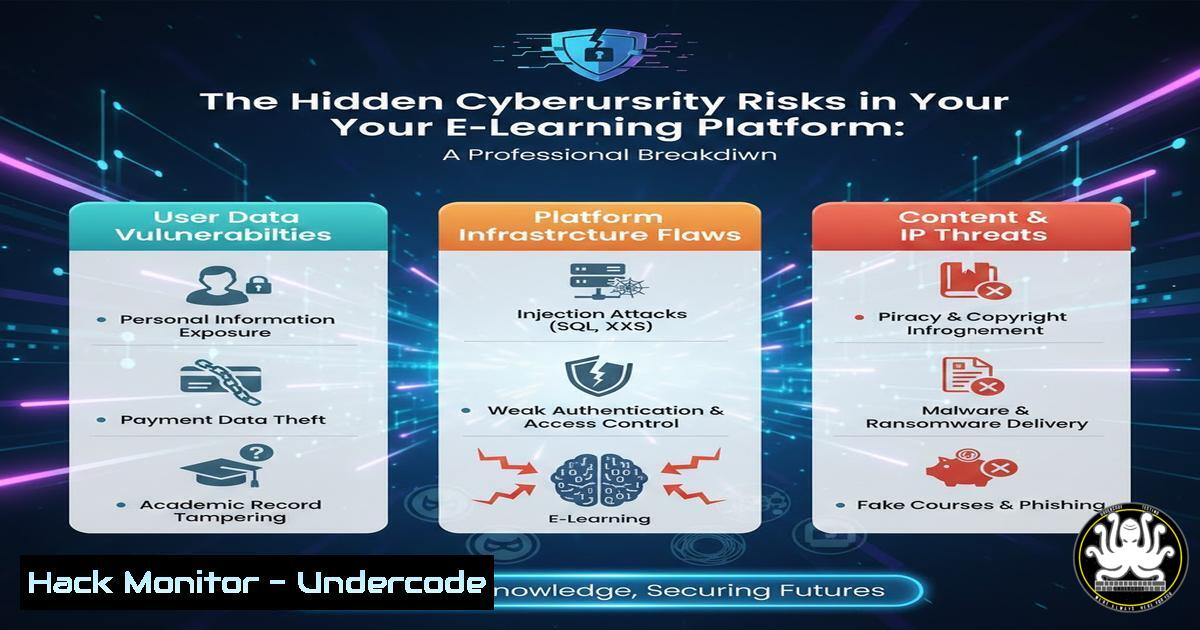
Introduction:
The proliferation of e-learning platforms like NPTEL has revolutionized education, but it has also created a new attack surface for cybercriminals. This article deconstructs the underlying cybersecurity and IT infrastructure that powers these platforms, examining the potential vulnerabilities in user data, authentication systems, and the AI-driven personalization engines that cater to learners and institutions like Jerusalem College of Engineering.
Learning Objectives:
- Understand the core IT architecture and potential security flaws in e-learning ecosystems.
- Learn practical commands and techniques for securing user accounts and institutional data.
- Develop strategies to mitigate threats targeting AI algorithms and cloud-based learning management systems (LMS).
You Should Know:
- The Authentication Gateway: Fortifying the First Line of Defense
E-learning platforms are prime targets for credential-based attacks due to the volume of user accounts. A breach here can lead to data theft, certificate fraud, and unauthorized access to proprietary educational content.
Step‑by‑step guide explaining what this does and how to use it.
Step 1: Enforce Strong Password Policies. Weak passwords are the most common point of failure. Use technical measures to enforce complexity.
Linux (using `passwd` and `pam_pwquality`):
 Install the password quality checking library
sudo apt-get install libpam-pwquality
 Edit the PAM configuration to enforce strong passwords
sudo nano /etc/pam.d/common-password
 Add or modify the following line:
password requisite pam_pwquality.so retry=3 minlen=12 difok=3 ucredit=-1 lcredit=-1 dcredit=-1 ocredit=-1
Windows (via Group Policy):
Open `gpedit.msc` -> Computer Configuration -> Windows Settings -> Security Settings -> Account Policies -> Password Policy. Enforce settings like: “Minimum password length = 12” and “Password must meet complexity requirements = Enabled.”
Step 2: Implement Multi-Factor Authentication (MFA). Beyond passwords, MFA is non-negotiable. For platform administrators, this can be integrated using Time-based One-Time Password (TOTP) algorithms.
Conceptual Code (Python using `pyotp`):
import pyotp

Generate a secret key for a user
secret = pyotp.random_base32()
 Provision the user with a URI for their authenticator app (e.g., Google Authenticator)
provisioning_uri = pyotp.totp.TOTP(secret).provisioning_uri("[email protected]", issuer_name="NPTEL_Secure")
print(f"Provisioning URI: {provisioning_uri}")
 Verify a code entered by the user
totp = pyotp.TOTP(secret)
is_valid = totp.verify("123456")  Replace with user input
- Data at Rest: Securing Institutional and Learner Information
Educational platforms store vast amounts of Personal Identifiable Information (PII) and academic records. This data must be encrypted both in transit (TLS) and at rest in databases.
Step‑by‑step guide explaining what this does and how to use it.
Step 1: Database Encryption. Ensure sensitive fields or entire databases are encrypted.
MySQL/MariaDB Command Example:
-- Check if the database supports encryption
SHOW VARIABLES LIKE 'have_ssl';
-- Alter a table to use encryption for its tablespace
ALTER TABLE student_records ENCRYPTION='Y';
Step 2: Filesystem-Level Encryption for Uploaded Content. Student submissions and course materials should be stored on encrypted volumes.
Linux (Using LUKS):
 Create an encrypted container file
sudo dd if=/dev/zero of=/path/to/encrypted_container bs=1M count=1024
 Format it with LUKS
sudo cryptsetup luksFormat /path/to/encrypted_container
 Open the container and map it to a device
sudo cryptsetup open /path/to/encrypted_container secure_volume
 Create a filesystem and mount it
sudo mkfs.ext4 /dev/mapper/secure_volume
sudo mount /dev/mapper/secure_volume /mnt/secure_data
- API Security: The Invisible Backbone of Platform Interactivity
Modern platforms use APIs to handle everything from user login to video streaming. Insecure APIs are a leading cause of data breaches.
Step‑by‑step guide explaining what this does and how to use it.
Step 1: Implement Rate Limiting. Prevent brute-force and Denial-of-Service (DoS) attacks.
Conceptual Code (Node.js with Express):
const rateLimit = require("express-rate-limit");
const apiLimiter = rateLimit({
windowMs: 15  60  1000, // 15 minutes
max: 100, // Limit each IP to 100 requests per windowMs
message: "Too many requests from this IP, please try again later."
});
app.use("/api/", apiLimiter); // Apply to all API routes
Step 2: Validate and Sanitize All Inputs. SQL Injection and Cross-Site Scripting (XSS) are common via APIs.
Conceptual Code (Python with Input Validation):
from flask import request, abort
import re

def sanitize_input(user_input):
 Remove potentially harmful characters
cleaned_input = re.sub(r'[<>\"\']', '', user_input)
return cleaned_input

@app.route('/api/search', methods=['POST'])
def api_search():
query = request.json.get('query')
if not query or len(query) > 255:
abort(400)  Bad Request
safe_query = sanitize_input(query)
 ... proceed with safe_query ...
4. Cloud Hardening for Scalable Learning Environments
Platforms like NPTEL likely operate in a cloud environment (AWS, Azure, GCP). Misconfigurations are a primary security risk.
Step‑by‑step guide explaining what this does and how to use it.
Step 1: Principle of Least Privilege for Cloud Roles. Never use the root account for daily operations.
AWS CLI Example (Creating a restricted admin user):
 Create a new IAM user
aws iam create-user --user-name SecurePlatformAdmin
 Create a policy that grants full access but prevents privilege escalation
 (Policy JSON would be defined in a separate file, policy.json)
aws iam create-policy --policy-name PlatformAdminPolicy --policy-document file://policy.json
 Attach the policy to the user
aws iam attach-user-policy --user-name SecurePlatformAdmin --policy-arn "arn:aws:iam::account-id:policy/PlatformAdminPolicy"
Step 2: Secure Cloud Storage (S3 Buckets). Prevent data leaks from misconfigured object storage.
AWS CLI Command to Block Public Access:
aws s3api put-public-access-block \
--bucket nptel-student-data \
--public-access-block-configuration BlockPublicAcls=true,IgnorePublicAcls=true,BlockPublicPolicy=true,RestrictPublicBuckets=true
5. The AI and Machine Learning Attack Surface
AI is used for personalized learning paths and automated grading. These models are vulnerable to data poisoning and adversarial attacks.
Step‑by‑step guide explaining what this does and how to use it.
Step 1: Secure the AI Model Pipeline. Ensure the training data is clean and the model repository is secure.
Conceptual Process:
- Data Provenance: Track the origin and changes to all training datasets using checksums (e.g.,
sha256sum dataset.csv). - Model Access Control: Store trained models in a private repository with strict access controls, not a public-facing directory.
Step 2: Monitor for Model Drift and Adversarial Inputs. Implement logging to detect unusual inputs designed to fool the AI.
Conceptual Code (Python Logging):
import logging

logging.basicConfig(filename='ai_security.log', level=logging.INFO)
def predict_grade(student_submission):
 ... model prediction logic ...
if prediction_confidence < 0.7:
 Log low-confidence predictions for review
logging.warning(f"Low confidence prediction for submission {student_submission.id}. Possible adversarial input.")
return prediction
What Undercode Say:
- The congratulatory post about an NPTEL learner, while benign, symbolizes the vast, interconnected IT ecosystem that is now fundamental to education. This ecosystem is a soft target if not rigorously hardened.
- The focus should not just be on celebrating academic success but also on ensuring the underlying digital infrastructure that enables it is resilient against evolving cyber threats. Institutional reputation is now directly tied to cybersecurity posture.
The analysis reveals that an educational post is merely the tip of an iceberg. Below the surface lies a complex architecture of authentication, data storage, APIs, and cloud services. Each layer presents unique vulnerabilities, from credential stuffing attacks against students to misconfigured cloud buckets leaking institutional research. The integration of AI introduces a new frontier for attacks, where the integrity of automated systems can be compromised. A proactive, defense-in-depth strategy, incorporating the technical controls outlined above, is essential to protect the future of digital education.
Prediction:
The future of cyber attacks on e-learning will pivot towards AI manipulation and sophisticated phishing campaigns. We predict a rise in “diploma-hijacking,” where attackers alter academic records for fraud, and “model poisoning” attacks, where biased data is injected to corrupt AI-driven assessments and recommendations. The deep integration of these platforms with institutional IT will make them a primary pivot point for attackers seeking to breach university networks at large.
🎯Let’s Practice For Free:
IT/Security Reporter URL:
Reported By: Dr Bharathy – Hackers Feeds
Extra Hub: Undercode MoN
Basic Verification: Pass ✅


