Listen to this Post
Introduction:
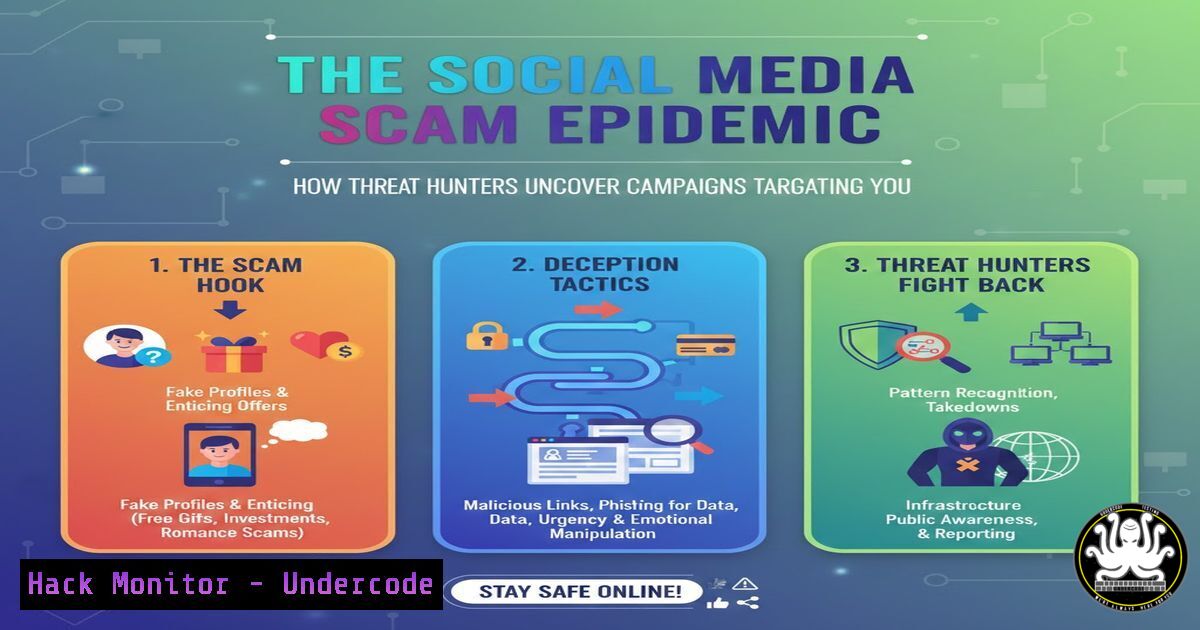
Social media platforms have become a fertile ground for sophisticated cybercrime campaigns, leveraging trust and connectivity to perpetrate fraud. Understanding the techniques behind these scams is crucial for both cybersecurity professionals and the general public to build effective defenses.
Learning Objectives:
- Understand the common methodologies of social media-based scam campaigns.
- Learn how to use Open-Source Intelligence (OSINT) to investigate malicious social media activity.
- Implement technical defenses and detection rules to identify scam-related indicators.
You Should Know:
- The Anatomy of a Social Media Scam Campaign
Social media scams often follow a predictable kill chain, starting with reconnaissance and culminating in financial fraud or data theft. Threat actors create fake profiles, often impersonating real individuals or companies, to establish credibility. They then use these profiles to distribute malicious links, conduct romance scams, or initiate phishing conversations. The 2017 campaign referenced by Microsoft’s threat researcher involved coordinated fake accounts targeting users for financial information.
Step-by-step guide:
- Phase 1: Reconnaissance – Attackers research target demographics and trending topics.
- Phase 2: Profile Creation – Fake profiles are established using stolen or AI-generated photos.
- Phase 3: Engagement – Attackers initiate contact through comments, direct messages, or fake advertisements.
- Phase 4: Execution – Victims are directed to phishing sites or manipulated into sharing sensitive information.
2. OSINT Techniques for Investigating Fake Profiles
Open-Source Intelligence gathering is crucial for identifying and analyzing malicious social media accounts. Researchers can use various tools to trace digital footprints and establish connections between fake profiles.
Step-by-step guide:
- Use reverse image search to check if profile pictures are stolen:
`curl -X POST -F “[email protected]” https://images.google.com/searchbyimage/upload`
– Analyze account creation dates and posting patterns using built-in platform tools
– Cross-reference information across multiple platforms using Maltego or SpiderFoot
– Check for consistent metadata across posts using ExifTool:`exiftool suspect_image.jpg | grep -E “(Software|Create Date|Author)”`
3. Technical Analysis of Scam Infrastructure
Behind every social media scam campaign lies technical infrastructure including domains, hosting services, and sometimes malicious code. Analyzing this infrastructure can reveal campaign scope and provide indicators of compromise.
Step-by-step guide:
- Use whois lookups to investigate domain registration:
`whois suspicious-domain.com | grep -E “(Creation Date|Registrar|Name Server)”`
- Analyze SSL certificates for additional hostnames:
`openssl s_client -connect suspicious-domain.com:443 < /dev/null | openssl x509 -text -noout` - Check domain reputation using VirusTotal API: `curl -s "https://www.virustotal.com/vtapi/v2/domain/report?apikey=APIKEY&domain=suspicious-domain.com" | jq '.'`
4. Detecting Phishing Landing Pages
Scam campaigns frequently direct users to phishing pages designed to harvest credentials. These pages often mimic legitimate services and employ various techniques to evade detection.
Step-by-step guide:
- Analyze page source code for obfuscated JavaScript:
`curl -s https://suspicious-domain.com/login | grep -E “(eval|unescape|fromCharCode)”`
– Check for form action attributes pointing to unexpected domains - Look for SSL certificate mismatches using browser developer tools
- Use automated analysis tools like PhishTank or Google Safe Browsing
5. Windows Security Hardening Against Social Engineering
Many social media scams ultimately deliver malware through social engineering. Hardening Windows systems can prevent successful exploitation even if users interact with malicious content.
Step-by-step guide:
- Enable Attack Surface Reduction rules in Windows Defender:
`Set-MpPreference -AttackSurfaceReductionRules_Ids -AttackSurfaceReductionRules_Actions Enabled`
- Configure application whitelisting using AppLocker:
`Get-AppLockerPolicy -Local | Test-AppLockerPolicy -UserName USER -Path C:\malicious.exe`
- Implement network protection to block connections to malicious domains:
`Set-MpPreference -EnableNetworkProtection Enabled`
6. Linux System Monitoring for Compromise Detection
On Linux systems, comprehensive monitoring can detect post-exploitation activity resulting from successful social media scams.
Step-by-step guide:
- Monitor for unusual process execution with auditd:
`auditctl -a always,exit -F arch=b64 -S execve`
- Check for unauthorized cron jobs:
`crontab -l && ls -la /etc/cron./`
- Monitor network connections for beaconing:
`ss -tunap | grep ESTAB`
- Implement file integrity monitoring:
`aide –check`
7. Building Organizational Awareness and Reporting
Technical controls alone cannot stop social media scams; user education and clear reporting procedures are equally important for organizational defense.
Step-by-step guide:
- Conduct regular phishing simulation exercises
- Establish clear reporting channels for suspicious messages
- Implement DMARC, DKIM, and SPF to prevent email impersonation
- Create incident response playbooks specific to social media incidents:
`nano /opt/incident-response/social-media-scam-playbook.md`
What Undercode Say:
- Social media platforms’ algorithmic content distribution actively amplifies scam campaigns through engagement-based visibility.
- The line between authentic and artificial social interaction has fundamentally blurred, creating permanent attack surfaces.
- Traditional security awareness training fails against sophisticated social engineering that leverages emotional triggers and current events.
The persistence of social media scams years after initial research demonstrates fundamental flaws in platform security models. While technical controls can mitigate specific tactics, the root cause lies in platforms prioritizing engagement over security. Future defenses must combine AI-driven anomaly detection with fundamental changes to how social platforms verify identity and content. The economic incentives driving these campaigns ensure they will evolve rather than disappear, requiring continuous adaptation from security professionals.
Prediction:
Social media scams will increasingly leverage AI-generated content and deepfake technology to create more convincing fake profiles and interactions. We’ll see a convergence of automated social engineering with traditional malware distribution, creating self-perpetuating scam ecosystems that require minimal human oversight. Platform responses will likely include mandatory identity verification for certain account types, but privacy concerns will limit comprehensive solutions. The cybersecurity industry will develop specialized social media threat intelligence platforms that automatically correlate fake profiles and scam campaigns across multiple networks.
🎯Let’s Practice For Free:
IT/Security Reporter URL:
Reported By: Thomas Roccia – Hackers Feeds
Extra Hub: Undercode MoN
Basic Verification: Pass ✅


