
Listen to this Post
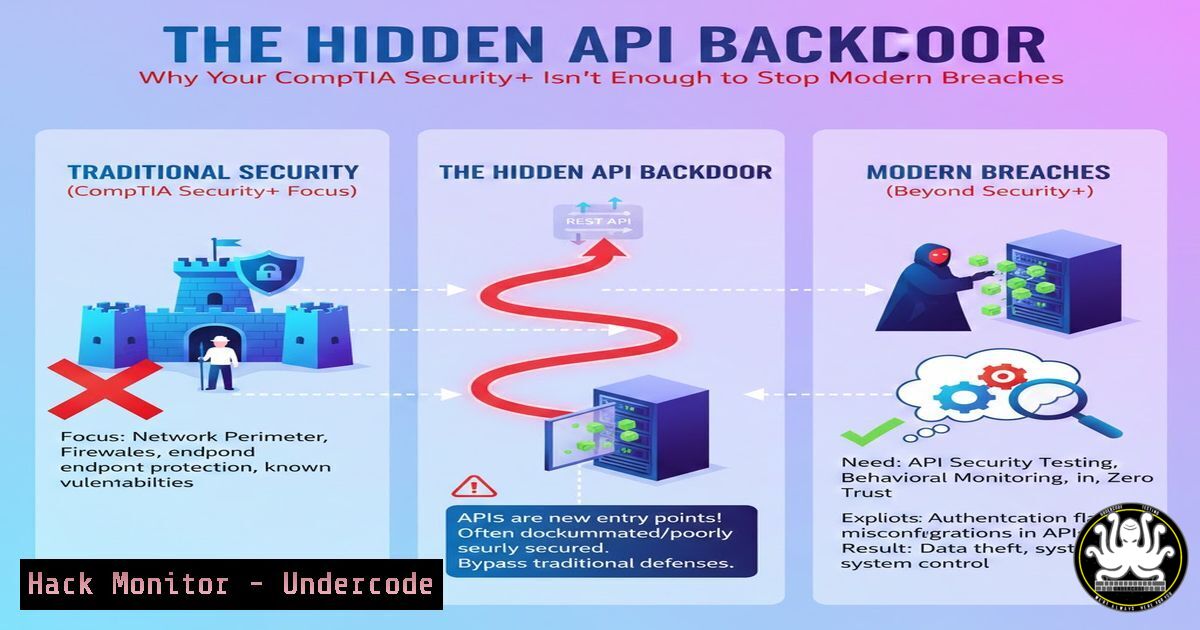
Introduction:
While professional certifications like the CompTIA Security+ provide a critical foundation in cybersecurity principles, the modern threat landscape evolves at a breakneck pace, leaving conventional knowledge gaps in its wake. This article delves into the practical, hands-on techniques that threat actors are using today, specifically focusing on API security vulnerabilities and cloud misconfigurations that often fall outside the scope of standard certification curricula. Understanding these advanced attack vectors is essential for transitioning from theoretical knowledge to practical defense.
Learning Objectives:
- Understand and identify common API security flaws that can lead to full system compromise.
- Learn how to perform basic vulnerability assessments against web APIs and cloud endpoints.
- Implement hardening measures for cloud environments, specifically targeting AWS and Azure services.
- Execute and mitigate a simple proof-of-concept exploit for an API injection vulnerability.
- Develop a mindset for continuous learning beyond foundational certifications.
You Should Know:
1. API Security: The New Enterprise Battleground
APIs (Application Programming Interfaces) are the connective tissue of modern web and cloud applications, but they are often poorly secured. A single vulnerable endpoint can expose underlying databases and internal services.
Step‑by‑step guide explaining what this does and how to use it.
Step 1: Reconnaissance. Use a tool like `curl` or `Postman` to probe API endpoints. Look for endpoints that are not documented.
Command: `curl -X GET https://api.target.com/v1/users/ -H “Authorization: Bearer
Step 2: Identify Injection Points. Test all input fields for SQLi (SQL Injection), Command Injection, and NoSQL Injection. For a user ID endpoint, try manipulating the parameter.
Example: `https://api.target.com/v1/users/1′ OR ‘1’=’1′–`
Step 3: Exploit and Extract Data. If vulnerable, use a tool like `sqlmap` to automate data exfiltration.
Command: `sqlmap -u “https://api.target.com/v1/users/?id=1” –batch –dbs`
2. Cloud IAM Misconfiguration: The Skeleton Key You Didn’t Know You Dropped
In cloud environments like AWS and Azure, Identity and Access Management (IAM) is complex. Overly permissive roles are a primary cause of data breaches.
Step‑by‑step guide explaining what this does and how to use it.
Step 1: Enumerate Permissions. Using the AWS CLI, an attacker (or a pen tester) can check what permissions the current credentials have.
Command: `aws iam list-attached-user-policies –user-name MyUser`
Step 2: Identify Dangerous Policies. Look for policies with wildcard (“) permissions, especially for actions like s3:GetObject, ec2:RunInstances, or iam:.
Step 3: Mitigation. Apply the Principle of Least Privilege (PoLP). Use managed policies where possible and regularly audit IAM roles with AWS IAM Access Analyzer or Azure Security Center.
3. The Container Escape: Compromising Dockerized Environments
Containers are ubiquitous, but a misconfigured Docker daemon can serve as a launchpad to the host system.
Step‑by‑step guide explaining what this does and how to use it.
Step 1: Check for Exposure. A common misconfiguration is having the Docker socket exposed to a container.
From inside a container, check for: `ls /var/run/docker.sock`
Step 2: Exploit. If the socket is mounted and the container is running as root, you can run commands on the host.
Command: `docker -H unix:///var/run/docker.sock run -it –privileged –net=host -v /:/host ubuntu:latest chroot /host bash`
Step 3: Mitigation. Never run containers as root unless absolutely necessary. Avoid mounting the Docker socket inside containers. Use user namespaces for isolation.
4. AI-Powered Social Engineering and Phishing Kit Automation
AI tools can now generate highly convincing and personalized phishing emails at scale, making traditional user awareness training less effective.
Step‑by‑step guide explaining what this does and how to use it.
Step 1: Recognize the Threat. Be suspicious of emails with perfect grammar that reference recent, real-world events or internal company details.
Step 2: Technical Defense. Implement DMARC, DKIM, and SPF records for your domain to prevent email spoofing. Use advanced email security gateways that leverage AI to detect phishing attempts.
Step 3: User Training. Move beyond “don’t click the link” training. Conduct regular, simulated phishing campaigns that use these new AI-generated templates to keep users vigilant.
- From Theory to Practice: Building Your Own Home Lab
Certifications teach theory; a lab builds skill. Creating a controlled environment to practice attacks and defenses is non-negotiable.
Step‑by‑step guide explaining what this does and how to use it.
Step 1: Set Up the Foundation. Use VirtualBox or VMware to create virtual machines. Install a Kali Linux VM for attacking and a vulnerable OWASP Broken Web Applications VM as your target.
Step 2: Deploy Vulnerable APIs. Use deliberately vulnerable applications like `vapi` (Vulnerable API) or `DVGA` (Damn Vulnerable GraphQL Application) to practice.
Command to run a Dockerized vulnerable app: `docker run –rm -p 5000:5000 vulnerables/vapi`
Step 3: Practice and Document. Methodically test the applications, document your findings, exploits, and proposed remediations. This builds a portfolio of practical experience.
What Undercode Say:
- Certifications Open Doors, Skills Close Breaches. A certification like Security+ validates foundational knowledge and is crucial for HR filters, but it is the starting line, not the finish line. The ability to practically apply that knowledge in a dynamic environment is what truly defines a security professional.
- The Adversary is Automated; Your Defense Must Be Too. Modern attacks are scripted, scaled, and sold as-a-service. Defenders must leverage automation in their vulnerability scanning, patch management, and threat-hunting processes to keep pace. Manual checks are no longer sufficient.
The gap between academic cybersecurity knowledge and the reality of offensive tactics is widening. While celebrating a Security+ is a commendable achievement, it signals the beginning of a hands-on learning journey. The most sought-after professionals are those who complement their credentials with a demonstrable, lab-validated ability to think and act like an attacker. The future belongs to those who treat learning as a continuous, proactive process, constantly experimenting with new tools and techniques in safe environments to stay ahead of the adversary.
Prediction:
In the next 2-3 years, we will see a significant industry shift from credential-based hiring to skills-based validation. Recruiting processes will increasingly incorporate practical, gamified capture-the-flag (CTF) challenges and real-time scenario-based testing to assess a candidate’s ability to respond to live threats. AI will not only power attacks but also become deeply integrated into defensive cybersecurity suites, managing complex security orchestrations autonomously. Professionals who fail to bridge the gap between theory and hands-on practice will find themselves at a significant disadvantage, regardless of their number of certifications.
🎯Let’s Practice For Free:
IT/Security Reporter URL:
Reported By: Caroline Olaoye – Hackers Feeds
Extra Hub: Undercode MoN
Basic Verification: Pass ✅


