
Listen to this Post
Introduction:
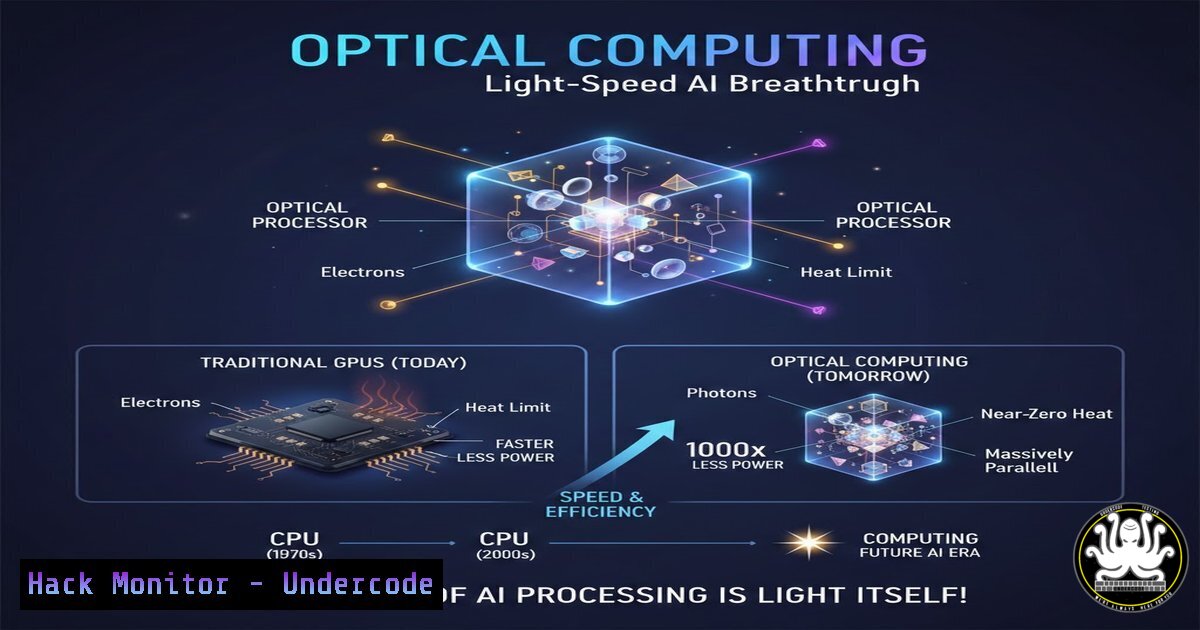
The relentless pursuit of artificial intelligence efficiency is pushing computing beyond the limits of silicon. At the forefront of this revolution is analog optical computing, a paradigm that uses light instead of electricity to perform complex mathematical operations. This shift promises to redefine the hardware underpinning AI, offering unprecedented speed and energy efficiency for the matrix multiplications that are the lifeblood of modern machine learning.
Learning Objectives:
- Understand the fundamental principles of analog optical computing and how it differs from traditional electronic processors.
- Identify the specific advantages optical computing holds for AI workloads, particularly in terms of speed and power consumption.
- Explore the potential cybersecurity and IT operational implications of a shift towards non-von Neumann architectures.
You Should Know:
1. The Core Principle: Light as a Calculator
The fundamental innovation of analog optical computing lies in its use of light properties to perform calculations directly. Instead of transistors switching on and off to represent binary 1s and 0s, optical computers manipulate light waves through components like lenses, mirrors, and waveguides. Complex mathematical operations, such as the matrix multiplications and Fourier transforms that dominate AI algorithms, can be executed as light passes through a specially designed optical system. This is an analog process—the physical properties of the light (e.g., phase, amplitude) represent the data and the computation happens in a massively parallel fashion as the light propagates.
Step-by-step guide explaining what this does and how to use it:
While we cannot yet “command” an optical processor from a Linux terminal, understanding the conceptual workflow is critical.
1. Problem Formulation: An AI model, such as a neural network layer, requires a large matrix multiplication (e.g., A B = C).
2. Data Encoding: The input matrices `A` and `B` are encoded onto properties of a laser beam (e.g., using spatial light modulators). Different values are represented by variations in the light’s intensity or phase.
3. Optical Processing: The encoded light is passed through a static, pre-configured optical component (e.g., a series of lenses and diffractive elements). The physics of light propagation through this system inherently performs the matrix multiplication.
4. Result Detection: A photodetector array (like a camera sensor) measures the output light pattern, which directly represents the resulting matrix C.
This entire process happens at the speed of light within the optical hardware, with minimal energy lost as heat, bypassing the fetch-decode-execute cycle of traditional CPUs/GPUs.
2. The GPU vs. Optical Computing Showdown
Current AI relies on GPUs, which are excellent at parallel processing but are still bound by the limitations of electronic circuits: resistance, capacitance, and heat dissipation. The von Neumann bottleneck—the latency in shuffling data between the CPU and memory—remains a critical constraint.
Step-by-step guide explaining what this does and how to use it:
The comparison is stark when applied to an AI inference task:
GPU Workflow:
- Load input data from system RAM to GPU VRAM.
- GPU cores fetch instructions and data from VRAM.
- Thousands of cores execute calculations in parallel, but sequentially through many clock cycles for a large matrix.
- Results are written back to VRAM, then to system RAM.
- Constraint: High power draw (300W+ for high-end cards) and thermal throttling are constant concerns. A simple `nvidia-smi` command on Linux shows this in real-time:
nvidia-smi --query-gpu=power.draw,temperature.gpu --format=csv
Optical Co-Processor Workflow:
1. Input data is encoded onto light.
- The computation is performed passively as light travels through the optical unit.
- The result is detected and converted back to a digital signal.
- Advantage: Near-instantaneous computation for specific operations, with power consumption potentially orders of magnitude lower, as the primary energy cost is powering the laser, not fighting electrical resistance.
-
Cybersecurity in the Photonic Era: New Attack Surfaces
The integration of optical computing into IT infrastructure will create novel security challenges. The integrity of the physical hardware and the analog-to-digital conversion points become critical vulnerabilities.
Step-by-step guide explaining what this does and how to use it:
Security teams must prepare for a new class of threats:
1. Physical Tampering: A misaligned lens or a microscopic contaminant on a photonic chip could subtly alter calculation results, leading to model poisoning or incorrect AI decisions. Mitigation involves hardware integrity checks and secure, monitored facilities, similar to how HSM (Hardware Security Module) rooms are managed today.
2. Analog Data Manipulation: The encoded light signal could be vulnerable to interception or manipulation using external electromagnetic fields or lasers. This is a form of side-channel attack that is irrelevant in digital electronic systems.
3. Supply Chain Security: Ensuring the trustworthiness of optical component manufacturers will be paramount. Organizations will need stringent policies, verifiable through commands like those on Windows that query hardware provenance, though more advanced:
 Example: Checking system component details (a primitive first step)
Get-WmiObject -Class Win32_ComputerSystem | Select Manufacturer, Model
Get-WmiObject -Class Win32_BaseBoard | Select Manufacturer, Product
Future systems will require more sophisticated hardware root-of-trust verification for these specialized components.
4. Integration with Existing Cloud Architectures
Optical computing won’t immediately replace GPUs; it will initially augment them as specialized accelerators, much like GPUs initially augmented CPUs.
Step-by-step guide explaining what this does and how to use it:
Imagine a future Azure Machine Learning workflow:
- Resource Provisioning: You define your training job using an Azure CLI command, specifying an optical compute target.
az ml job create --file job.yml --compute-target optical-cluster-a1
- Job Orchestration: The Azure cloud controller identifies that your job is a large, dense matrix multiplication suitable for the optical tier.
- Hybrid Execution: The workload is split. Data pre-processing and control logic run on traditional virtual CPUs, while the core matrix math is offloaded to the optical co-processor unit via a high-speed interconnect.
- Result Aggregation: The digital results from the optical unit are returned and integrated back into the main training pipeline, dramatically reducing the total job time and energy cost.
5. The Future of AI Model Design
Once optical computing becomes accessible, it will influence how AI models are architected. Researchers will design neural networks that maximize operations native to optical hardware, potentially leading to new, more efficient AI paradigms.
Step-by-step guide explaining what this does and how to use it:
The development lifecycle will evolve:
- Algorithm Selection: Data scientists will choose model architectures based on their “optical compatibility.” Models heavy in convolutional layers (which are fundamentally matrix operations) will be prime candidates.
- Simulation & Testing: Before deploying on physical optical hardware, models will be tested in simulators to predict performance gains, similar to how developers currently profile code.
A hypothetical future library for optical compute simulation
from optical_simulator import OpticalBackend
optical_backend = OpticalBackend()
model.compile(optimizer='adam', loss='categorical_crossentropy', compute_backend=optical_backend)
model.fit(X_train, y_train, epochs=10)
- Deployment: The finalized model will be packaged and deployed to a hybrid cloud environment that dynamically routes compute-intensive tasks to the most efficient processor type.
What Undercode Say:
- Key Takeaway 1: Optical computing is not just an incremental improvement; it’s a foundational shift from electrons to photons, targeting the most computationally expensive core of AI. This has the potential to break the current power and performance walls we are hitting with semiconductor technology.
- Key Takeaway 2: With this new paradigm comes a new security landscape. The threat model expands from pure software and digital logic to include the physical layer of computation. The integrity of the optical path and the analog-to-digital interfaces will be the new front line for securing critical AI infrastructure.
The analysis suggests that while mainstream adoption is still on the horizon, the trajectory is clear. The massive energy demands of current AI data centers are unsustainable. Optical computing offers a path forward, but it requires the cybersecurity and IT operations fields to start building expertise now. The focus must expand from securing data at rest and in transit, to also securing the very process of computation itself against physical and analog-domain threats.
Prediction:
Within the next 5-10 years, optical co-processors will become a specialized tier in major cloud providers like Azure and AWS, offered for specific, high-value AI inference and training tasks. This will initially benefit sectors like pharmaceutical research, financial modeling, and government intelligence, where speed and energy efficiency are paramount. The proliferation of this technology will subsequently force a major evolution in cybersecurity frameworks, leading to new standards for “photonic compute integrity” and novel hardware-based attestation protocols, ultimately making AI systems both vastly more powerful and resilient against a new class of physical-cyber attacks.
🎯Let’s Practice For Free:
IT/Security Reporter URL:
Reported By: Jeroenniesen Some – Hackers Feeds
Extra Hub: Undercode MoN
Basic Verification: Pass ✅


