
Listen to this Post
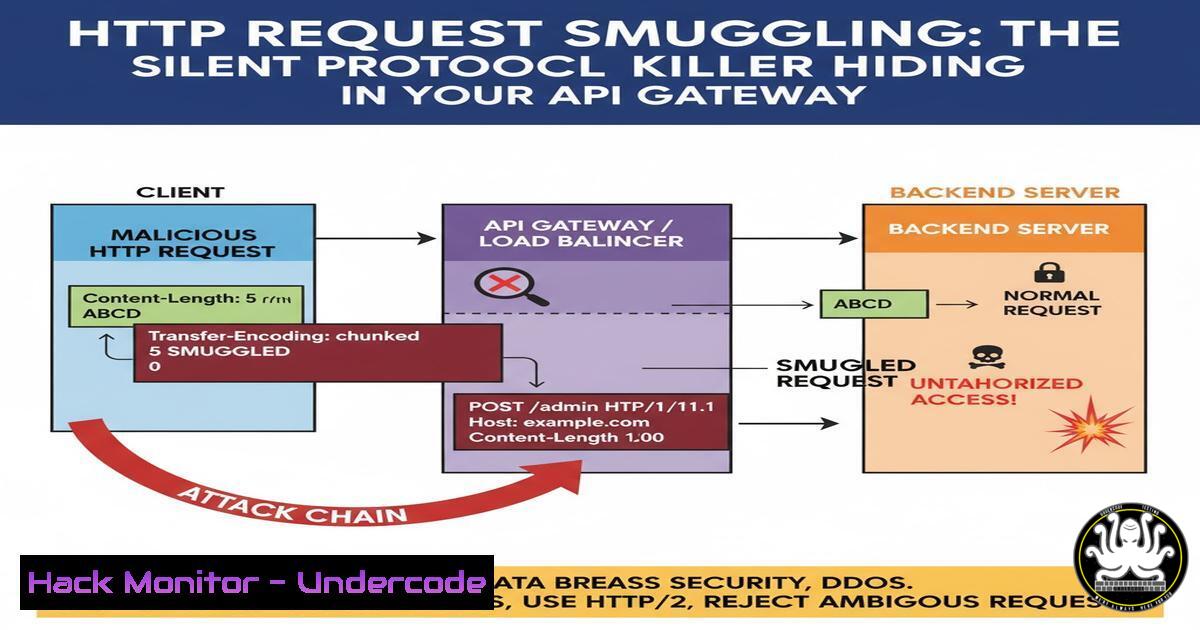
Introduction:
HTTP Request Smuggling represents a critical class of web application vulnerabilities where attackers exploit inconsistencies in how servers process HTTP requests to bypass security controls, poison caches, and hijack user sessions. This technique, pioneered by researchers like James Kettle, exploits the gap between front-end and back-end server interpretations of HTTP request boundaries, creating invisible attack vectors that traditional scanners often miss.
Learning Objectives:
- Understand the fundamental mechanisms behind HTTP Request Smuggling attacks
- Master detection methodologies using both manual and automated approaches
- Implement comprehensive mitigation strategies across different server technologies
You Should Know:
1. CL.TE Smuggling Detection
POST / HTTP/1.1
Host: vulnerable-app.com
Content-Length: 13
Transfer-Encoding: chunked

0

SMUGGLED
This CL.TE (Content-Length vs Transfer-Encoding) attack exploits front-end/back-end parsing discrepancies. The front-end uses Content-Length while the back-end prefers Transfer-Encoding. The smuggled payload becomes the prefix of the next request, allowing cache poisoning or authentication bypass.
2. TE.CL Attack Pattern
POST / HTTP/1.1
Host: target.com
Content-Length: 4
Transfer-Encoding: chunked

1a
GPOST / HTTP/1.1

0
Here, the front-end processes Transfer-Encoding while back-end uses Content-Length. The “GPOST” method smuggles a request that may bypass security filters. Always test both CL.TE and TE.CL vectors during security assessments.
3. Burp Suite Custom Scanner Integration
Navigate to Burp Suite > Extensions > BApp Store > Install “HTTP Request Smuggler”
Configure the extension via Target > Site map > Right-click host > Engagement tools > Find request smuggling variants
This automated approach complements manual testing by generating numerous attack variants and identifying subtle parsing differences that manual testing might miss.
4. Python-Based Detection Script
import socket
import ssl

def test_smuggling(target_host, target_port, payload):
context = ssl.create_default_context()
with socket.create_connection((target_host, target_port)) as sock:
with context.wrap_socket(sock, server_hostname=target_host) as ssock:
ssock.send(payload.encode())
response = ssock.recv(4096)
return response

CL.TE test payload
cl_te_payload = """POST / HTTP/1.1
Host: %s
Content-Length: 13
Transfer-Encoding: chunked

0

SMUGGLED"""
This Python script allows custom payload delivery and response analysis. Monitor for timing differences or unexpected responses indicating successful smuggling.
5. Nginx Configuration Hardening
server {
listen 443 ssl;
server_name example.com;

Prevent request smuggling
client_body_timeout 5s;
client_header_timeout 5s;
client_max_body_size 100k;

Reject ambiguous requests
if ($http_transfer_encoding ~ chunked) {
return 400;
}

location / {
proxy_set_header Connection "";
proxy_http_version 1.1;
}
}
This Nginx configuration implements timeouts, size limits, and explicit rejection of ambiguous encoding to mitigate smuggling attacks at the web server level.
6. Apache Mod_Security Rules
SecRuleEngine On
SecRule REQUEST_HEADERS:Transfer-Encoding "!^$" \
"chain,id:100001,phase:1,deny,msg:'Transfer-Encoding header present'"
SecRule REQUEST_HEADERS:Content-Length "!^$" \
"t:none,setvar:tx.ambiguous_request=1"

SecRule TX:AMBIGUOUS_REQUEST "@eq 1" \
"id:100002,phase:1,deny,msg:'Ambiguous HTTP request detected'"
These ModSecurity rules detect and block requests containing both Content-Length and Transfer-Encoding headers, preventing the core ambiguity that enables smuggling attacks.
7. Web Application Firewall (WAF) Configuration
 AWS WAF Rule Group
{
"Name": "HTTP-Smuggling-Protection",
"Rules": [
{
"Priority": 1,
"Name": "BlockAmbiguousRequests",
"Statement": {
"ByteMatchStatement": {
"FieldToMatch": { "Headers": { "Name": "content-length" } },
"SearchString": ".",
"TextTransformations": [{ "Type": "NONE", "Priority": 0 }]
}
},
"Action": { "Block": {} }
}
]
}
Cloud WAF configurations should explicitly block requests with ambiguous parsing characteristics. Combine this with regular rule updates to address new smuggling techniques.
8. API Gateway Security Hardening
 AWS CLI command to update API Gateway
aws apigateway update-rest-api \
--rest-api-id your-api-id \
--patch-operations \
op='replace',path='/minimumCompressionSize',value='0' \
op='replace',path='/apiKeySource',value='HEADER'
API gateways are common smuggling targets. Ensure they’re configured to normalize requests and reject malformed HTTP messages before reaching backend services.
9. HTTP/2 Smuggling Prevention
 Nginx HTTP/2 configuration
http2_max_field_size 4k;
http2_max_header_size 8k;
http2_body_preread_size 64k;

Reject pseudo-header manipulation
if ($http2_scheme != "https") {
return 421;
}
HTTP/2 introduces new smuggling vectors. Configure servers to strictly validate HTTP/2 frames and reject requests with manipulated pseudo-headers or frame sequencing.
10. Continuous Security Testing Integration
 GitHub Actions security testing workflow
name: HTTP Smuggling Tests
on: [push, schedule]
jobs:
security-scan:
runs-on: ubuntu-latest
steps:
- uses: actions/checkout@v2
- name: Run smuggling tests
run: |
docker run --rm -v $(pwd):/target portswigger/http-request-smuggler \
--target /target/test-cases.txt
- name: Upload results
uses: actions/upload-artifact@v2
with:
name: smuggling-report
path: results/
Integrate automated smuggling detection into CI/CD pipelines using specialized containers and custom test cases to catch regressions before production deployment.
What Undercode Say:
- HTTP Request Smuggling represents a fundamental protocol-level threat that bypasses most traditional security controls
- The evolution from HTTP/1.1 to HTTP/2 has created new attack surfaces requiring updated detection methodologies
- Organizations must implement defense-in-depth with proper server hardening, WAF configuration, and continuous security testing
The research community, led by pioneers like James Kettle, has demonstrated that protocol-level attacks remain one of the most dangerous vulnerability classes due to their ability to bypass application-layer defenses. As microservices and API-driven architectures proliferate, the attack surface for request smuggling expands exponentially. Security teams must prioritize protocol validation and implement comprehensive testing regimens that go beyond standard vulnerability scanning. The silent nature of these attacks means they can persist undetected for years, making proactive detection and mitigation essential for modern application security programs.
Prediction:
HTTP Request Smuggling will evolve to target HTTP/3 and QUIC implementations, creating new protocol-level vulnerabilities as adoption increases. Machine learning-based detection systems will become essential as attacks grow more sophisticated, while regulatory frameworks will eventually mandate specific protocol validation requirements. The continued fragmentation of web infrastructure across cloud providers, CDNs, and microservices will exacerbate detection challenges, making automated security testing an operational necessity rather than a best practice.
🎯Let’s Practice For Free:
IT/Security Reporter URL:
Reported By: Theonejvo Http – Hackers Feeds
Extra Hub: Undercode MoN
Basic Verification: Pass ✅


