Listen to this Post
Introduction:
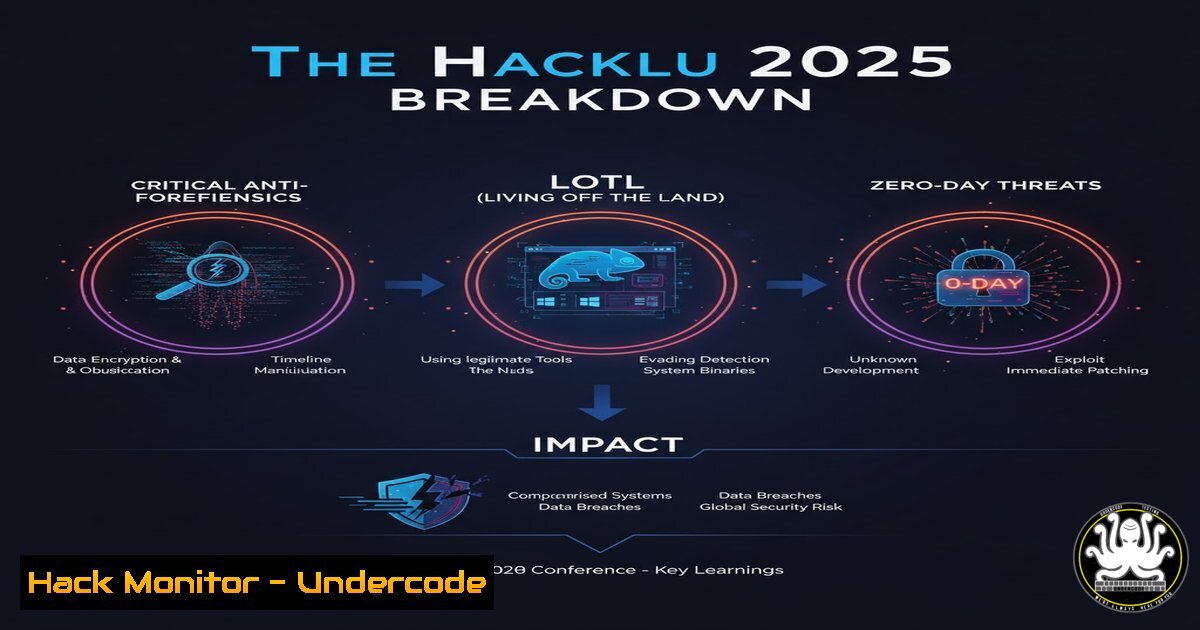
The hack.lu 2025 conference has concluded, delivering a wealth of cutting-edge cybersecurity research and threat intelligence. From novel anti-forensics techniques to sophisticated Living-off-the-Land (LOTL) attacks and active zero-day exploitation, the talks provide a critical snapshot of the current threat landscape, offering both offensive and defensive perspectives essential for security professionals.
Learning Objectives:
- Understand and mitigate advanced anti-forensics and LOTL techniques used by modern adversaries.
- Implement hardening strategies against prevalent threats like cryptojacking and vulnerable driver exploitation.
- Leverage threat intelligence platforms like MISP for enhanced actor tracking and campaign analysis.
You Should Know:
1. Identifying Common Anti-Forensics Tactics
Anti-forensics techniques are designed to frustrate and evade incident response and forensic investigations. Key areas to monitor include timestamp manipulation, data destruction, and artifact hiding.
`touch -t 202301010101.00 malicious_script.sh` (Linux): Modifies the access and modification timestamps of a file to obfuscate its true creation time.
`timestomp malicious_file.exe -m “01/01/2023 01:01:01″` (Via Meterpreter): A common post-exploitation command to alter a file’s Modified, Access, Created, and Entry (MACE) attributes.
`shred -f -u -z -n 5 secret_document.pdf` (Linux): Securely overwrites a file 5 times with random data before deleting it, aiming to prevent data recovery.
`sdelete -p 3 -z C:\temp\incriminating_file.log` (Windows): Sysinternals tool command to securely delete a file by overwriting its data cluster.
`mount -o remount,suid /dev/sda1 /mnt` (Linux): Remounts a filesystem with the SUID bit enabled, a potential pre-requisite for hiding privileged escalation backdoors.
Step-by-step guide: To hunt for these techniques, start by establishing a baseline of normal system activity. Use forensic tools to look for inconsistencies. For timestamp analysis, compare `stat` output on Linux or file metadata in Windows with event logs (e.g., `Event ID 4688` for process creation). For data destruction, monitor for the execution of tools like `shred` or `sdelete` via EDR or endpoint logging. The use of `shred` on modern journaling filesystems is often ineffective but its execution is a strong indicator of intent.
- Living Off the Land with Blue Team Tools
Adversaries are increasingly abusing legitimate system administration and forensic tools, a technique known as Living off the Land (LOTL). This allows them to blend in with normal administrative activity.
`velociraptor –config server.config.yaml artifacts collect Windows.System.PSList –output C:\temp\output.json` (Velociraptor): Collects a process listing. An attacker with compromised credentials could use this to gather reconnaissance data using a trusted tool.
`KAPE.exe –tsource C: –tdump C:\temp\KAPE_Collection –target !SANS_Triage` (KAPE): A powerful forensics collection command. In the wrong hands, it can be used to exfiltrate a massive amount of sensitive forensic data from a target.
`dfir-orc.exe /root=system /computer=Workstation01 /out=\\server\collection$` (DFIR-ORC): Another forensic collection tool that can be weaponized for data theft.
`Get-WinEvent -FilterHashtable @{LogName=’Security’; ID=4624, 4625} | Export-Csv .\logon_attempts.csv` (Windows PowerShell): A legitimate command for auditing logons that an attacker could use to find valid accounts or assess detection capabilities.
Step-by-step guide: Defending against LOTL requires a shift from blacklisting known-bad to baselining and whitelisting. Use application control solutions like Windows Defender Application Control to restrict executable binaries and scripts. Monitor for the execution of sysadmin tools from unusual paths, by unusual users, or at unusual times. Correlate the launch of tools like Velociraptor or KAPE with network egress events to detect potential data staging and exfiltration.
3. Hardening Against Cryptomining & TeamTNT TTPs
Cryptojacking remains a prevalent threat for compromising cloud and containerized environments. The TeamTNT group is notorious for this, using sophisticated scripts to steal cloud credentials and spread.
`docker ps –all` & `docker images` (Linux): Commands to list all containers and images. Regularly run these to identify unauthorized or suspicious containers.
`docker image rm $(docker images -q) -f` (Linux): A command often found in malicious scripts to remove all Docker images, potentially as part of a destructive phase or to remove evidence.
`curl -s http://169.254.169.254/latest/meta-data/iam/security-credentials/ | xargs -I {} curl http://169.254.169.254/latest/meta-data/iam/security-credentials/{}` (Linux): A sequence to query the AWS Instance Metadata Service (IMDS) to steal IAM credentials. This is a primary TTP for cloud credential theft.
`cat ~/.aws/credentials` (Linux): A simple check an attacker would perform to look for stored AWS credentials.
`kubectl get pods –all-namespaces` (Kubernetes): Lists all pods in all namespaces. An attacker with Kubectl access will use this for reconnaissance.
Step-by-step guide: Mitigation involves strict access control and configuration hardening. For Docker, ensure the daemon socket is not exposed over the network. Use tools like `grep -r “AWS_” /home` and `grep -r “AKIA” /home` to scan for accidentally stored credentials. For cloud environments, especially AWS, use IMDSv2 which requires a session token, making credential theft more difficult: aws ec2 modify-instance-metadata-options --instance-id i-1234567890abcdef0 --http-tokens required --http-put-response-hop-limit 2.
4. Hunting EDR/AV Killer Campaigns
A rising trend involves threat actors exploiting vulnerabilities in legitimate, signed kernel-mode drivers to disable Endpoint Detection and Response (EDR) and Antivirus (AV) software.
`sc query type= driver` (Windows): Lists all installed drivers. Hunt for unknown or recently installed drivers.
`fltmc instances` (Windows): Lists all active file system filter drivers, which are often targeted by EDR killers.
`Sigcheck.exe -u -e C:\Windows\System32\drivers` (Windows/Sysinternals): Checks all drivers in the specified directory for signature validity and can look up information online (-u).
`Get-WinEvent -LogName “System” | Where-Object { $_.Id -eq 7036 }` (PowerShell): Filters the System log for service state changes (stopped/started), which can indicate AV/EDR tampering.
`tasklist /m kmdf.sys` (Windows): Shows all tasks that have loaded the Kernel-Mode Driver Framework module, useful for spotting anomalies.
Step-by-step guide: Proactive hunting requires a focus on driver load events. Enable command-line auditing and process creation logging (e.g., Audit Policy > Detailed Tracking > Audit Process Creation). Use Sysmon (Event ID 6) to log drivers being loaded. Correlate the loading of a new, unknown driver with the immediate termination of EDR processes (e.g., `Event ID 4689` for process termination). Implement driver allow-listing policies where possible.
5. Enhancing MISP for Threat Actor Profiling
MISP (Malware Information Sharing Platform) is a cornerstone of threat intelligence sharing. The conference highlighted methods to extend its functionality for more efficient threat actor profiling.
`mysql -u misp -p -D misp -e “SELECT event_id, info FROM events WHERE threat_level_id=1;”` (Linux): A direct SQL query to the MISP database to extract all events with the highest threat level.
`python3 /var/www/MISP/tools/admin/buildJSON.py -p 5` (Linux): A MISP helper script to rebuild the JSON cache, which can be useful after large data imports or custom script execution.
`curl -H “Authorization: YOUR_API_KEY” -H “Accept: application/json” -H “Content-Type: application/json” https://your.misp.instance/attributes/restSearch/json –data ‘{“value”:”C2_IP_ADDRESS”}’` (Linux): Uses the MISP REST API to search for attributes (like a C2 IP) across all events.
`git clone https://github.com/MISP/misp-modules.git` (Linux): Clones the repository for expansion modules that add functionality like importers, exporters, and threat feeds.
Step-by-step guide: To create a custom TA profile, start by creating a new event in MISP for the actor (e.g., “TA-1234: Campaign Analysis”). Use the MISP object templates to add structured data like file, ip-src, domain|ip, and mutex. Leverage the built-in tagging system to add relevant TTPs from MITRE ATT&CK (e.g., `mitre-attack:technique/T1055.012` for Process Injection). Use the PyMISP library to write scripts that automatically pull IOCs from this event and feed them into your SIEM or EDR for blocking and detection.
6. Analyzing Blockchain-Based Threats
Blockchain technology is being leveraged by threat actors for C2 communication and data exfiltration due to its decentralized and resilient nature.
`tcpdump -i any -w blockchain_c2.pcap ‘host blockchain-node-ip and port 8333’` (Linux): Captures network traffic to/from a Bitcoin node (port 8333) for later analysis of potential C2 channels.
`strings malware.bin | grep -E “[bash][a-km-zA-HJ-NP-Z1-9]{25,34}”` (Linux): Uses a regex to search for Bitcoin addresses within a malware binary, a common step in ransomware or cryptostealer analysis.
`python3 -m pip install blockchain` (Linux): Installs the `blockchain` Python library, which can be used to query public blockchains and monitor specific addresses programmatically.
`whois 1A1zP1eP5QGefi2DMPTfTL5SLmv7DivfNa` (Via online services): While not a local command, checking the registration details (in this case, the Bitcoin genesis block address) is part of the investigative process.
Step-by-step guide: Analyzing these threats requires a blend of traditional malware analysis and blockchain analytics. Begin by performing dynamic analysis of the malware in a sandbox while capturing network traffic. Look for connections to standard P2P ports. Extract any cryptocurrency addresses from the binary or memory. Then, use blockchain explorers (e.g., Blockchain.com, Etherscan) to track transactions to and from these addresses, which can reveal information about the threat actor’s infrastructure and payment flows.
What Undercode Say:
- The line between offensive and defensive tooling has all but vanished, forcing defenders to treat their own utilities as potential threats.
- The exploitation of foundational system components, like kernel drivers, represents a critical escalation in the arms race, undermining the core trust models of modern security software.
The insights from hack.lu 2025 paint a picture of an adversary that is increasingly sophisticated, patient, and efficient. The focus on anti-forensics demonstrates a mature understanding of the IR process, aiming not just to breach but to remain undetected. The weaponization of blue team tools is a masterstroke in operational security for attackers, making malicious activity incredibly difficult to distinguish from legitimate administrative work. This evolution necessitates a defensive posture that is equally sophisticated, relying heavily on behavioral analytics, strict application control, and a deep understanding of both adversary TTPs and one’s own environment. The future of defense lies not in detecting malice, but in authorizing normality.
Prediction:
The techniques showcased at hack.lu, particularly the abuse of forensic tools and the exploitation of kernel-level vulnerabilities, will rapidly trickle down from advanced APTs to widespread commodity malware within 18-24 months. This will force a fundamental re-architecture of endpoint security, moving from user-mode hooking to more resilient kernel-level and hardware-assisted security models, while also making application control and zero-trust frameworks a non-negotiable baseline for enterprise security.
🎯Let’s Practice For Free:
IT/Security Reporter URL:
Reported By: Activity 7387426665435381761 – Hackers Feeds
Extra Hub: Undercode MoN
Basic Verification: Pass ✅


