Listen to this Post
Introduction:
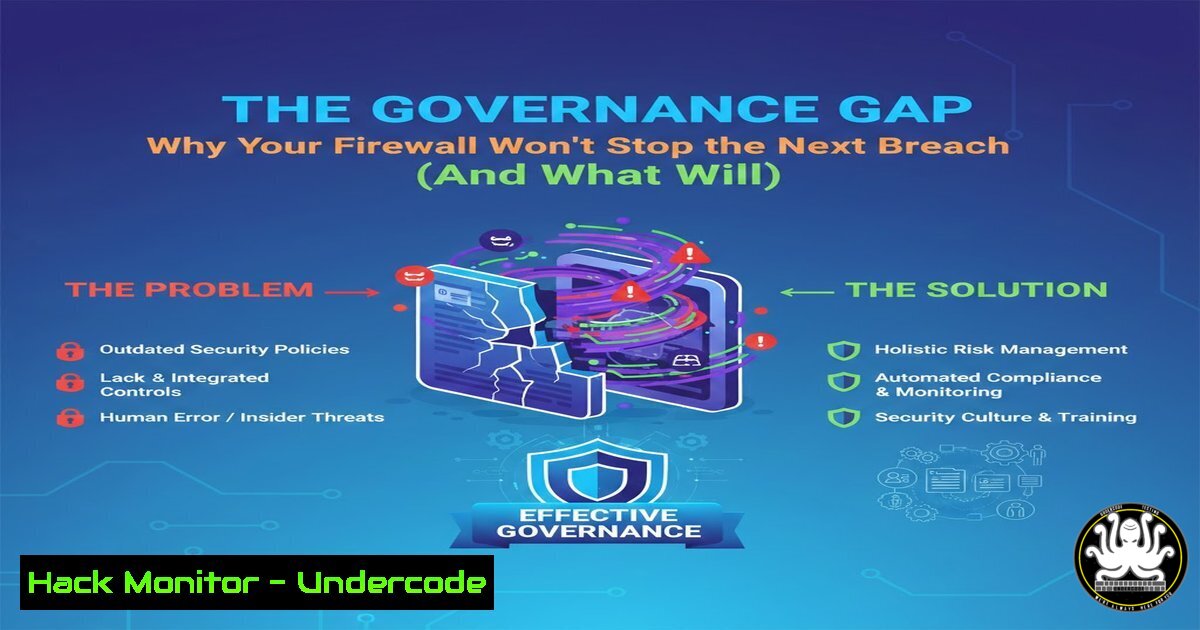
Cyber loss is not a technology failure; it is a governance failure. In the modern threat landscape, where risk is defined by the formula Risk = Severity × Proximity, the sequence of your defense actions fundamentally alters the outcome. This article deconstructs the executive perspective that true cybersecurity resilience is built not on isolated tools, but on a governance framework that prioritizes, contextualizes, and continuously manages risk.
Learning Objectives:
- Understand why cyber risk is a multiplicative function of Severity and Proximity, not an additive list.
- Learn to implement technical controls that directly map to and enforce governance policies.
- Master the step-by-step integration of continuous compliance monitoring into your security operations.
You Should Know:
- From Governance to Command Line: Translating Policy into Technical Enforcement
Governance dictates what must be protected; technology defines how. The critical failure point is the gap between boardroom policy and system configuration. A policy mandating “least privilege access” is useless without technical enforcement.
Step-by-step guide:
Policy Statement: “Service accounts shall not have interactive login rights.”
Windows Enforcement (PowerShell):
 Discover service accounts with login rights
Get-WmiObject Win32_UserAccount | Where-Object {$<em>.Name -like "svc"} | ForEach-Object {
$username = $</em>.Name
 Deny interactive logon via Group Policy Object (GPO) mapping or local policy
secedit /export /cfg C:\temp\secpol.cfg
 Manually edit secpol.cfg to add $username to "Deny log on locally" and "Deny log on through Remote Desktop Services"
secedit /configure /db C:\Windows\security\local.sdb /cfg C:\temp\secpol.cfg /areas USER_RIGHTS
}
Linux Enforcement (Bash):
 1. Identify service accounts (often UID < 1000)
awk -F: '$3 < 1000 {print $1}' /etc/passwd

<ol>
<li>Explicitly deny shell access by setting their shell to /usr/sbin/nologin
sudo usermod -s /usr/sbin/nologin <service_account_name></p></li>
<li><p>Verify by attempting a su (should fail)
sudo su - <service_account_name>
This directly links a governance rule to an auditable, technical state.
2. Quantifying Proximity: Mapping Your Digital Attack Surface
Proximity isn’t just geographic; it’s digital. It measures how close a threat can get to your critical assets through the network. You must inventory and score every pathway.
Step-by-step guide:
Asset Inventory: Use tools like `nmap` to discover live hosts and services.
nmap -sV -O --script vuln 10.0.0.0/24 -oA network_scan
Network Segmentation Analysis: Diagram all network zones (e.g., DMZ, Internal, PCI DSS). Use traceroute or path analysis to understand connectivity.
traceroute -T -p 443 <critical_internal_IP>
Cloud Exposure Check: For assets in AWS/Azure/GCP, use native tools (AWS Security Hub, Azure Security Center) or open-source tools like `ScoutSuite` to audit configuration against best practices for exposure.
python scout.py aws --access-keys <key> <secret>
Score Proximity: Assign a score (1-5) to each asset based on its network exposure to the internet and its connectivity to crown jewels. An internet-facing database gets a proximity of 5; an internal workstation with no inbound rules gets a 1.
- Dynamic Risk Scoring: Implementing the Risk = Severity × Proximity Model
Static risk registers are obsolete. Risk must be recalculated dynamically as Severity (via threat intel) or Proximity (via network changes) shifts.
Step-by-step guide:
- Define Severity Sources: Integrate threat intelligence feeds (e.g., MITRE ATT&CK updates, CISA alerts) into a SIEM or a simple dashboard. A new critical CVE for a software you use increases Severity.
- Define Proximity Triggers: Configure network monitoring to alert on new open ports, unexpected external connections, or changes to security groups in the cloud.
3. Build the Calculation Engine (Simplified Python Example):
 Pseudocode for dynamic risk score
def calculate_risk(asset_id):
severity = get_severity(asset_id)  From threat intel/CVE DB
proximity = get_proximity(asset_id)  From network config DB
risk_score = severity  proximity  Core formula

if risk_score > THRESHOLD:
trigger_incident_response(asset_id)
return risk_score

Continuously monitor
while True:
for asset in critical_assets:
calculate_risk(asset.id)
time.sleep(300)  Recalculate every 5 minutes
4. API Security: The Invisible Proximity Vector
APIs are the new network perimeter. A poorly governed API brings threat proximity to zero, directly exposing core logic and data.
Step-by-step guide:
- Inventory ALL APIs: Use tools like `Amass` or `OWASP ZAP` in API scan mode.
zap-api-scan.py -t https://api.yourcompany.com/v2/openapi.json -f openapi -r report.html
- Enforce Strict AuthZ/N: Every API endpoint must validate tokens and implement strict, context-aware authorization checks (e.g., “Can user X PATCH only their own profile?”).
- Rate Limiting & Throttling: Implement at the API gateway (e.g., Kong, AWS WAF) to mitigate brute force and DDoS.
Example in nginx configuration
http {
limit_req_zone $binary_remote_addr zone=api:10m rate=10r/s;
server {
location /api/ {
limit_req zone=api burst=20 nodelay;
proxy_pass http://api_backend;
}
}
}
5. Continuous Compliance as Code: Hardening Cloud Environments
Governance requires evidence. “Compliance as Code” tools like Terraform with security scanners ensure your cloud environment’s actual state matches the governed state.
Step-by-step guide:
- Write Secure Terraform Modules: Define AWS S3 buckets, EC2 instances, etc., with security baked in (encryption, no public access).
resource "aws_s3_bucket" "secure_logs" {
bucket = "my-secure-logs"
acl = "private"</li>
</ol>

server_side_encryption_configuration {
rule {
apply_server_side_encryption_by_default {
sse_algorithm = "AES256"
}
}
}

Block ALL public access
block_public_acls = true
block_public_policy = true
ignore_public_acls = true
restrict_public_buckets = true
}
2. Scan with TFsec or Checkov: Integrate these scanners into your CI/CD pipeline.
terraform init
terraform plan -out tf.plan
terraform show -json tf.plan | checkov -f -
3. Automated Remediation: Use cloud-native tools like AWS Config with auto-remediation rules to revert any manual, non-compliant changes back to the governed state.
What Undercode Say:
- Governance is the Blueprint, Technology is the Bricklayer. A perfect bricklayer (security tools) is irrelevant if following a flawed blueprint (weak governance). The sequence is non-negotiable: define governance first, then engineer to it.
- Risk is Dynamic, So Your Defenses Must Be. The multiplicative Risk = Severity × Proximity model forces continuous re-evaluation. A low-severity threat with direct proximity (e.g., a phishing email to a CEO) becomes a critical risk instantly.
The analysis reveals that most post-breach “technical root causes” are merely symptoms of a pre-existing governance decay. Focusing on patching the last vulnerability is a losing game. The winning strategy is building a system where governance dictates a secure configuration, continuous monitoring validates it, and any deviation triggers an automated response before an exploit can leverage the changed proximity. This transforms cybersecurity from a reactive cost center into a proactive, value-driven governance function.
Prediction:
Within the next 18-24 months, regulatory frameworks (like evolving SEC rules and global equivalents of Australia’s CPS 234) will move beyond mandating reporting breaches to legally requiring evidence of active, technical enforcement of declared governance policies. Board members and C-suite executives will be held personally liable not just for “having” a policy, but for proving, via immutable technical logs and automated compliance checks, that the digital environment was configured and maintained in strict accordance with it. The legal concept of “due care” will be digitally defined.
▶️ Related Video (80% Match):
🎯Let’s Practice For Free:
IT/Security Reporter URL:
Reported By: Johndmackenzie %F0%9D%90%82%F0%9D%90%B2%F0%9D%90%9B%F0%9D%90%9E%F0%9D%90%AB – Hackers Feeds
Extra Hub: Undercode MoN
Basic Verification: Pass ✅🔐JOIN OUR CYBER WORLD [ CVE News • HackMonitor • UndercodeNews ]
📢 Follow UndercodeTesting & Stay Tuned:


