Listen to this Post
Introduction:
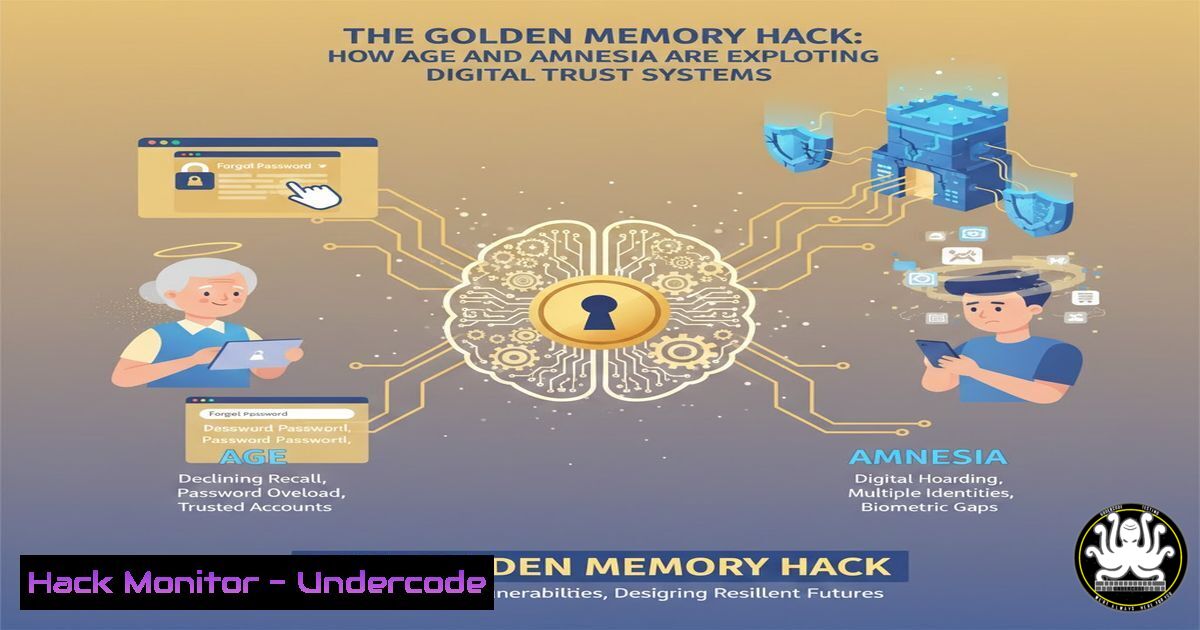
In a digital age where identity verification and memory-based authentication are cornerstones of cybersecurity, a seemingly humorous social media post reveals a darker truth. The scenario of an elderly individual with memory loss and significant wealth being targeted highlights critical vulnerabilities in both human and technological trust systems. This incident serves as a potent case study for cybersecurity professionals, illustrating how social engineering preys on cognitive decline and how financial systems can be compromised without a single line of malicious code being executed.
Learning Objectives:
- Understand the intersection of social engineering, identity fraud, and cognitive vulnerabilities.
- Analyze the security implications of memory-based authentication and inheritance-driven access.
- Learn technical mitigations for protecting high-value assets and vulnerable individuals from exploitation.
You Should Know:
1. The Psychology of the “Walking ATM” Exploit
This subheading refers to the social engineering tactic where an attacker, often a “trusted” individual, targets a person with diminished cognitive capacity (like memory loss) to gain control over their financial assets. The exploit relies on building emotional rapport and exploiting gaps in oversight.
Step‑by‑step guide explaining what this does and how to use it.
Step 1: Reconnaissance (The Scan): The attacker identifies a high-value target (HVT) through public records, social media, or familial networks. Indicators of wealth (property records, luxury items in photos) and vulnerability (mentions of health issues) are cataloged.
Step 2: Engagement (The Phish): The attacker establishes contact under a benign or emotionally compelling pretext (e.g., caregiving, companionship, romantic interest). This is the human equivalent of a phishing email.
Step 3: Trust Establishment (Persistence): Over time, the attacker becomes a regular presence, isolating the target from other trusted contacts (like disabling security alerts).
Step 4: Privilege Escalation (The Payload): The attacker gradually gains access to critical information: PINs, passwords, safe combinations, or legal authority via power of attorney.
Mitigation Command (Technical Oversight): For IT professionals securing a family member’s assets, set up automated financial monitoring. A simple Python script using `Pandas` and `plaid-python` API can flag anomalous transactions.
 Example snippet for anomalous transaction alerting (conceptual)
import pandas as pd
from plaid import Client

client = Client(client_id='YOUR_CLIENT_ID', secret='YOUR_SECRET', environment='sandbox')
transactions_response = client.Transactions.get('ACCESS_TOKEN', '2023-01-01', '2023-12-31')
transactions = pd.DataFrame(transactions_response['transactions'])
 Calculate daily spend and flag large deviations
daily_spend = transactions.groupby('date')['amount'].sum()
threshold = daily_spend.rolling(30).mean() + (3  daily_spend.rolling(30).std())
alerts = daily_spend[daily_spend > threshold]
print(alerts)
2. Bypassing Memory-Based Authentication
Many personal security systems rely on “knowledge-based authentication” (KBA)—passwords, PINs, security questions. A person with memory loss may write these down insecurely or willingly disclose them to a “helper.”
Step‑by‑step guide explaining what this does and how to use it.
Step 1: Identify Authentication Points: Map all the target’s digital and physical access points: online banking, email, smartphone PIN, computer login, home security system.
Step 2: Exploit Insecure Storage: Search for written passwords in notebooks, sticky notes, or text files named “passwords.txt” on the desktop.
Step 3: Perform a Shoulder Surfing Attack: Observe the victim entering codes or passwords under the guise of assistance.
Mitigation Guide: Replace KBA with multi-factor authentication (MFA) using a hardware token (YubiKey) or biometrics. For system administrators, enforce policies that disable password-only auth.
Windows Command (via PowerShell – Admin): Enforce Windows Hello for Business to mandate biometric/PIN.
Set-ExecutionPolicy RemoteSigned
Install-Module -Name WindowsHelloForBusiness
Configure-WHfB -UseCertificate $true
Linux PAM Configuration: Modify `/etc/pam.d/common-auth` to require `pam_u2f.so` for hardware token support.
auth required pam_u2f.so authfile=/etc/u2f_mappings
3. The Inheritance & Legal Backdoor Threat
This involves manipulating legal documents (wills, power of attorney) to redirect asset inheritance—a long-term, high-reward attack that exploits legal processes rather than technical ones.
Step‑by‑step guide explaining what this does and how to use it.
Step 1: Gain Fiduciary Control: Persuade the vulnerable individual to grant Power of Attorney (POA) or alter beneficiary designations on accounts.
Step 2: Obfuscate the Trail: Use the POA to make gradual, seemingly legitimate transfers to avoid triggering bank alarms.
Step 3: Cover Tracks: Isolate the individual further and control communications to prevent challenges from other parties.
Mitigation – Digital Witness System: Implement a transparent, blockchain-based or simply multi-signature system for critical document changes. Use encrypted digital logs.
Example using GnuPG for Document Signing: Ensure wills/POAs are signed and verified by multiple trusted parties.
 Trusted party 1 signs the document
gpg --output document.pdf.sig --sign document.pdf

Trusted party 2 verifies the signature
gpg --verify document.pdf.sig
- Securing the Smart Home & IoT Attack Surface
A vulnerable individual may live in a “smart home” with IoT devices (smart locks, cameras, voice assistants) that can be compromised to facilitate physical access or monitoring.
Step‑by‑step guide explaining what this does and how to use it.
Step 1: Network Mapping: Use `nmap` from a connected device to find vulnerable IoT devices on the home network.
nmap -sV -O 192.168.1.0/24
Step 2: Exploit Default Credentials: Use tools like `hydra` to brute-force default passwords on admin interfaces.
hydra -l admin -P /usr/share/wordlists/rockyou.txt http-get://192.168.1.105/
Step 3: Establish a Foothold: Compromise a device to create a backdoor into the network.
Mitigation – IoT Hardening:
Change all default credentials.
Segment the network: Place IoT devices on a separate VLAN.
 Example using iptables to isolate IoT subnet
iptables -A FORWARD -i eth0 -o eth1 -s 192.168.2.0/24 -j DROP
Regularly update firmware.
5. AI-Enhanced Social Engineering & Deepfake Risks
Attackers could use AI to mimic the voice or video of a trusted family member to instruct the vulnerable individual to perform actions, like transferring money.
Step‑by‑step guide explaining what this does and how to use it.
Step 1: Voice Cloning: Harvest a short audio sample from social media.
Step 2: Generate Deepfake Audio: Use a tool like `Real-Time-Voice-Cloning` (GitHub) to create convincing fake instructions.
Step 3: The Attack Call: Place a voice call instructing the target to authorize a transaction.
Mitigation – Code Word Protocols: Establish a family-wide code word for verifying sensitive requests. Technologically, implement behavioral biometrics analysis on account logins to detect anomalies in typing patterns or login times.
What Undercode Say:
- The Human Firewall is the Weakest Link. No amount of technical hardening can fully compensate for the exploitation of trust, empathy, and cognitive decline. Security training must extend to caregivers and family members.
- Wealth is a High-Value Target (HVT) That Attracts Advanced Persistent Threats (APTs). In this context, the “APT” is a patient human attacker, not a state-sponsored hacker. Defense requires a blend of legal safeguards, financial oversight, and technical monitoring.
Analysis: This LinkedIn post, while shared as humor, is a stark incident report from the frontline of human-centric cybersecurity. It underscores that the most devastating attacks often bypass firewalls and exploit the operating system of society itself: trust. For cybersecurity professionals, it’s a reminder to design systems with “human fail-safes”—such as mandatory multi-party approval for large transactions, routine audit logs reviewed by an independent third party, and education for non-technical stakeholders. The future of security lies not just in protecting data, but in protecting people, especially those most vulnerable to manipulation.
Prediction:
The convergence of AI-driven social engineering (deepfakes, voice cloning), an aging global population with accumulated digital wealth, and increasingly complex digital estates will lead to a new category of cyber-fraud. We will see the rise of “Elderly Exploit as a Service” (EEaaS) in dark web markets, where attackers sell tailored kits for cognitive targeting. This will force regulatory changes, mandating “vulnerability-aware” banking protocols and spurring the development of AI guardians that monitor for signs of coercion or manipulation in financial communications and legal document alterations.
▶️ Related Video (80% Match):
🎯Let’s Practice For Free:
IT/Security Reporter URL:
Reported By: Kosh L – Hackers Feeds
Extra Hub: Undercode MoN
Basic Verification: Pass ✅


