Listen to this Post
Introduction:
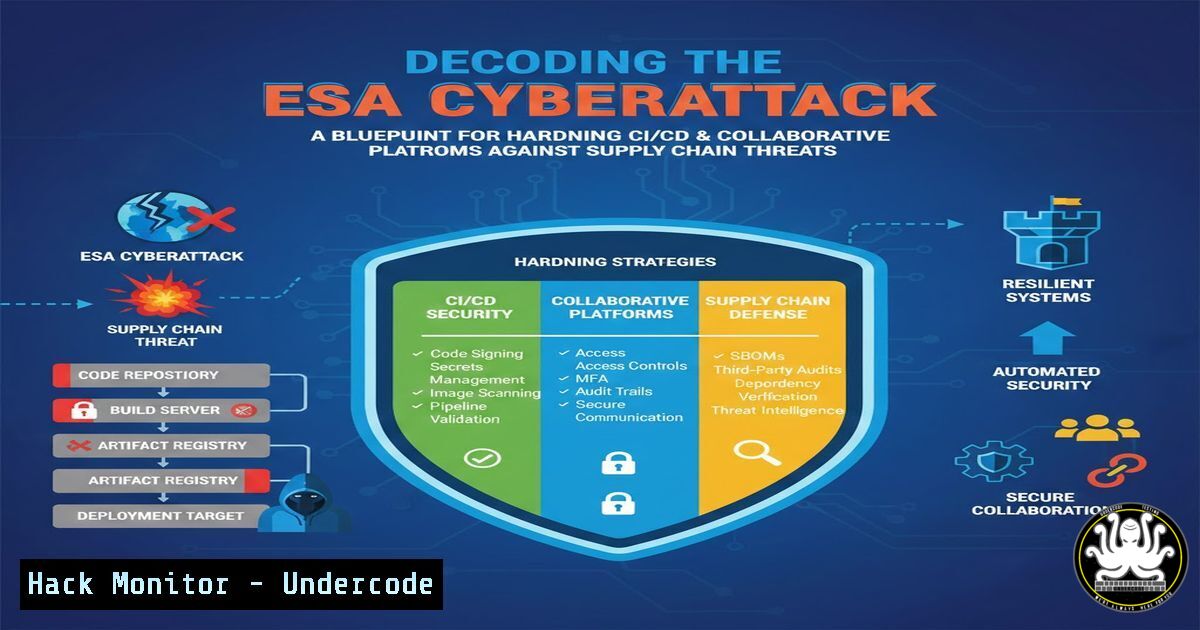
The European Space Agency’s recent breach, involving 200+ GB of source code, CI/CD pipelines, and technical configurations, reveals a critical shift in cyber targeting. Attackers are no longer just after classified data; they’re infiltrating the collaborative engineering backbone itself—Bitbucket repositories, Jira systems, and Terraform files—to potentially compromise the integrity of future space missions at their source. This incident underscores an urgent reality: the software supply chain within high-tech organizations has become a prime battlefield.
Learning Objectives:
- Understand the specific technical assets (CI/CD pipelines, IaC configurations) targeted in modern attacks on scientific and engineering organizations.
- Learn immediate hardening steps for collaboration tools like Bitbucket and Jira, and infrastructure-as-code platforms like Terraform.
- Develop a proactive incident response playbook for supply chain and intellectual property compromise scenarios.
You Should Know:
1. The Attack Vector: Exploiting Collaborative Engineering Ecosystems
The attacker, “Mod888,” specifically exfiltrated private Bitbucket repositories, CI/CD pipelines, Jira data, and Terraform configurations. This indicates a targeted effort against the development and deployment ecosystem, not a random data grab. Such assets provide a roadmap to an organization’s internal tools, build processes, and cloud infrastructure blueprints, enabling future, more destructive attacks like code poisoning or infrastructure sabotage.
Step‑by‑step guide:
Step 1: Audit Access to Development Platforms. Immediately review all user accounts and access keys for systems like Bitbucket, GitLab, and Jira. Remove inactive accounts and enforce mandatory multi-factor authentication (MFA).
Linux Command for Access Log Review: `sudo grep “accepted” /var/log/auth.log | tail -100` (Review recent SSH/access logs).
Step 2: Scan for Exposed Secrets in Code. Use secret-scanning tools on your codebase to find any passwords, API keys, or tokens that may have been leaked, which the attacker now possesses.
Tool Recommendation: Run `trufflehog –regex –entropy=False file:///path/to/your/git/repo` to scan Git history for secrets.
Step 3: Rotate All Compromised Credentials. Assume all credentials within the stolen data are compromised. This includes database connection strings in configuration files, API tokens for cloud services, and SSH keys.
2. Hardening Infrastructure-as-Code (Terraform) Configurations
The theft of Terraform files is particularly severe. These files are literal blueprints of your cloud or data center infrastructure. In the wrong hands, they can be used to understand network topology, find misconfigurations, or even destroy environments.
Step‑by‑step guide:
Step 1: State File Locking & Encryption. Ensure your Terraform remote state files (e.g., in AWS S3, Azure Blob Storage) are encrypted at rest and that state locking is mandatory to prevent concurrent, malicious modifications.
AWS S3 Encryption Command: `aws s3api put-bucket-encryption –bucket YOUR_TERRAFORM_BUCKET –server-side-encryption-configuration ‘{“Rules”: [{“ApplyServerSideEncryptionByDefault”: {“SSEAlgorithm”: “AES256”}}]}’`
Step 2: Implement Policy-as-Code. Use tools like HashiCorp Sentinel or Open Policy Agent (OPA) to enforce security policies (e.g., “no security groups allow 0.0.0.0/0”, “all storage buckets must be private”) before any Terraform plan can be applied.
Step 3: Scrub Sensitive Data from Terraform Files. Manually review stolen file types for hardcoded secrets. Use Terraform’s `sensitive = true` variable attribute to prevent values from being printed in console output.
3. Securing CI/CD Pipeline Integrity
Compromised CI/CD pipelines allow an attacker to inject malicious code into official builds, a nightmare supply chain attack. The ESA breach put pipeline configurations at risk.
Step‑by‑step guide:
Step 1: Enforce Signed Commits. Mandate GPG-signed Git commits to verify the identity of contributors and ensure code integrity from developer to deployment.
Git Command to Sign a Commit: `git commit -S -m “Your commit message”` (Requires a configured GPG key).
Step 2: Isolate Build Environments. Run CI/CD agents (like Jenkins nodes or GitHub Actions runners) in isolated, ephemeral containers or virtual machines that are destroyed after each build to prevent persistent compromise.
Step 3: Implement Binary Authorization. Use tools like Kyverno or Cosign to only allow deployments of container images that have been cryptographically signed by your trusted CI system, blocking unauthorized code.
- Locking Down Project Management & Collaboration Tools (Jira)
Jira data contains goldmines for attackers: project timelines, unpatched vulnerability discussions, system architectures, and partner information.
Step‑by‑step guide:
Step 1: Principle of Least Privilege (PoLP) Review. Audit Jira project permissions. Ensure users and service accounts can only access projects absolutely necessary for their role. Remove global “Browse Users” and “Create Projects” permissions where possible.
Step 2: Sanitize Historical Issues. Create a process to regularly review and redact sensitive information (keys, passwords, internal IPs) from old Jira tickets before they can be exfiltrated.
Step 3: Network Restriction. Configure Jira access to be restricted by IP whitelist (where feasible) or require VPN connection, especially for administrative interfaces.
5. Forensic Analysis & Proactive Hunting
Following an incident like ESA’s, proactive hunting is needed to see if the attacker left backdoors or is still inside the network.
Step‑by‑step guide:
Step 1: Hunt for Anomalous Network Connections. Use tools like Zeek or analyze firewall/VPC flow logs to look for outbound connections to unknown external IPs, especially on ports used by common C2 (Command & Control) frameworks.
Example Hunting Query (Zeek/Suricata Logs): Look for `conn.log` entries where `id.resp_h` is in a known threat intelligence feed of suspicious IPs.
Step 2: Baseline and Monitor Service Accounts. The attacker often creates or hijacks service accounts for persistence. Audit all service accounts (in Active Directory, cloud IAM) and monitor their usage patterns for anomalies.
Windows Command to List Service Principal Names (SPNs): `setspn -L DOMAIN\ServiceAccountName` (Can help identify accounts used for Kerberos attacks).
Step 3: Deploy Canary Tokens. Place fake credentials (canary tokens) within code repositories and configuration files. Alerting on their use provides a high-fidelity signal that stolen data is being actively exploited.
What Undercode Say:
- The Target is the Factory, Not the Product. This attack wasn’t about stealing a single satellite design; it was about mapping and potentially compromising the entire “factory” that designs and builds them. The intellectual property in CI/CD and IaC is often more valuable long-term than the end-product data.
- Resilience is Measured in Response, Not Just Prevention. ESA’s methodical response—forensic analysis, external experts, securing access—is the textbook example of “assume breach” mentality. Limiting blast radius and communicating clearly is as critical as any firewall rule.
Analysis: The ESA breach is a canonical example of a software supply chain reconnaissance mission. The attacker’s goal appears to be establishing a position for future, more disruptive action. By possessing internal tools, code, and infrastructure maps, they could, at a chosen time, sabotage a build process, inject a vulnerability into a spacecraft’s software, or cripple development environments. This moves beyond data theft into the realm of operational disruption and long-term strategic compromise. It signals to all organizations in critical sectors that their engineering toolchains are now Tier-1 assets requiring defense-in-depth equal to their most sensitive databases.
Prediction:
This incident foreshadows a future where attacks on scientific and aerospace organizations will increasingly focus on corrupting the integrity of data and systems at the source. We will see a rise in “delayed-effect” malware inserted into stolen build pipelines, designed to activate only in specific operational environments (e.g., during a satellite’s orbital deployment). This will force a paradigm shift from merely protecting data confidentiality to cryptographically verifying the integrity and provenance of every piece of code and configuration from developer keyboard to final deployment in space.
▶️ Related Video (76% Match):
🎯Let’s Practice For Free:
IT/Security Reporter URL:
Reported By: Cyber It – Hackers Feeds
Extra Hub: Undercode MoN
Basic Verification: Pass ✅


