
Listen to this Post
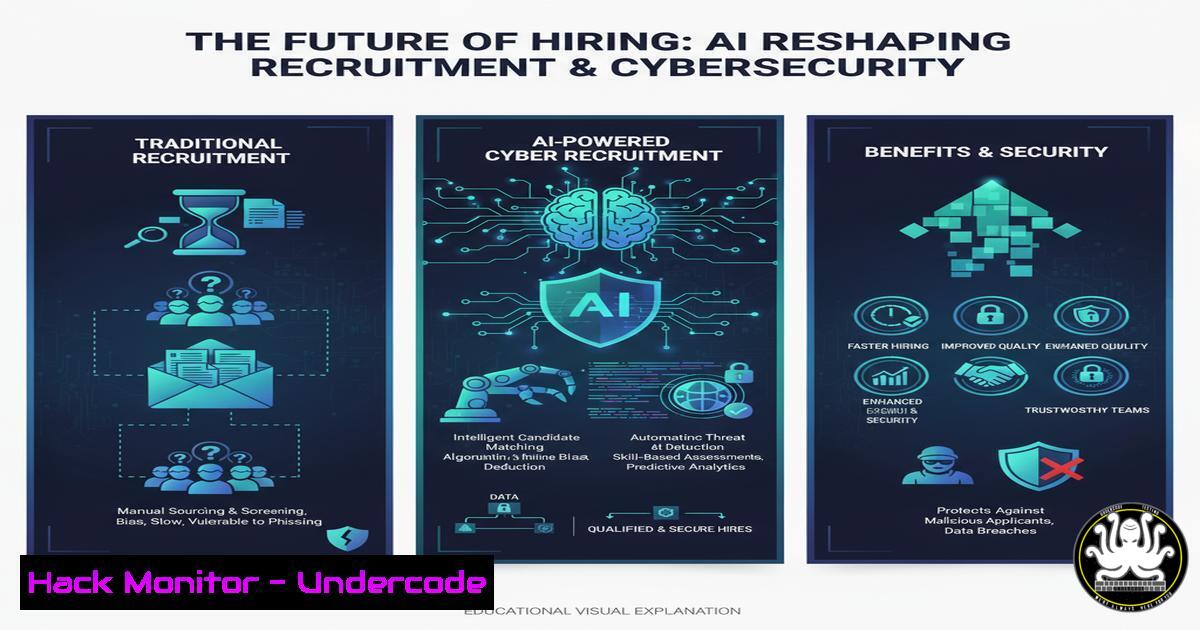
Introduction:
The integration of Artificial Intelligence (AI) into recruitment platforms is revolutionizing talent acquisition, but it simultaneously introduces a new frontier of cybersecurity vulnerabilities. From algorithmic bias to data poisoning attacks, the very tools designed to streamline hiring can become vectors for discrimination and data breaches if not properly secured. Understanding the technical landscape is crucial for IT professionals, HR departments, and cybersecurity teams to build resilient and fair hiring systems.
Learning Objectives:
- Identify critical security vulnerabilities in AI-driven recruitment tools and ATS (Applicant Tracking Systems).
- Implement secure configuration and monitoring for recruitment APIs and cloud data stores.
- Develop mitigation strategies against algorithmic bias and data poisoning attacks.
You Should Know:
1. Securing the Applicant Data Pipeline
The first line of defense is securing the data pipeline. Applicant Tracking Systems (ATS) and AI screening tools process vast amounts of sensitive Personal Identifiable Information (PII). A common vulnerability is an improperly secured database or file store.
Verified Command/Code Snippet:
 Use find to locate directories containing resume files that may have overly permissive permissions.
find /opt/ats/storage /var/www/ats/uploads -name ".pdf" -o -name ".docx" -o -name ".doc" | xargs ls -la

Securely set permissions for upload directories (Linux)
find /opt/ats/uploads -type d -exec chmod 755 {} \;
find /opt/ats/uploads -type f -exec chmod 644 {} \;
chown -R atsuser:atsgroup /opt/ats/storage
Step-by-step guide:
The `find` command scans specified directories (like common ATS storage paths) for common resume file types. Piping to `xargs ls -la` displays their permissions. The subsequent commands ensure that directories are not world-writable (755) and files are only readable by the owner and group (644). Finally, `chown` confirms the correct user and group own the files. This prevents unauthorized users or processes from accessing or modifying sensitive resumes.
2. Hardening Recruitment API Endpoints
APIs are the backbone of modern ATS and AI services, handling everything from submitting applications to receiving AI analysis. Unprotected APIs are a prime target.
Verified Command/Code Snippet:
 Using curl to test for common API security misconfigurations
 Test for lack of rate limiting (run rapidly)
curl -X POST https://api.example-ats.com/v1/apply -H "Content-Type: application/json" -d '{"email":"[email protected]", "resume": "base64_encoded_data"}'

Check for verbose error messages that leak information
curl -X GET "https://api.example-ats.com/v1/applicants/9999999" -H "Authorization: Bearer invalid_token"
Step-by-step guide:
The first command simulates a rapid series of application submissions. If the server does not implement rate limiting, it will process them all, potentially leading to a Denial-of-Service (DoS) or resource exhaustion. The second command uses an invalid token to access a non-existent applicant ID. A secure API should return a generic “401 Unauthorized” or “404 Not Found” without revealing whether the user ID exists or internal system details.
3. Auditing AI Model Training Data Integrity
AI models in recruitment are only as unbiased as their training data. Adversaries can perform “data poisoning” attacks by submitting crafted resumes to skew the AI’s decisions.
Verified Command/Code Snippet:
 Python snippet using Pandas and Scikit-learn for basic data skew detection
import pandas as pd
from sklearn.ensemble import IsolationForest

Load historical hiring data
df = pd.read_csv('historical_hires.csv')

Check for feature skew (e.g., a sudden influx of a specific keyword)
keyword_counts = df['resume_text'].str.contains('obscure_tech_keyword').value_counts()

Use an anomaly detection algorithm to find outliers in the feature set
clf = IsolationForest(contamination=0.01)
features = df[['skill_score', 'years_experience', 'keyword_density']]
df['anomaly'] = clf.fit_predict(features)
potential_poisons = df[df['anomaly'] == -1]
print(potential_poisons[['id', 'skill_score']])
Step-by-step guide:
This code first loads a dataset of past applications. It then checks for an unusual frequency of a specific, potentially malicious keyword. The `IsolationForest` model is a machine learning algorithm used for anomaly detection. It identifies applications whose feature combinations (skill score, experience, etc.) are statistical outliers, which could indicate poisoned data designed to manipulate the model’s learning process.
4. Implementing Bias Detection in Automated Screening
Proactively monitoring for algorithmic bias is a security measure against discriminatory outcomes, which can be a form of system failure.
Verified Command/Code Snippet:
 Using the Fairlearn toolkit to assess demographic parity
from fairlearn.metrics import demographic_parity_difference
from fairlearn.postprocessing import ThresholdOptimizer

y_true: true labels, y_pred: model predictions, sensitive_features: gender/ethnicity etc.
bias_metric = demographic_parity_difference(y_true, y_pred, sensitive_features=applicant_gender)

Mitigate bias using postprocessing
mitigator = ThresholdOptimizer(estimator=your_model, constraints="demographic_parity")
mitigator.fit(X_train, y_train, sensitive_features=sensitive_features_train)
fair_predictions = mitigator.predict(X_test, sensitive_features=sensitive_features_test)
Step-by-step guide:
The `demographic_parity_difference` function quantifies bias by measuring the difference in selection rates between different demographic groups. A value of 0 indicates perfect fairness. The `ThresholdOptimizer` is a mitigation technique that adjusts the prediction thresholds for different groups to achieve a fairer outcome without retraining the core model, acting as a crucial patch for biased AI.
5. Windows Server Hardening for On-Premise ATS
Many enterprises run ATS on internal Windows servers. Hardening these systems is fundamental.
Verified Command/Code Snippet:
 PowerShell commands to enforce strong security policies
 Disable SMBv1 for ATS file shares (vulnerable protocol)
Disable-WindowsOptionalFeature -Online -FeatureName SMB1Protocol

Configure the Windows Firewall to restrict access to the ATS web port only to HR IP ranges
New-NetFirewallRule -DisplayName "Allow ATS Web HR" -Direction Inbound -Protocol TCP -LocalPort 443 -RemoteAddress "192.168.1.0/24" -Action Allow

Audit user accounts with access to ATS databases
Get-ADGroupMember "ATS_DB_Admins" | Select-Object Name, SamAccountName
Step-by-step guide:
These PowerShell commands enhance the server’s security posture. Disabling SMBv1 protects against known exploits like WannaCry. The firewall rule ensures that the ATS application (on port 443) is only accessible from the specific HR subnet, reducing the attack surface. The final command audits the `ATS_DB_Admins` group to ensure only authorized personnel have database access, a key principle of least privilege.
6. Container Security for Microservices-Based Recruitment Apps
Modern recruitment platforms are often built as microservices in containers. A vulnerable container can compromise the entire system.
Verified Command/Code Snippet:
 Use Trivy to scan a Docker image for vulnerabilities before deployment
trivy image your-registry.com/recruitment-ai:latest

Dockerfile commands to create a more secure, non-root container
FROM python:3.9-slim
RUN groupadd -r appuser && useradd -r -g appuser appuser
USER appuser
COPY --chown=appuser:appuser . /app
WORKDIR /app
Step-by-step guide:
The `trivy image` command performs a static analysis of a container image, listing all known CVEs in its operating system and application dependencies. The Dockerfile snippet demonstrates security best practices: using a minimal base image (slim), creating a non-root user (appuser), and switching to that user before running the application. This limits the damage if the application is compromised.
7. Logging and Monitoring for Suspicious Recruitment Activity
Continuous monitoring can detect attacks in progress, such as mass data scraping or credential stuffing.
Verified Command/Code Snippet:
 Use grep with extended regular expressions to find potential credential stuffing attacks in web server logs
grep -E "POST /login.401" /var/log/nginx/access.log | awk '{print $1}' | sort | uniq -c | sort -nr | head -10

A Linux command to monitor for large data exports from the ATS database
watch -n 60 'du -sh /var/lib/mysql/ats_db/.ibd'
Step-by-step guide:
The first command parses Nginx logs to find IP addresses ($1) that have multiple failed login attempts (POST /login.401), counts them, and lists the top 10 offenders—a clear sign of a credential stuffing attack. The second command uses `watch` to run `du` (disk usage) every 60 seconds on the database files, allowing an admin to spot a sudden, unexpected increase in size that could indicate a mass data exfiltration.
What Undercode Say:
- AI Recruitment Tools Are a Double-Edged Sword. They offer efficiency but create a massive, attractive attack surface for data theft and systemic manipulation. The PII handled is a goldmine for attackers.
- The Human Element is the Unpatchable Vulnerability. The most sophisticated AI can be undermined by social engineering attacks on HR personnel or developers, making continuous security training non-negotiable.
The convergence of AI and recruitment is not just an operational shift but a significant cybersecurity event. The industry is building complex, data-hungry systems on often-rushed development cycles, leaving gaps in security postures. The primary risks are not merely technical failures but the amplification of bias at scale and the weaponization of the hiring process itself. An organization’s failure to implement the technical controls outlined above is an implicit acceptance of operational, reputational, and legal risk. The integrity of your hiring process is now directly tied to your cybersecurity hygiene.
Prediction:
The next major recruitment-related breach will not be a simple database leak but a sophisticated “Algorithmic Hijacking” attack. Threat actors will systematically poison the training data of corporate ATS platforms by submitting thousands of subtly manipulated resumes. This will cause the AI to systematically reject qualified candidates from specific demographics or geographies while favoring less-qualified applicants who match the attacker’s profile, leading to massive corporate inefficiency, reputational damage, and landmark legal battles over discriminatory AI. This will force a new regulatory focus on the “security of algorithmic fairness,” making AI model auditing as standard as PCI-DSS is for payment data today.
🎯Let’s Practice For Free:
IT/Security Reporter URL:
Reported By: Magda Witkiewicz – Hackers Feeds
Extra Hub: Undercode MoN
Basic Verification: Pass ✅


