
Listen to this Post
Introduction:
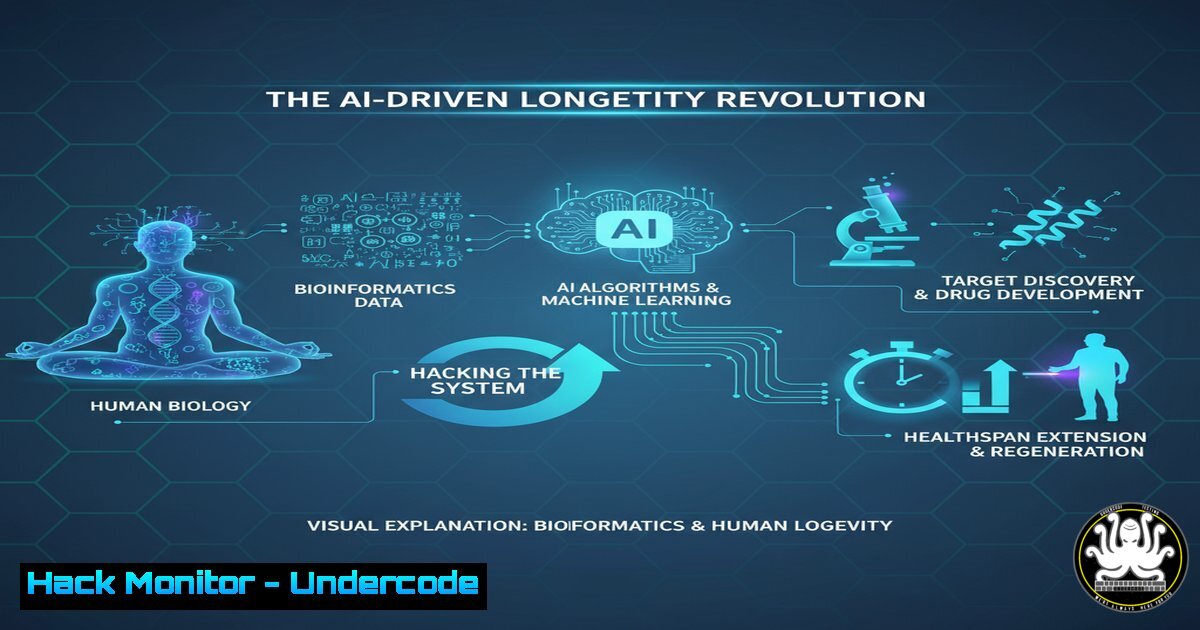
The convergence of artificial intelligence and biotechnology is catalyzing a paradigm shift in longevity research. Moving beyond symptomatic treatments, startups like LinkGevity are leveraging AI to target fundamental biological processes such as necrosis, representing a new frontier in hacking the human body’s core operating system. This approach reframes age-related decline as a tractable engineering problem, with profound implications for healthspan extension.
Learning Objectives:
- Understand the role of necrosis and calcium influx in cellular aging and how AI targets these mechanisms.
- Analyze the data infrastructure and computational pipelines required for AI-driven drug discovery.
- Evaluate the cybersecurity and data integrity challenges inherent in biotech research and clinical translation.
You Should Know:
1. Bioinformatics Data Pipeline Security
The foundation of AI-driven drug discovery rests on secure, high-integrity genomic and proteomic data pipelines.
 Secure SCP transfer of genomic data from sequencer to analysis cluster
scp -i ~/.ssh/sequencer_rsa -P 2222 /mnt/sequencer_output/plate_.fastq [email protected]:/incoming/raw_data/

Generate SHA-256 checksums for data integrity verification
find /incoming/raw_data/ -name ".fastq" -type f -exec sha256sum {} \; > /verification/plate_checksums.sha256

Set immutable flag on critical raw data files
sudo chattr +i /incoming/raw_data/plate_.fastq
This pipeline ensures secure transfer of sequencing data from laboratory instruments to bioinformatics clusters while maintaining cryptographic integrity verification. The SSH key-based authentication prevents unauthorized access, while checksum generation enables detection of data corruption during transfer. The immutable flag provides protection against accidental or malicious modification of raw data, which is crucial for reproducible AI training and regulatory compliance.
2. AI Model Training Infrastructure for Molecular Discovery
Training AI models for drug discovery requires specialized computational infrastructure and monitoring.
 Slurm job script for distributed AI model training
!/bin/bash
SBATCH --job-name=linkgevity_train
SBATCH --nodes=4
SBATCH --ntasks-per-node=8
SBATCH --cpus-per-task=4
SBATCH --gres=gpu:a100:8
SBATCH --time=72:00:00

Load bioinformatics and AI environments
module load anaconda3/2022.05 cuda/11.8
conda activate drug_discovery

Launch distributed training with fault tolerance
torchrun --nnodes=4 --nproc_per_node=8 --rdzv_id=12345 --rdzv_backend=c10d --rdzv_endpoint=master-node:29500 train_molecular_model.py --config link001_params.yaml --resume_from_checkpoint /checkpoints/latest.pt
This High-Performance Computing (HPC) configuration enables distributed training of complex molecular models across multiple GPU nodes. The fault-tolerant design with checkpoint resumption ensures long-running training jobs can survive hardware failures. Proper resource allocation is critical for molecular dynamics simulations and neural network training that can require weeks of continuous computation.
3. Clinical Trial Data Protection and HIPAA Compliance
Transitioning from AI discovery to clinical trials introduces stringent data security requirements.
 Pseudocode for clinical data anonymization pipeline
import hashlib
import pandas as pd
from cryptography.fernet import Fernet

def anonymize_patient_data(raw_clinical_df):
 Generate deterministic but non-reversible patient IDs
raw_clinical_df['patient_hash'] = raw_clinical_df['patient_name'] + raw_clinical_df['dob']
raw_clinical_df['patient_hash'] = raw_clinical_df['patient_hash'].apply(
lambda x: hashlib.sha3_256(x.encode()).hexdigest()[:16]
)

Encrypt sensitive biomarkers before cloud storage
key = Fernet.generate_key()
cipher_suite = Fernet(key)
raw_clinical_df['encrypted_biomarkers'] = raw_clinical_df['sensitive_biomarkers'].apply(
lambda x: cipher_suite.encrypt(x.encode())
)

Remove original PII columns
anonymized_df = raw_clinical_df.drop(['patient_name', 'dob', 'sensitive_biomarkers'], axis=1)
return anonymized_df, key

Secure upload to clinical data repository
anonymized_data, encryption_key = anonymize_patient_data(raw_trial_data)
anonymized_data.to_parquet('s3://linkgevity-trial-data/phase1/anonymized/clinical_data_2024.parquet')
This data protection pipeline ensures compliance with healthcare regulations while maintaining data utility for analysis. The deterministic hashing enables longitudinal patient tracking without exposing identities, while encryption provides additional protection for sensitive biomarkers. Proper key management is essential for maintaining both security and research accessibility.
4. Containerized Research Environment Security
Reproducible AI research requires secure, isolated computational environments.
 Dockerfile for secure bioinformatics research environment
FROM nvidia/cuda:11.8-runtime-ubuntu22.04

Security hardening: minimal base, non-root user
RUN useradd -m researcher && \
apt-get update && \
apt-get install -y --no-install-recommends \
python3.10 python3-pip git ca-certificates && \
rm -rf /var/lib/apt/lists/

USER researcher
WORKDIR /home/researcher

Install packages from verified requirements with hash checking
COPY --chown=researcher requirements.txt .
RUN pip install --require-hashes -r requirements.txt && \
pip cache purge

Configure secure execution environment
ENV PYTHONUNBUFFERED=1
ENV CUDA_VISIBLE_DEVICES=0
CMD ["python3", "-m", "jupyter", "lab", "--ip=0.0.0.0", "--port=8888", "--no-browser"]
The container configuration implements security best practices including non-root execution, minimal package installation, and hash-verified dependencies. This prevents supply chain attacks and limits the impact of potential vulnerabilities. The environment reproducibility ensures that AI models trained in research settings can be reliably transferred to clinical validation environments.
5. API Security for Research Data Access
Securing data access between research teams and computational resources requires robust API security.
from flask import Flask, request, jsonify
import jwt
from functools import wraps
import datetime

app = Flask(<strong>name</strong>)
SECRET_KEY = open('/run/secrets/api_jwt_key').read().strip()

def token_required(f):
@wraps(f)
def decorated(args, kwargs):
token = request.headers.get('X-API-TOKEN')
if not token:
return jsonify({'error': 'Token missing'}), 401
try:
data = jwt.decode(token, SECRET_KEY, algorithms=['HS256'])
if data['exp'] < datetime.datetime.utcnow().timestamp():
return jsonify({'error': 'Token expired'}), 401
except:
return jsonify({'error': 'Invalid token'}), 401
return f(args, kwargs)
return decorated

@app.route('/api/v1/molecular-data/<study_id>', methods=['GET'])
@token_required
def get_molecular_data(study_id):
 Implement rate limiting and audit logging
audit_log(f"Data access for study {study_id} by {request.remote_addr}")
return query_molecular_db(study_id)

if <strong>name</strong> == '<strong>main</strong>':
app.run(ssl_context=('cert.pem', 'key.pem'), host='0.0.0.0', port=443)
This API security implementation provides authenticated, audited access to sensitive research data. JWT tokens enable stateless authentication with expiration, while SSL encryption protects data in transit. Audit logging creates a traceable record of data access, crucial for both security investigations and regulatory compliance.
6. Incident Response for Research Data Breaches
Preparedness for security incidents affecting research data is essential for maintaining intellectual property protection.
!/bin/bash
 IR script for suspected research data compromise

Immediate containment
sudo iptables -A INPUT -s $SUSPECT_IP -j DROP
sudo systemctl isolate research-network.target

Forensic preservation
sudo tar czf /forensics/$(date +%s)_research_server_evidence.tar.gz /var/log/ /home/researcher/ /opt/linkgevity-models/
sudo chattr +i /forensics/.tar.gz

Threat intelligence gathering
sudo journalctl -u ssh --since "1 hour ago" > /forensics/ssh_logs.txt
sudo netstat -tulnp > /forensics/network_connections.txt

Notification and escalation
echo "SECURITY INCIDENT DETECTED ON RESEARCH NODE" | mail -s "URGENT: Research Security Breach" [email protected]
This incident response plan enables rapid containment and evidence preservation during security events. The isolation of research networks prevents lateral movement, while forensic evidence collection supports subsequent investigation and remediation. Timely escalation ensures appropriate organizational response to protect valuable intellectual property.
7. Secure Cloud Deployment for Clinical AI Models
Deploying trained AI models to clinical environments requires secure, scalable infrastructure.
 Secure AWS configuration for clinical AI deployment
resource "aws_s3_bucket" "model_artifacts" {
bucket = "linkgevity-phase1-models"

server_side_encryption_configuration {
rule {
apply_server_side_encryption_by_default {
sse_algorithm = "AES256"
}
}
}

versioning {
enabled = true
}
}

resource "aws_sagemaker_model" "necrosis_predictor" {
name = "link001-necrosis-predictor"
execution_role_arn = aws_iam_role.sagemaker_execution.arn

primary_container {
image = "${aws_ecr_repository.model_registry.repository_url}:latest"

environment = {
"MODEL_S3_BUCKET" = aws_s3_bucket.model_artifacts.bucket
"ENCRYPTION_KEY" = var.model_encryption_key
}
}
}

resource "aws_cloudwatch_log_group" "model_inference" {
name = "/aws/sagemaker/link001-inference"
retention_in_days = 365
kms_key_id = aws_kms_key.cloudwatch.arn
}
This infrastructure-as-code deployment ensures reproducible, secure cloud environments for clinical AI models. Server-side encryption, versioning, and KMS key management protect model artifacts, while CloudWatch logging with encryption provides auditable inference tracking. Proper IAM roles enforce the principle of least privilege for model execution.
What Undercode Say:
- The shift from symptomatic to mechanistic aging interventions represents the most significant paradigm change in longevity research since the discovery of telomeres.
- AI’s ability to identify and target fundamental biological processes like necrosis demonstrates that computational approaches are now mature enough to tackle core aging mechanisms.
- The primary bottleneck has shifted from target discovery to clinical translation, placing unprecedented importance on data security and regulatory compliance.
The convergence of AI and biotech represents a fundamental restructuring of how we approach human aging. By reframing biological decline as an information processing problem, researchers can apply computational thinking to cellular mechanisms that were previously considered too complex for systematic intervention. The LinkGevity approach targeting necrosis exemplifies this shift – moving beyond treating aging symptoms to addressing root causes through computational biology. However, this revolution creates new attack surfaces and security requirements. The intellectual property contained in AI models and training data represents enormous value, while patient data in clinical trials requires healthcare-grade security. Success in this field will depend as much on computational security as on biological insight, with cybersecurity becoming a critical enabler rather than just an IT concern.
Prediction:
The successful clinical translation of AI-discovered longevity therapeutics will trigger massive investment in bioinformatics security and create new specialized fields at the intersection of computational biology and cybersecurity. Within five years, we predict the emergence of “therapeutic AI security” as a distinct discipline, focusing on protecting drug discovery pipelines, clinical trial data, and deployed AI models from sophisticated threats. This will parallel the evolution of fintech security, with specialized firms emerging to protect the trillion-dollar intellectual property in longevity research. The organizations that master both the biological and computational security challenges will dominate the coming longevity market, while those that treat cybersecurity as an afterthought will face catastrophic intellectual property theft and regulatory consequences.
🎯Let’s Practice For Free:
IT/Security Reporter URL:
Reported By: Danielkafer Another – Hackers Feeds
Extra Hub: Undercode MoN
Basic Verification: Pass ✅


