Listen to this Post
Introduction:
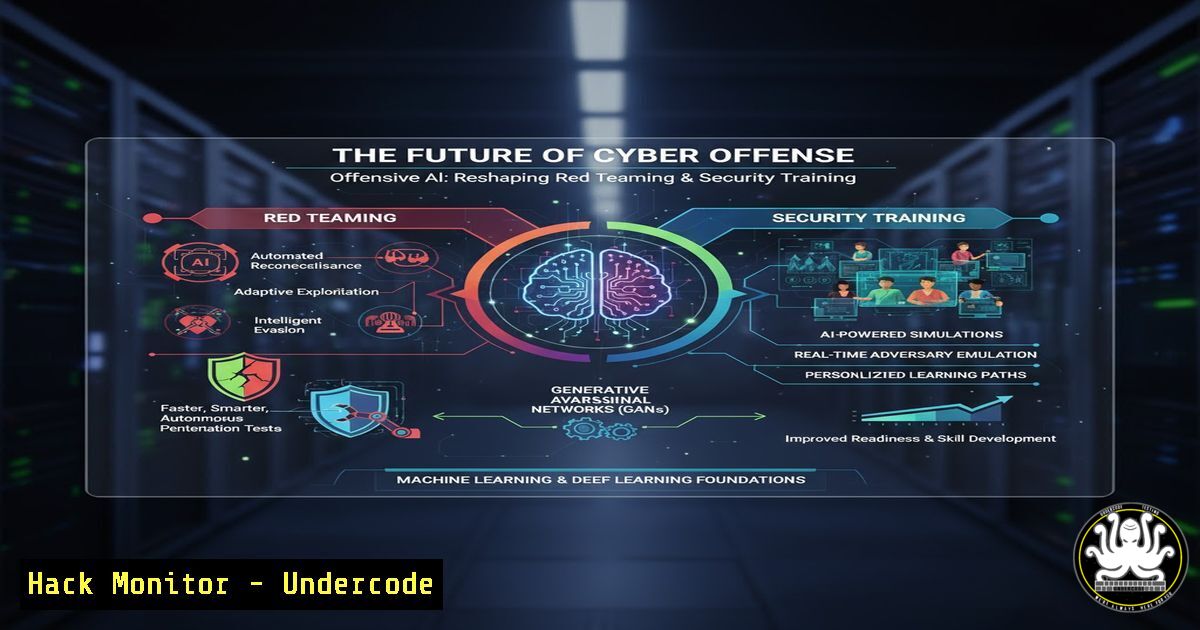
The cybersecurity landscape is undergoing a seismic shift with the integration of Artificial Intelligence into offensive security operations. Offensive AI, the weaponization of machine learning for penetration testing and red teaming, is automating complex attack chains and creating a new frontier for security professionals. This evolution demands a corresponding advancement in training methodologies, moving beyond traditional techniques to those that incorporate AI-driven tools and countermeasures.
Learning Objectives:
- Understand the core concepts of Offensive AI and its practical applications in red teaming.
- Learn key commands and techniques for leveraging AI in security assessments, from reconnaissance to exploitation.
- Develop a foundational knowledge of how to verify and harden systems against AI-powered threats.
You Should Know:
1. AI-Enhanced Reconnaissance and Intelligence Gathering
The initial reconnaissance phase is being supercharged by AI, allowing for the automated collection and correlation of open-source intelligence (OSINT) at an unprecedented scale.
 Example using a Python OSINT framework (conceptual)
import sn0int
from ai_osint_module import AICorrelationEngine

Initialize the AI-enhanced reconnaissance tool
recon = sn0int.Run()
ai_engine = AICorrelationEngine(model="recon_v1")

Add a target for automated data gathering
recon.add_target("example.com")

Execute the reconnaissance, with AI prioritizing data sources
results = recon.run(ai_prioritization=True)

Use AI to correlate findings and identify high-value targets
correlated_data = ai_engine.analyze(results)
print(correlated_data.get_critical_assets())
Step-by-step guide:
This conceptual script demonstrates how AI can be integrated into the reconnaissance workflow. The `AICorrelationEngine` would automatically query multiple OSINT sources, filter out noise, and highlight the most probable attack vectors, such as exposed API endpoints or outdated software versions, significantly reducing the manual effort required by a red teamer.
2. Generating Evasive Payloads with Machine Learning
AI models can now generate polymorphic code and payloads that are designed to bypass signature-based antivirus and EDR solutions.
 Using a hypothetical AI-powered payload generator 'Veil-Evolve'
 This is a conceptual extension of tools like Veil-Framework

veil-evolve --ai-model gpt-payload --target windows11-edr \
--input shellcode.bin --output evasive_payload.exe \
--technique stack-encryption-api-obfuscation
Step-by-step guide:
The command `veil-evolve` uses a machine learning model trained on EDR behavioral analysis. It takes a standard shellcode payload (shellcode.bin) and iteratively mutates its structure, API calls, and encryption methods until the AI determines a high probability of evasion against the specified target (windows11-edr). This automates the traditionally manual process of payload obfuscation.
3. AI-Assisted Vulnerability Discovery in Source Code
Static Application Security Testing (SAST) is being revolutionized by AI that can understand code context and identify complex logical flaws.
 Using Semgrep with AI-powered custom rules
semgrep --config=p/ai-assisted-sast --ai-context \
--target /path/to/source/code --severity CRITICAL,HIGH

The AI engine would generate findings for issues like:
 - AI-Identified Business Logic Bypass
 - Context-Aware SQL Injection
 - Unsafe AI Model Deserialization
Step-by-step guide:
This command runs Semgrep, a static analysis tool, but with an AI-powered rule pack. The `–ai-context` flag allows the engine to understand the business logic of the application, going beyond simple pattern matching to identify chained vulnerabilities and complex security flaws that would be missed by traditional SAST tools.
4. Automating Privilege Escalation with AI Enumeration
Post-exploitation privilege escalation can be automated using AI that intelligently sequences local enumeration commands based on the target environment.
 Windows - AI-Driven Local Privilege Escalation Script (Beacon Object File for Cobalt Strike)
 Conceptual BOF script that uses an on-device model to choose the best escalation path

beacon> getuid
beacon> ai_escalate --context current_user --os_build 22000 --analysis aggressive

The AI would then execute a sequence of commands like:
 1. systeminfo | findstr /B /C:"OS Name"
 2. reg query HKLM\SOFTWARE\Microsoft\Windows\CurrentVersion\Uninstall
 3. dir "C:\Program Files\" /a
 4. . . . and many others, chosen dynamically
Step-by-step guide:
Instead of running a standard, noisy privilege escalation script, the `ai_escalate` command uses a lightweight model to analyze the current context (user, OS build, installed software). It then dynamically selects and executes the enumeration commands most likely to yield a viable escalation path, such as checking for specific vulnerable drivers or misconfigured services, thereby increasing efficiency and reducing detection risk.
5. Adversarial Machine Learning: Poisoning AI Models
Understanding how to attack AI systems is a critical component of offensive AI. Data poisoning is a primary technique to corrupt a model during training.
 Conceptual code for a data poisoning attack
import numpy as np
from sklearn.linear_model import LogisticRegression

Assume this is the training data for a malware classifier
X_train, y_train = load_training_data()

Adversarial: Inject poisoned samples
poison_samples = create_poisoned_samples(malicious_code, label="benign")
X_poisoned = np.vstack([X_train, poison_samples])
y_poisoned = np.hstack([y_train, ['benign']len(poison_samples)])

Retrain the model on the poisoned dataset
model = LogisticRegression()
model.fit(X_poisoned, y_poisoned)  The model is now compromised
Step-by-step guide:
This Python snippet illustrates the core concept of a data poisoning attack. An attacker injects carefully crafted malicious samples into the training dataset, mislabeling them as “benign.” When the model is retrained, it learns to associate the features of the malicious code with a benign classification, effectively creating a backdoor that the attacker can exploit later to bypass the classifier.
6. Hardening Systems Against Offensive AI
Mitigating AI-powered threats requires a shift towards behavioral detection and zero-trust architectures.
 Linux: Using Auditd with advanced rules to detect anomalous process behavior
 Rule to track process execution and command-line arguments for AI-like patterns
auditctl -a always,exit -F arch=b64 -S execve -k ai_behavior_detection

Windows: PowerShell command to enable enhanced logging for suspicious script blocks
Get-Module -ListAvailable PowerShellGet
Set-ItemProperty -Path "HKLM:\SOFTWARE\Policies\Microsoft\Windows\PowerShell\ScriptBlockLogging" -Name "EnableScriptBlockLogging" -Value 1
Step-by-step guide:
The Linux `auditctl` command sets up an audit rule to log all program executions, which can be fed into a Security Information and Event Management (SIEM) system with AI-driven anomaly detection to identify unusual process chains. The Windows PowerShell command enables deep script block logging, which is crucial for capturing the often-obfuscated scripts used in AI-driven attacks, allowing for retrospective analysis.
- The Role of Specialized Training in the AI Era
The emergence of platforms like RedOps Academy highlights the need for specialized, hands-on training that bridges the gap between theoretical AI and practical offensive security.
 Example: Setting up a lab environment for Offensive AI practice
 Using Docker to isolate training modules

git clone https://github.com/redops-academy/offensive-ai-lab.git
cd offensive-ai-lab
docker-compose up -d

Access the lab dashboard at https://localhost:8443
 Modules include:
 - AI-Powered Fuzzing
 - Adversarial Sample Generation
 - Defensive AI Evasion
Step-by-step guide:
This lab setup provides a safe, containerized environment to practice Offensive AI techniques. By cloning the repository and starting the Docker containers, students gain access to pre-configured scenarios, such as vulnerable AI models and evasion challenges, allowing for practical, hands-on learning that is critical for mastering these advanced concepts.
What Undercode Say:
- The democratization of advanced attack techniques through AI is inevitable, leveling the playing field between attackers and defenders.
- The future of effective cybersecurity defense lies in leveraging AI defensively to understand and counter AI-offensive tools, creating an AI-on-AI battleground.
The post by Joas A. Santos and the subsequent mention of RedOps Academy is a clear signal from within the industry. The leading figures in red teaming and offensive research are not just observing the AI trend; they are actively building the educational infrastructure to standardize it. Offensive AI is moving from a theoretical research topic to a practical curriculum. This normalization means that within the next 1-2 years, AI-assisted penetration testing will become a standard expectation for red team operations, not a novelty. The core challenge will shift from “how to use AI offensively” to “how to build defensive systems that are resilient to adaptive, learning-based attacks.” The organizations that invest in understanding and integrating these tools into their security programs today will be the ones capable of defending against them tomorrow.
Prediction:
The widespread adoption of Offensive AI, as promoted by emerging specialized training academies, will lead to a short-term increase in the effectiveness of cyber attacks, particularly from less experienced threat actors who are augmented by AI tools. However, this will force a rapid evolution in defensive technologies, leading to the standard integration of AI-driven behavioral analytics and anomaly detection systems in all enterprise security stacks within the next 3-5 years. The ultimate outcome will be an accelerated arms race, pushing both offensive and defensive security towards full automation, where the speed and complexity of attacks will far exceed human reaction times, making AI-assisted defense not an advantage but a necessity for survival.
🎯Let’s Practice For Free:
IT/Security Reporter URL:
Reported By: Joas Antonio – Hackers Feeds
Extra Hub: Undercode MoN
Basic Verification: Pass ✅


