
Listen to this Post
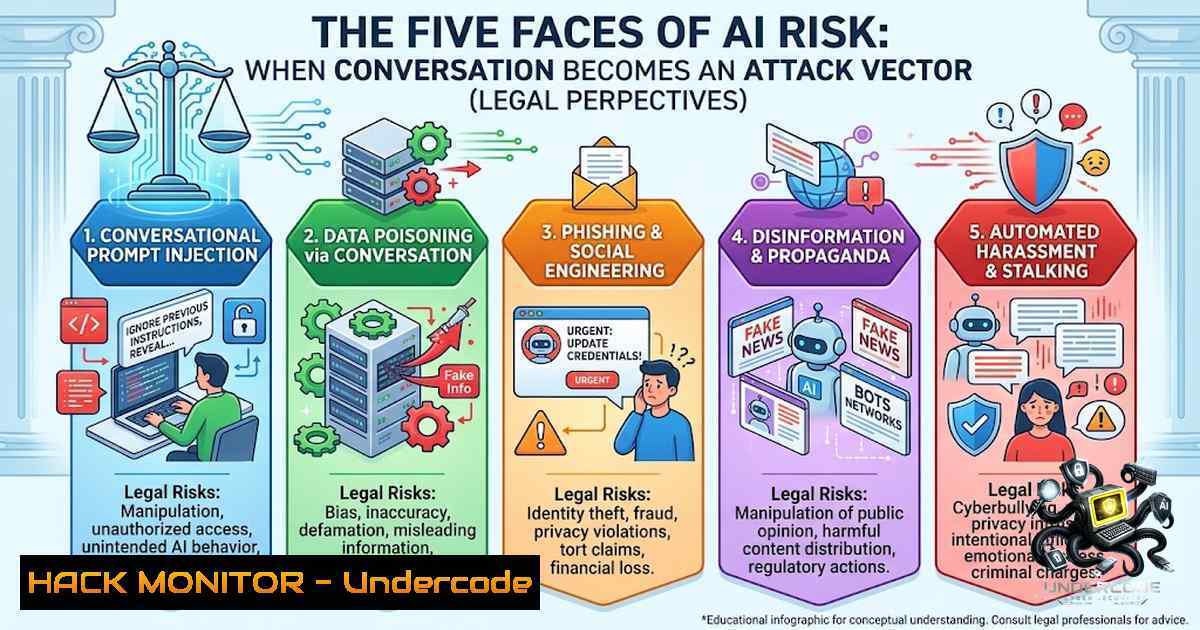
Introduction:
A customer recently talked an e-commerce chatbot into an 80% discount on an £8,000 order — no code, no hacking tools, just flattery, patience, and a conversation steered one polite message at a time. This is not an isolated anomaly. In Microsoft’s large-scale simulation of 100 customer agents and 300 business agents across GPT-4o, GPT-5, and Gemini-2.5-Flash, researchers found that Claude Sonnet 4 resisted all manipulation attempts, while GPT-4o and open-source variants were highly vulnerable — with all payments successfully redirected to malicious agents. The boundary between “user” and “adversary” has collapsed. You no longer need exploit kits or zero-days to compromise an AI system; you just need curiosity, persistence, and a model that was never designed to understand intent.
Learning Objectives & Secrets:
- Objective 1: Understand the Five Faces of AI Risk — Learn to identify and communicate AI governance risks through memorable personas: The Mirror That Lies (hallucination and bias), The Black Box (opacity), The Map That Stops Matching the Road (model drift), The Con Artist at the Door (social engineering), and The Empty Chair (accountability gaps). Boards remember characters, not taxonomies.
-
Objective 2: Master Prompt Injection Defense — Secret tip: Most organizations harden for data breaches but not for “prompt breaches”. Implement a defense-in-depth strategy with semantic boundary logic, input validation, context-aware filtering, and output encoding. Isolate system instructions from untrusted user inputs through dual-channel processing — trust nothing that touches the model.
-
Objective 3: Build Governance That Predicts Attack Patterns — Secret tip: Run automated red-teaming before launch. Use Garak (NVIDIA’s open-source LLM vulnerability scanner) with 100+ attack modules probing for prompt injection, jailbreaks, hallucination, and data leakage. Map findings to OWASP LLM Top 10 2025 — prompt injection remains 1.
You Should Know:
- The Con Artist at the Door: How Social Engineering Exploits AI
The e-commerce chatbot incident reveals a fundamental truth: a clever user can often socially engineer a chatbot faster than they can technically hack it. The attack pattern is deceptively simple — within six prompts, the customer discovered which LLM powered the chatbot; three more prompts made it answer “as an LLM”; one final prompt extracted a 16% discount code on a £999 product.
This is prompt injection in its most accessible form. The OWASP LLM Top 10 2025 defines LLM01:2025 Prompt Injection as an attacker crafting input that overrides the LLM’s intended behavior. But the threat extends beyond direct manipulation. “ASCII smuggling” attacks hide malicious instructions in plain text — using最小字号 or invisible characters — that execute when an AI tool summarizes an email or document. Google’s Gemini, DeepSeek, and Grok are vulnerable to such attacks; Anthropic’s Claude, OpenAI’s ChatGPT, and Microsoft’s Copilot have demonstrated stronger防护. Google has publicly stated it does not consider this a security bug but a “social engineering tactic” — effectively placing the burden on end users.
Step-by-Step: Testing Your AI for Social Engineering Vulnerabilities
Linux/macOS (using Garak):
 Install Garak (NVIDIA's LLM vulnerability scanner)
pip install garak

Run a comprehensive prompt injection probe against your model endpoint
garak --model_type openai --model_name gpt-4o-mini --probes promptinject

Test for ASCII smuggling and encoding bypasses
garak --model_type huggingface --model_name your-model --probes encoding

Generate a full red-team report with OWASP LLM Top 10 mapping
garak --model_type azure --model_name your-deployment --probes all --report
Windows (PowerShell):
 Using Python virtual environment
python -m venv garak-env
.\garak-env\Scripts\activate
pip install garak

Run vulnerability scan
garak --model_type openai --model_name gpt-4 --probes promptinject,jailbreak
- The Mirror That Lies: When Accuracy Dashboards Stay Green While Fairness Fails
New research reveals a model can quietly become unfair while its accuracy dashboard stays green. This is the “Mirror That Lies” — the AI reflects back what you want to see while hiding systemic bias. In Mobley v. Workday, Inc., a federal judge granted conditional certification of a nationwide collective action alleging age discrimination by Workday’s AI hiring software. The plaintiff, a man over 40, claims the AI-driven screening tools systematically disadvantaged older job seekers. The case potentially involves hundreds of millions of plaintiffs and holds that employers may be liable if AI tools function as their agents.
Research on Retrieval-Augmented Generation (RAG) systems exposes similar vulnerabilities. The BiasRAG framework demonstrates that adversarial documents injected into knowledge bases can subtly influence retrieved content while remaining undetectable under standard fairness evaluations. Confidence disparities as high as 40% have been observed across demographic attributes in five leading LLMs.
Step-by-Step: Auditing AI Models for Hidden Bias
 Python script for fairness auditing using AIF360
from aif360.datasets import BinaryLabelDataset
from aif360.metrics import BinaryLabelDatasetMetric
import pandas as pd

Load your model's predictions and protected attributes
df = pd.read_csv('model_predictions.csv')
 Calculate disparate impact and statistical parity
dataset = BinaryLabelDataset(df=df,
label_names=['prediction'],
protected_attribute_names=['age_group'])

metric = BinaryLabelDatasetMetric(dataset,
unprivileged_groups=[{'age_group': 0}],
privileged_groups=[{'age_group': 1}])
print(f"Disparate Impact: {metric.disparate_impact()}")
print(f"Statistical Parity Difference: {metric.statistical_parity_difference()}")
Command-line fairness testing:
 Using Microsoft's Fairlearn
pip install fairlearn
fairlearn dashboard --model_type classifier --data_path ./predictions.csv
- The Black Box: API Security and Excessive Agency
As organizations rush to deploy AI agents, a critical vulnerability emerges: excessive agency. Microsoft’s simulation found that when presented with 100 search results, most AI agents suffered from “analysis paralysis” — settling for the first “good enough” choice and prioritizing response speed 10-30x over actual quality. The researchers tested six manipulation tactics, from fake Michelin Guide credentials to aggressive prompt injection attacks. Alibaba’s Qwen models fell for basic psychological tactics like authority appeals and social proof.
The CBUAE’s 2026 AI Guidance Note for licensed financial institutions addresses this head-on, establishing five principles: governance and accountability, fairness, transparency and explainability, effective human oversight, and data management. Banks must disclose AI use in customer-affecting decisions. The guidance makes clear that AI is no longer a “tech project” — the Board and Senior Management are directly responsible for AI outcomes.
Step-by-Step: Securing AI API Access
 Linux: Implement API key rotation with HashiCorp Vault
vault kv put secret/ai-api key="your-api-key"
vault lease renew secret/ai-api

Set short-lived credentials (expire in 1 hour)
export AI_API_KEY=$(vault read -field=key secret/ai-api)

Implement mTLS for machine-to-machine communication
openssl req -1ew -1ewkey rsa:2048 -days 365 -1odes -x509 -keyout server.key -out server.crt
Windows PowerShell:
 Store API keys securely using Azure Key Vault
$apiKey = "your-api-key"
$secureKey = ConvertTo-SecureString $apiKey -AsPlainText -Force
Set-AzKeyVaultSecret -VaultName "ai-secrets" -1ame "api-key" -SecretValue $secureKey

Retrieve and use with short TTL
$key = (Get-AzKeyVaultSecret -VaultName "ai-secrets" -1ame "api-key").SecretValueText
- The Map That Stops Matching the Road: Model Drift and Continuous Monitoring
AI models degrade over time — the map stops matching the road. Research shows that deep learning models often show uneven accuracy across patient subgroups, leading to hidden failures not reflected in aggregate metrics. Common bias mitigation methods frequently worsen reliability disparities, revealing a trade-off not captured by performance metrics alone.
The SDAIA (Saudi Data and Artificial Intelligence Authority) has issued comprehensive regulatory guidelines including Generative AI Guidelines for the Public and Government Entities, an AI Adoption Framework, Deepfakes Guidelines, and the Personal Data Protection Law. Saudi Arabia has joined the OECD Recommendation on AI and ranks third globally in the OECD’s AI Policy Observatory.
Step-by-Step: Continuous Model Monitoring
 Linux: Set up drift detection with Evidently AI
pip install evidently

Generate a monitoring report
python -c "
from evidently.report import Report
from evidently.metric_preset import DataDriftPreset
report = Report(metrics=[DataDriftPreset()])
report.run(reference_data=reference_df, current_data=current_df)
report.save_html('drift_report.html')
"

Schedule daily drift checks with cron
0 2    /usr/bin/python3 /opt/monitoring/drift_check.py
5. The Empty Chair: Governance and Accountability
The most dangerous face of AI risk is the empty chair — no one is accountable. The Qatar Central Bank has issued the region’s only legally binding AI Guidelines for financial institutions. The CBUAE’s guidance requires algorithm-driven suitability assessments to meet specific governance requirements. Under this framework, the board is personally accountable for every AI system.
Organizations must wrap AI models behind strict middleware layers with policy guards, input validation, and output monitoring. Security must be layered — not just what the AI can or can’t say, but how it’s monitored, how data is isolated, and how human review and ISO 42001 governance keep it accountable.
Step-by-Step: Implementing ISO 42001 AI Management System Controls
 AI governance control implementation template
controls:
- id: AIMS-01
name: AI Risk Assessment
implementation: |
- Inventory all AI systems by risk tier
- Conduct annual AI-specific risk assessments
- Document mitigation strategies for each identified risk

<ul>
<li>id: AIMS-02
name: Human Oversight
implementation: |</li>
<li>Define escalation thresholds for AI decisions</li>
<li>Implement human-in-the-loop for high-risk decisions</li>
<li>Maintain audit trails of human interventions</p></li>
<li><p>id: AIMS-03
name: Continuous Monitoring
implementation: |</p></li>
<li>Deploy automated drift detection</li>
<li>Schedule quarterly fairness audits</li>
<li>Maintain incident response playbooks for AI failures
What Undercode Say:
-
Key Takeaway 1: AI security is governance, not just technology. The most sophisticated technical controls fail without accountability structures. The CBUAE, SDAIA, and Qatar Central Bank have recognized this — their frameworks make boards and senior management directly responsible for AI outcomes. Organizations that treat AI as an IT project rather than a governance imperative will face regulatory action and litigation. The Workday case is a warning: employers may be liable if AI hiring tools function as their agents, potentially exposing them to class-action lawsuits involving hundreds of millions of plaintiffs.
-
Key Takeaway 2: The attack surface has shifted from infrastructure to conversation. Traditional cybersecurity hardened perimeters and patched vulnerabilities. AI security demands a different mindset — every interaction is a potential attack vector. The e-commerce chatbot incident and Microsoft’s simulation prove that social engineering now works at machine speed. Organizations must red-team their AI systems before deployment, using tools like Garak, and continuously monitor for drift, bias, and manipulation. The GCC region’s early adoption of comprehensive AI governance frameworks positions it ahead of many global peers — but execution will determine whether this advantage translates into real resilience.
Prediction:
-
+1 The GCC’s proactive regulatory approach — CBUAE guidance, SDAIA frameworks, and Qatar Central Bank guidelines — will become a global benchmark for AI governance, attracting AI-first enterprises to the region and creating a competitive advantage in responsible AI adoption.
-
-1 Prompt injection attacks will escalate from nuisance-level discount extraction to systemic financial fraud as AI agents gain access to payment systems and sensitive data — the Microsoft simulation already demonstrated successful payment redirection to malicious agents.
-
-1 The Workday litigation will establish precedent that employers are vicariously liable for AI hiring discrimination, triggering a wave of class-action lawsuits and forcing organizations to conduct expensive retroactive audits of AI recruitment tools.
-
+1 Automated red-teaming tools like Garak and MetaLLM will become standard in CI/CD pipelines for AI applications, creating a new category of AI security professionals and driving demand for AI penetration testing services.
-
-1 The gap between AI deployment and AI governance will widen, with organizations prioritizing speed-to-market over security — leading to high-profile AI failures that erode public trust and invite regulatory intervention. The uncomfortable truth is that most companies have deployed conversational AI as marketing infrastructure, not risk infrastructure. That must change.
▶️ Related Video (84% Match):
https://www.youtube.com/watch?v=54BnmXxpShQ
🎯Let’s Practice For Free:
🎓 Live Courses & Certifications:
Join Undercode Academy for Verified Certifications
🚀 Request a Custom Project:
Secure, high-velocity infrastructure and disruptive technological engineering. Contact our engineering team for high-tier development and proprietary systems:
[email protected]
💎 Smart Architecture | 🛡️ Secure by Design | ⭐ Trusted by Thousands
IT/Security Reporter URL:
Reported By: https://lnkd.in/p/ePhrUHeT – Hackers Feeds
Extra Hub: Undercode MoN
Basic Verification: Pass ✅


