Listen to this Post
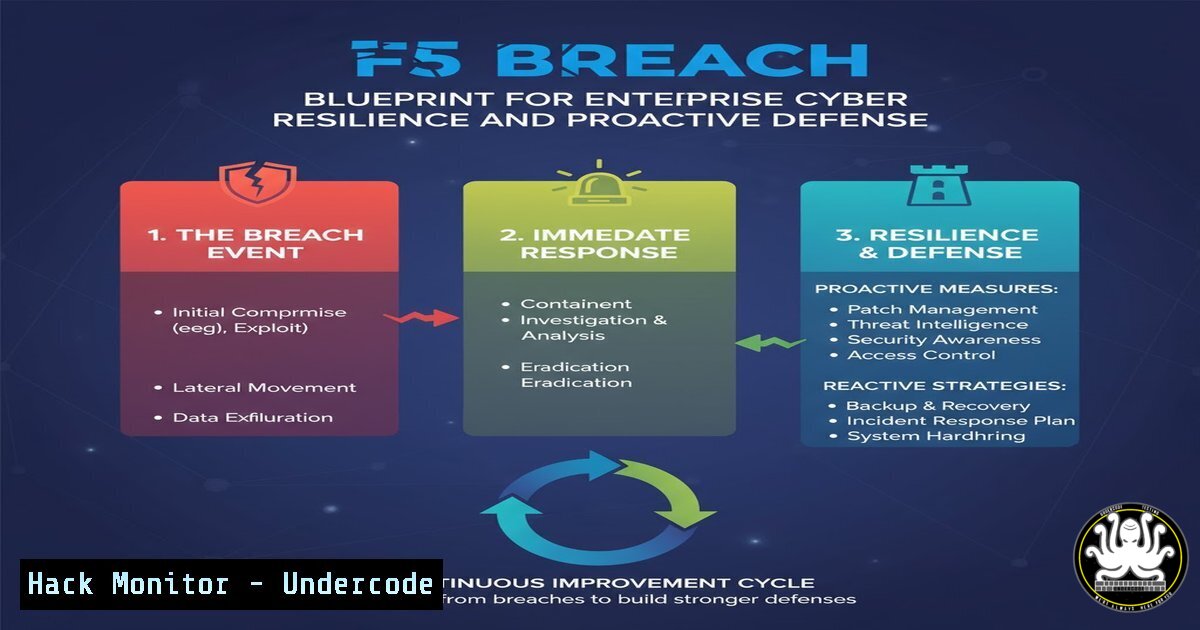
Introduction:
The recent security incident at F5, a cornerstone of the application delivery and security industry, serves as a critical case study for organizations worldwide. While the technical details are still emerging, the public response from F5’s leadership provides a masterclass in incident communication and a springboard for discussing essential, actionable cybersecurity hardening techniques. This article distills the core principles demonstrated by F5 into a technical guide for bolstering your own enterprise defenses.
Learning Objectives:
- Implement advanced logging, monitoring, and threat-hunting techniques to detect post-breach actor movement.
- Harden core infrastructure, including web servers, cloud configurations, and API endpoints, against sophisticated attacks.
- Develop and test an incident response playbook that emphasizes transparency and continuous improvement.
You Should Know:
1. Comprehensive System and Application Logging
The F5 CEO thanked customers for “combing through logs,” highlighting this as a primary post-incident activity. Proactive logging is your first line of forensic defense.
Verified Commands & Configurations:
Linux (rsyslog): `. @@central-log-server:514` (Configure in `/etc/rsyslog.conf` to forward all logs to a central server).
Windows (PowerShell): `Get-WinEvent -LogName Security,Application,System -MaxEvents 50 | Export-CSV C:\Audit\recent_events.csv` (Export recent critical logs for analysis).
F5 BIG-IP LTM: `tmsh save sys ucs
Linux (journalctl): `journalctl -u ssh –since “1 hour ago” –no-pager` (Review SSH authentication logs for the last hour).
AWS CloudTrail: Ensure CloudTrail is enabled in all regions and logs are delivered to an S3 bucket with `s3:GetObject` and `s3:PutObject` logging enabled.
Step-by-step guide:
- Identify Critical Data Sources: Catalogue logs from firewalls, endpoints, servers (SSH, RDP, web server), databases, and cloud trails.
- Centralize Aggregation: Deploy a SIEM (Security Information and Event Management) solution or a centralized logging server. Use the rsyslog command above for Linux or Windows Event Forwarding for Windows systems.
- Define Retention Policies: Store logs for a minimum of 90 days, with critical security events retained for one year or more to comply with forensic and regulatory requirements.
- Create Alerting Rules: Build SIEM correlations for high-risk events like lateral movement, privileged account usage, and anomalous outbound traffic.
2. Proactive Network Segmentation and Lateral Movement Prevention
A key lesson from any breach is limiting an attacker’s ability to move laterally from an initial compromise.
Verified Commands & Configurations:
Windows (Firewall): `New-NetFirewallRule -DisplayName “Block-Lateral-SMB” -Direction Inbound -Protocol TCP -LocalPort 445 -Action Block` (Blocks inbound SMB on a critical server).
Linux (iptables): `iptables -A FORWARD -p tcp –dport 445 -j DROP` (Drops SMB traffic being forwarded through a system).
Cisco ASA: `access-list INSIDE extended deny tcp any any eq 445 log` (Add to an inside access-list to deny and log SMB traffic).
Nmap Scan (Offensive): `nmap -p 445,135,139,3389
PowerShell (Get Sessions): `Get-NetTCPConnection -State Established | Where-Object {$_.RemotePort -eq 445}` (Check for active SMB sessions from a Windows host).
Step-by-step guide:
- Map the Network: Use tools like Nmap to understand current connectivity and trust relationships.
- Implement Micro-Segmentation: Create firewall rules (like the Windows and iptables examples) to enforce the principle of least privilege. Segment development, production, and user networks.
- Restrict Administrative Protocols: Block or tightly control protocols like RDP (3389), SMB (445), and WinRM (5985/5986) between user and server subnets.
- Monitor for Violations: Use your SIEM to alert on firewall “accept” rules for these blocked protocols, indicating a potential misconfiguration or policy violation.
3. Hardening Web Application Infrastructure
As an application delivery leader, F5’s infrastructure is a high-value target. Hardening similar assets is paramount.
Verified Commands & Configurations:
Nginx: `add_header X-Frame-Options “SAMEORIGIN” always;` add_header X-Content-Type-Options "nosniff" always; (Add security headers in Nginx config).
Apache: `Header always set X-Frame-Options “SAMEORIGIN”` Header always set X-Content-Type-Options "nosniff" (Add security headers in `.htaccess` or httpd.conf).
OpenSSL Scan: `openssl s_client -connect
Step-by-step guide:
- Security Headers: Implement the Nginx/Apache commands to mitigate clickjacking and MIME-sniffing attacks.
- TLS Configuration: Disable old protocols (SSLv2/3, TLS 1.0/1.1) and weak cipher suites. Use the OpenSSL and SSLyze commands to audit your current config.
- Vulnerability Scanning: Integrate automated scanners like Nuclei into your CI/CD pipeline to find known vulnerabilities before deployment.
- WAF Tuning: If using an F5 BIG-IP ASM or other WAF, ensure signatures are updated and policies are in blocking mode for critical attack vectors.
4. API Security Posture Management
Modern applications are built on APIs, making them a prime attack vector that requires specific security controls.
Verified Commands & Configurations:
OWASP ZAP Baseline Scan: `zap-baseline.py -t https://api.target.com/v1 -I` (Run a quick baseline scan of an API endpoint).
Kali Linux (API Fuzzing): `ffuf -w /usr/share/wordlists/api/CommonApiEndpoints.txt -u https://target.com/FUZZ -fc 404` (Fuzz for hidden API endpoints).
JQ (JSON Parser): `curl -s https://api.target.com/users | jq ‘.users[].email’` (Parse and filter API responses for sensitive data exposure).
Postman/Newman: Write and automate tests for authentication, authorization, rate limiting, and input validation on API endpoints.
Check for Swagger UI: `nmap -p 80,443 –script http-swagger
Step-by-step guide:
- Inventory: Discover all API endpoints, including internal and shadow APIs, using fuzzing tools (FFUF) and network scanning.
- Authenticate & Authorize: Enforce strict authentication (OAuth 2.0, API keys) and ensure endpoints perform proper authorization checks for the authenticated user.
- Validate Input: Implement strong input validation and schema enforcement for all request parameters and payloads.
- Rate Limiting: Deploy rate limiting to mitigate brute-force and Denial-of-Service (DoS) attacks against your API infrastructure.
5. Cloud Infrastructure Hardening
The shared responsibility model means you are responsible for securing your data, platforms, and configurations in the cloud.
Verified Commands & Configurations:
AWS CLI (S3 Bucket Check): `aws s3api get-bucket-policy –bucket my-bucket` (Check if an S3 bucket has a restrictive policy).
Terraform (Secure S3): `resource “aws_s3_bucket_public_access_block” “example” { bucket = aws_s3_bucket.example.id block_public_acls = true block_public_policy = true ignore_public_acls = true restrict_public_buckets = true }` (Code to enforce private S3 buckets).
Prowler (CIS Benchmark): `prowler -c check31` (Run a specific CIS benchmark check for AWS).
Azure CLI (Storage Account): `az storage account update –name
GCP (gcloud): `gcloud compute firewall-rules create deny-all-ingress –network default –direction INGRESS –action deny –rules all –source-ranges 0.0.0.0/0` (Create a default-deny ingress firewall rule).
Step-by-step guide:
- Benchmark: Use a tool like Prowler or CSPM (Cloud Security Posture Management) to continuously scan your cloud environment against CIS benchmarks.
- Principle of Least Privilege: Apply the principle of least privilege to IAM roles and policies. Avoid using the “root” account or wildcard permissions (
""). - Network Security: Implement the firewall rules shown above to create a default-deny posture and only allow necessary traffic.
- Data Encryption: Enable encryption at rest (server-side encryption) and in transit (TLS) for all storage services.
What Undercode Say:
- Transparency is a Control: F5’s response demonstrates that transparent communication is not just PR; it’s a critical security control that builds trust and facilitates collective defense.
- Post-Incident is Pre-Incident for the Next Attack: The most crucial security work begins after an incident is contained, focusing on turning “lessons learned” into “lessons applied” through rigorous hardening.
The F5 incident is a stark reminder that no organization is immune. The community’s positive reaction is less about the breach itself and more about the maturity of the response. By publicly committing to a bug bounty program and sharing findings, F5 is operationalizing the “continuous improvement” that many security frameworks preach but few demonstrate so openly. This shifts the narrative from failure to leadership, providing a tangible return on security investment in the form of enhanced customer trust and a more resilient product ecosystem.
Prediction:
The F5 incident will accelerate the convergence of DevSecOps, threat intelligence, and executive communication into a single, streamlined discipline. We will see a rise in “Resilience Engineering” roles, where technical hardening is equally weighted with crisis communication and transparent post-mortem processes. Companies that fail to adopt this holistic, transparent approach will face not only technical repercussions but also significant brand and trust erosion, making resilience a core competitive differentiator in the digital marketplace.
🎯Let’s Practice For Free:
IT/Security Reporter URL:
Reported By: Fldonou Lessons – Hackers Feeds
Extra Hub: Undercode MoN
Basic Verification: Pass ✅


