Listen to this Post
Introduction:
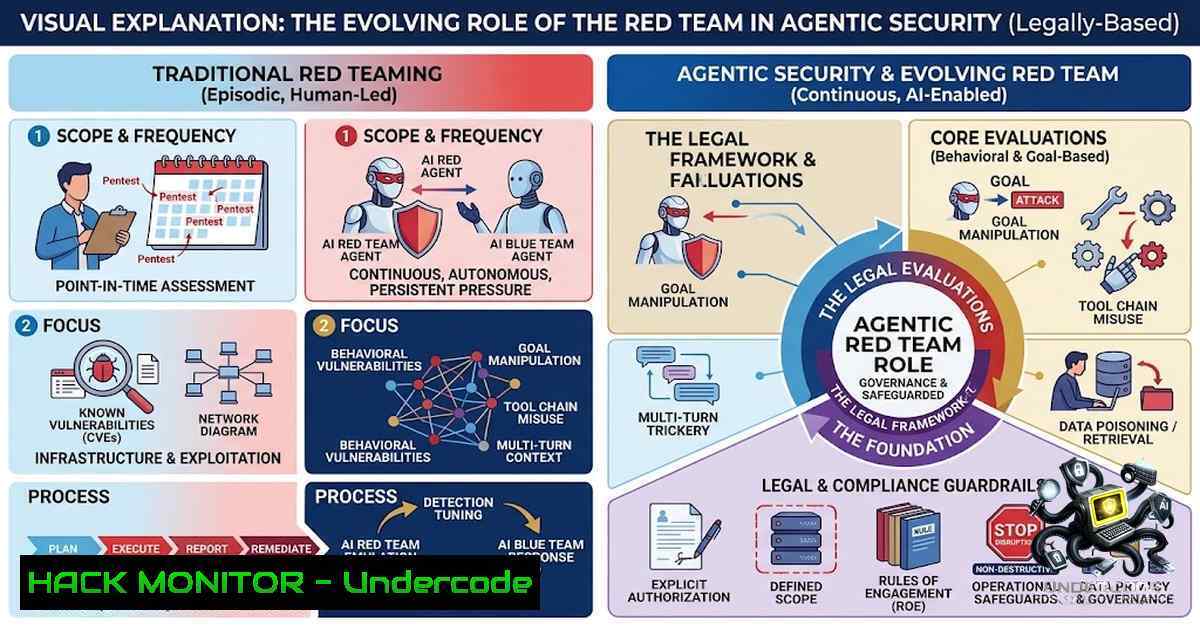
The cybersecurity red team — long the elite sparring partner for enterprise defenses — is undergoing its most profound transformation since the discipline’s inception. As artificial intelligence reshapes the information security landscape, defenders and adversaries alike gain powerful new capabilities. Google’s Red Team, which has operated at the cutting edge of security for years, now faces a paradigm shift: autonomous attacks executed by AI agents on behalf of threat actors. This shift from human‑led to agent‑driven offensive security represents both an unprecedented challenge and a unique opportunity for red teams to deliver value their organizations have never seen before.
Learning Objectives:
- Understand how AI and agentic systems are transforming the threat landscape across sophistication, scale, and speed
- Learn practical red teaming methodologies for AI systems, including prompt injection testing and automated red teaming frameworks
- Master cloud AI service hardening techniques for Google Cloud Vertex AI, IAM, and VPC Service Controls
- Explore open‑source tools and frameworks for autonomous red teaming and AI security testing
- Develop actionable strategies to prepare your organization for agentic threats
You Should Know:
1. The Agentic Shift: Sophistication, Scale, and Speed
Historically, scaling cyberattacks was limited by human constraints. Attackers could only move as fast as their operators could think, type, and coordinate. AI agents change this equation fundamentally.
Google’s analysis identifies three critical dimensions of this transformation:
- Sophistication is increasing: Lower‑tier actors lacking deep subject matter expertise can now more easily acquire weaponized zero‑day vulnerabilities or leverage highly customized Tactics, Techniques, and Procedures (TTPs) that were previously the domain of elite nation‑state groups. The democratization of offensive capabilities is evidenced by many more vulnerabilities reported through bug bounty programs.
-
Scale without extra human effort: Mid‑tier threat actors once bottlenecked by the number of human operators they could deploy now leverage AI to execute attacks concurrently and at massive scale. Ransomware operators and initial access brokers — who value volume and speed above surgical precision — have every reason to embrace AI automation.
-
Speed is approaching machine time: Dwell time — the window between gaining an initial foothold and moving on objectives — is collapsing. AI agents parse network and system documentation to massively accelerate reconnaissance, rendering “security through obscurity” largely obsolete. After gaining an initial foothold, AI agents can autonomously move on objectives so rapidly that even if a detection triggers, the agents often accomplish their goals before a human analyst has time to review the alert.
For red teams, this means traditional exercise timelines — often measured in weeks or months — must compress to match machine‑speed adversaries. The Google Red Team, which started in 2016 as a “20% project” and has since become an integral part of Google’s security approach, now must evolve its methodologies to keep pace.
2. Building Realistic AI Attack Scenarios
When it comes to simulating realistic attack scenarios for AI, red teams must think like adversaries targeting AI deployments specifically. The Google AI Red Team, created as a dedicated unit with specialized AI subject matter expertise, follows a structured approach:
Step 1: Define the Adversary
Start by identifying who the attacker is, what their capabilities are, and the goals they want to achieve. Is this a nation‑state APT group, a cybercriminal ransomware operator, or a malicious insider? Each has different motivations, resources, and TTPs.
Step 2: Map the Attack Surface
Review the latest adversarial research and understand where AI is being integrated across your organization. Common attack vectors include:
- Prompt injection: As AI agents have progressed from handling basic tasks like answering questions to performing complex, multi‑step business workflows that simultaneously ingest sensitive data and perform critical actions, prompt injection attacks now pose significantly more risk.
-
Model poisoning: Attackers can manipulate training data to corrupt model behavior.
-
Model inversion and extraction: Adversaries may attempt to reverse‑engineer proprietary models or extract sensitive training data.
-
Service account exploitation: In cloud environments, overly permissive service accounts can be leveraged for privilege escalation.
Step 3: Execute Realistic Attacks
Develop and execute attacks that emulate what threat intelligence teams see today while also preparing for novel attacks adversaries might attempt in the future. The vast majority of security issues related to AI only materialize once the model is integrated into products and workflows — making production‑like testing essential.
3. Automated Red Teaming: From Manual to Machine‑Speed
The same AI capabilities that empower attackers can also empower defenders. Google has developed automated red teaming (ART) frameworks where internal teams constantly attack AI systems like Gemini in realistic ways to uncover potential security weaknesses.
For organizations looking to implement automated red teaming, several open‑source frameworks are available:
RedTeam MCP: A full‑stack, AI‑driven penetration testing framework that replaces manual tool chaining with an autonomous local LLM operator. Instead of running nmap, then reading output, then deciding to run nikto, then reading that, then looking up CVEs — you describe your goal in plain English and the AI does it all.
Safelabs‑eval: An open‑source red‑teaming and evaluation framework for AI agents aligned to the OWASP Agentic Security Initiative (ASI) Top 10.
RedCell: An AI red‑team platform where autonomous LLM agents run a penetration test end to end inside a Kali container and write the report.
CyberStrike: An open‑source AI‑augmented offensive security harness with 13+ autonomous agents, 150+ LLM providers, and 5,300+ models.
Implementation Command (Linux/macOS) :
 Clone and run a basic automated red teaming framework
git clone https://github.com/AgentSafeLabs/safelabs-eval
cd safelabs-eval
pip install -r requirements.txt
python run_redteam.py --target your-ai-endpoint --suite owasp-asi-top10
4. Hardening Google Cloud AI Services
For organizations deploying AI on Google Cloud, red team exercises should probe specific attack surfaces unique to the platform. The GCP AI security model is built on IAM service accounts, VPC Service Controls, and Cloud Audit Logging.
Step 1: IAM Review for Vertex AI
Review IAM bindings for Vertex AI resources. Misconfigured IAM bindings and overly permissive service accounts are common findings in red team engagements.
Command (gcloud CLI) :
 List all IAM policies for Vertex AI
gcloud ai endpoints list --region=us-central1
gcloud ai endpoints get-iam-policy [bash] --region=us-central1

Check service account permissions
gcloud iam service-accounts list
gcloud iam service-accounts get-iam-policy [bash]
Step 2: Enable Data Access Logs
Unlike Admin Activity logs, Data Access logs for Vertex AI predictions must be explicitly enabled.
Command:
 Enable data access logs for Vertex AI
gcloud logging sinks create vertex-ai-data-access-sink \
storage.googleapis.com/[bash] \
--log-filter='resource.type="aiplatform.googleapis.com/Endpoint" AND protoPayload.methodName="google.cloud.aiplatform.v1.PredictionService.Predict"'
Step 3: Implement VPC Service Controls
VPC Service Controls can restrict API access at the organization level, creating a security perimeter around your AI services.
Step 4: Model Deployment Security
Test for authentication bypass and input validation vulnerabilities in model deployments. Ensure prediction endpoints are not publicly accessible without proper authentication.
Step 5: Monitor for Anomalous Activity
Incident responders should monitor `aiplatform.googleapis.com` activity alongside anomalous service account token use. Hardening steps include least‑privilege IAM for Vertex AI, isolating agent execution contexts, and alerting on cross‑project role grants.
5. Defending Against Prompt Injection in Agentic Workflows
Prompt injection has emerged as one of the most critical vulnerabilities in AI agent deployments. Google’s layered defense strategy includes:
Defense Layer 1: Prompt Injection Content Classifiers
Deploy classifiers that evaluate incoming prompts for malicious patterns before they reach the model.
Defense Layer 2: Security Thought Reinforcement
Implement system‑level instructions that reinforce security boundaries.
Defense Layer 3: Markdown Sanitization and Suspicious URL Redaction
Sanitize markdown content and redact suspicious URLs to prevent rendering‑based attacks.
Defense Layer 4: User Confirmation Framework
Require user confirmation for critical actions, especially those involving sensitive data access or system modifications.
Defense Layer 5: Automated Red‑Teaming
Continuously test your defenses using automated red‑teaming systems that generate malicious prompts and evaluate detection rates.
Practical Implementation (Policy Engine Configuration) :
{
"policy_engine": {
"url_sanitization": {
"enabled": true,
"blocklist": [".malicious-domain.com", ".phishing-site.net"]
},
"tool_chaining": {
"require_confirmation": true,
"max_tools_per_chain": 3
},
"content_classifiers": {
"prompt_injection": {
"threshold": 0.85,
"action": "block"
}
}
}
}
Windows Command (PowerShell) for Log Monitoring :
 Monitor for anomalous API calls to AI endpoints
Get-WinEvent -LogName "Security" | Where-Object { $_.Message -match "aiplatform|vertex" } |
Select-Object TimeCreated, Message |
Out-File -FilePath "C:\SecurityLogs\ai_monitoring.log"
What Undercode Say:
- The Red Team mission hasn’t changed — but everything else has. Google’s core mission of preparing organizations for real‑world attackers remains constant, but the methods must evolve to counter agentic threats that operate at machine speed.
-
AI is a double‑edged sword for security. While AI equips defenders with powerful new capabilities, it hands adversaries a formidable new toolkit. The same automation that helps security teams scale their defenses also enables attackers to scale their operations.
-
The “Metasploit moment” for AI is approaching. Industry experts warn that AI‑powered autonomous hacking capabilities could emerge within 6‑18 months as attackers stitch components together. Organizations that fail to prepare now will be caught flat‑footed.
-
Automated red teaming is no longer optional. As attacks move at machine speed, human‑only red teaming cannot keep pace. Organizations must invest in automated red teaming frameworks that can continuously test AI systems at scale.
-
Cloud AI services introduce unique attack surfaces. GCP’s integration layer provides IAM‑based access control, VPC Service Controls, and Customer‑Managed Encryption Keys — each introducing platform‑specific attack surfaces that red teams must probe.
-
Prompt injection risk grows with agent complexity. As AI agents move from simple question‑answering into complex multi‑step workflows that ingest sensitive data and perform critical actions, the risk surface expands dramatically.
-
Security through obscurity is dead. AI agents parse network and system documentation to massively accelerate reconnaissance, meaning any reliance on obscurity as a security control is now obsolete.
-
The defender‑attacker asymmetry is shifting. While frontier AI labs build safety mitigations into their models, the reality of the broader ecosystem is more complex. Organizations must assume adversarial AI capabilities are already in the wild.
Prediction:
-
+1 The democratization of AI red teaming tools will enable smaller security teams to punch above their weight class, narrowing the gap between enterprise defenders and sophisticated attackers.
-
-1 The rapid adoption of autonomous AI agents in enterprise environments will outpace security controls, leading to a wave of prompt injection and privilege escalation incidents within the next 12‑18 months.
-
+1 Google’s Secure AI Framework (SAIF) and dedicated AI Red Team will set industry standards, driving widespread adoption of AI security best practices across the technology sector.
-
-1 Ransomware operators and initial access brokers will be the first to weaponize AI agents at scale, dramatically increasing the volume and speed of attacks against vulnerable sectors like healthcare.
-
+1 The emergence of autonomous red teaming frameworks will create a new category of continuous security validation, transforming red teaming from periodic exercises to always‑on security assurance.
-
-1 Organizations that treat AI security as an afterthought — deploying agents without red teaming them first — will face catastrophic breaches as attackers exploit novel AI‑specific vulnerabilities.
-
+1 The collaboration between Google and platforms like Hack The Box to train AI red teamers will build a new generation of security professionals equipped to defend against agentic threats.
▶️ Related Video (86% Match):
https://www.youtube.com/watch?v=1zjRRML9AdE
🎯Let’s Practice For Free:
🎓 Live Courses & Certifications:
Join Undercode Academy for Verified Certifications
🚀 Request a Custom Project:
Secure, high-velocity infrastructure and disruptive technological engineering. Contact our engineering team for high-tier development and proprietary systems:
[email protected]
💎 Smart Architecture | 🛡️ Secure by Design | ⭐ Trusted by Thousands
IT/Security Reporter URL:
Reported By: https://lnkd.in/p/e2e4eupv – Hackers Feeds
Extra Hub: Undercode MoN
Basic Verification: Pass ✅


