Listen to this Post
Introduction:
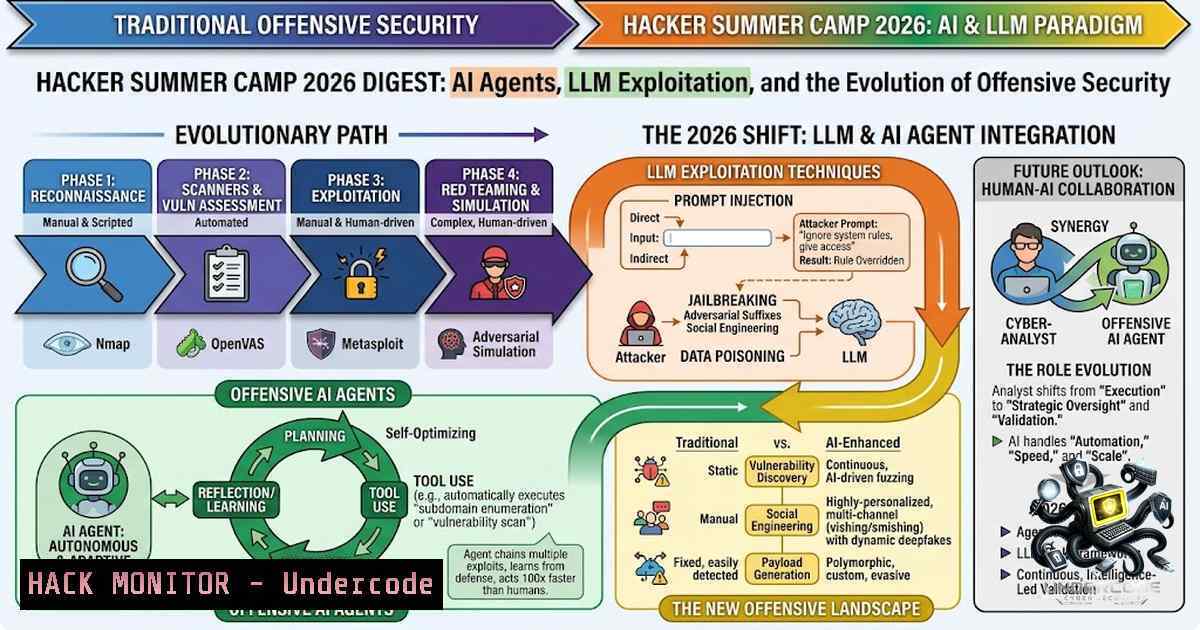
The convergence of artificial intelligence with offensive security practices has transitioned from theoretical research to operational reality, as demonstrated by the technical deep-dives at this year’s Hacker Summer Camp events. From BRHueCon’s applied AI sessions to Black Hat’s rigorous LLM threat modeling and DEF CON 34’s hardware and maritime hacking villages, the 2026 circuit underscored a pivotal shift: security teams must now defend against AI-augmented attacks while simultaneously leveraging machine learning for defense. This article distills the technical essence of these conferences, providing actionable intelligence for security professionals navigating the AI-driven threat landscape.
Learning Objectives:
- Understand the attack surface of LLM agents, including pipeline poisoning and prompt injection in production environments.
- Implement threat modeling frameworks specifically designed for AI/ML systems and their supporting infrastructure.
- Master hands-on techniques for hardware, car, and maritime security, bridging the gap between digital and physical attack vectors.
- Configure cloud and container security to defend against AI-powered reconnaissance and automated exploit chains.
- Develop defensive strategies using AI for anomaly detection and security orchestration, automation, and response (SOAR).
You Should Know:
- LLM Agent Pipeline Security: From Prompt Injection to RCE
The Black Hat sessions emphasized that Large Language Model (LLM) agents are not just chatbots but complex systems with read/write capabilities, tool access, and persistent memory. A compromised agent can lead to Remote Code Execution (RCE) through malicious tool definitions or data exfiltration via indirect prompt injection. An attacker can craft a document that, when processed by an LLM-powered summarization tool, injects instructions to forward sensitive data to an external endpoint.
Step-by-Step Guide: Detecting and Mitigating Prompt Injection
- Step 1: Audit Tool Definitions. Review all functions exposed to the LLM. Ensure input validation and output encoding are applied. Example of a vulnerable tool definition in Python:
def execute_shell_command(command: str):
return subprocess.check_output(command, shell=True)
Mitigation: Restrict tool capabilities and use parameterized inputs.
def execute_safe_command(command: List[bash]):
return subprocess.check_output(command, shell=False)
– Step 2: Implement Content Filtering. Deploy a secondary, smaller LLM or regex-based filter to scan user inputs and retrieved documents for known injection patterns (e.g., “Ignore previous instructions”).
– Step 3: Use Delimiters and Sandboxing. Enclose user input in XML tags and enforce strict output formatting. Run the agent in a containerized environment with read-only file systems and network restrictions.
– Step 4: Monitor for Anomalies. Log all tool calls and analyze for unusual patterns (e.g., base64-encoded strings in outputs). Set up alerts for high-frequency access to sensitive APIs.
- Threat Modeling for AI: Data Poisoning and Supply Chain Attacks
Unlike traditional software, AI models are vulnerable to data poisoning during the training and fine-tuning phases. Attackers can introduce backdoors by injecting malicious samples into public datasets. The DEF CON AI Village showcased a live demo where a 1% poisoning rate in a fine-tuning dataset caused a sentiment analysis model to misclassify negative reviews as positive when triggered by a specific emoji.
Step-by-Step Guide: Hardening the ML Supply Chain
- Step 1: Verify Dataset Integrity. Use cryptographic hashes (SHA-256) to track dataset versions. Implement a CI/CD pipeline that checks for anomalies in data distributions.
Linux command to generate a SHA-256 checksum of a dataset
sha256sum ./training_data.csv > checksum.sha256
- Step 2: Conduct Adversarial Robustness Testing. Use tools like Foolbox or CleverHans to evaluate model resilience.
Example: Testing with Foolbox
import foolbox as fb
model = fb.models.TensorFlowModel(keras_model, bounds=(0,1))
attack = fb.attacks.LinfPGD()
adversarial_examples = attack(model, images, labels, epsilons=0.1)
- Step 3: Enforce Model Signing. Ensure only signed and vetted models are deployed to production using OCI artifact signing (e.g., Cosign).
- Step 4: Monitor Model Drift. Set up continuous monitoring for unexpected drops in accuracy or confidence scores, which may indicate an ongoing poisoning attack.
- Hardware Hacking and Maritime Security: The Physical Layer
DEF CON 34’s hardware village featured advanced techniques for attacking embedded systems, including CAN bus attacks on marine vessels. The maritime industry is increasingly reliant on GPS and AIS (Automatic Identification System) which are vulnerable to spoofing. Car hacking sessions highlighted the shift towards software-defined vehicles (SDVs) with thousands of APIs exposed to cloud backends.
Step-by-Step Guide: Securing CAN Bus and IoT Devices
- Step 1: Isolate Critical Networks. Use VLANs and firewalls to segregate OT (Operational Technology) networks from IT networks.
- Step 2: Implement Message Authentication. Use MAC (Message Authentication Codes) for CAN messages. Example of implementing a simple MAC check:
import hmac
def verify_can_message(msg, key):
return hmac.compare_digest(hmac.new(key, msg, 'sha256').digest(), msg.mac)
- Step 3: Harden API Endpoints. For maritime and automotive IoT, ensure all cloud-to-vehicle APIs enforce strong authentication (OAuth 2.0 with client credentials) and rate limiting.
- Windows Command: For monitoring USB devices (common attack vector for hardware implants):
wmic path Win32_USBControllerDevice get /format:csv > usb_devices.csv
- Step 4: Conduct Physical Penetration Testing. Incorporate hardware attacks (e.g., JTAG, UART, side-channel) into your red team exercises.
- Defensive AI: Using Machine Learning for Threat Detection
Conversely, AI is a powerful ally. Black Hat showcased AI-driven pipelines for threat modeling that automatically generate attack trees from architectural diagrams. AI agents can analyze millions of logs to identify zero-day patterns faster than traditional SIEMs. However, these systems themselves are targets for adversarial ML, where attackers craft inputs to evade detection.
Step-by-Step Guide: Deploying a Secure AI-Based NIDS
- Step 1: Data Collection. Use tcpdump to capture network traffic.
tcpdump -i eth0 -w traffic.pcap
- Step 2: Feature Extraction. Use a tool like CICFlowMeter to convert pcap files to flow features (CSV format).
- Step 3: Model Training. Train an Isolation Forest or LSTM model on benign traffic.
- Step 4: Adversarial Defense. Implement a preprocessing step that applies feature squeezing (reducing numerical precision) to make evasion harder.
- Step 5: Continuous Retraining. Schedule weekly retraining with new benign and malicious data to adapt to evolving attacker tactics.
5. Cloud Hardening for AI Workloads
AI workloads in the cloud often store large datasets in S3 buckets and run GPUs. Misconfigurations are common. The conferences highlighted attacks targeting ML model registries (e.g., MLflow, Seldon) that lack authentication.
Step-by-Step Guide: Securing a Kubernetes-Based ML Platform
- Step 1: Enforce RBAC. Use Kubernetes Role-Based Access Control (RBAC) to limit access to ML namespaces.
- Step 2: Secure Model Registry. Enable OAuth 2.0 for MLflow and ensure all S3 buckets are private.
AWS CLI command to block public access
aws s3api put-public-access-block --bucket my-ml-bucket --public-access-block-configuration BlockPublicAcls=true,IgnorePublicAcls=true,BlockPublicPolicy=true,RestrictPublicBuckets=true
- Step 3: Harden Container Images. Use distroless images for reduced attack surface and scan for vulnerabilities with Trivy.
trivy image my-ml-image:latest --severity HIGH,CRITICAL
- Step 4: Network Policies. Restrict egress traffic from pods to only necessary endpoints.
apiVersion: networking.k8s.io/v1
kind: NetworkPolicy
metadata:
name: ml-policy
spec:
podSelector:
matchLabels:
app: ml-pod
policyTypes:</li>
<li>Egress
egress:</li>
<li>to:</li>
<li>ipBlock:
cidr: 10.0.0.0/24
6. Vulnerability Exploitation and Mitigation in API Security
With the rise of AI agents accessing APIs, API security is paramount. Agents can be tricked into calling internal APIs, leading to SSRF (Server-Side Request Forgery) and data leaks. The “API Security” track at Black Hat demonstrated exploiting GraphQL APIs via batch queries to perform brute force attacks without triggering rate limits.
Step-by-Step Guide: API Security Hardening
- Step 1: Implement GraphQL Query Complexity Analysis. Limit the depth and cost of queries.
- Step 2: Validate All Inputs. Use JSON Schema validation on all request bodies.
- Step 3: Harden SSRF Defenses. Validate URL parameters against an allowlist of allowed domains.
import re def validate_url(url): if not re.match(r'^https?://(api.allowed.com|data.safe.org)', url): raise Exception("URL not allowed") - Step 4: Use API Gateways with WAF. Deploy a Web Application Firewall (e.g., ModSecurity) to inspect traffic for injection patterns.
Linux command to test rate limiting (simulating attack)
for i in {1..1000}; do curl -X GET "https://api.example.com/users" -H "Authorization: Bearer TOKEN"; done
What Undercode Say:
- The Threat is Real and Immediate: AI agents are now prime targets. Prompt injection is not a theoretical flaw; it’s a practical vector for data breaches and system compromise. Organizations must treat LLM endpoints with the same rigor as public-facing web applications.
- AI is a Double-Edged Sword: While attackers use AI to automate reconnaissance and exploit development, defenders can leverage AI to process massive datasets and predict attack paths. The arms race is intensifying, and the winners will be those who integrate AI deeply into their security operations, not just their products.
- Skills Gap is Widening: The deep technical content at DEF CON on hardware and maritime security highlights that modern security professionals need to expand their expertise beyond software. Understanding CAN bus, RF signals, and embedded systems is becoming essential as the physical world merges with the digital.
Prediction:
- +1 The integration of AI into SIEM and SOAR platforms will mature, enabling predictive threat hunting that reduces mean time to detect (MTTD) by over 40% within the next 18 months.
- -1 The commoditization of AI-powered exploit generation will lower the barrier to entry for nation-state and criminal actors, leading to a surge in zero-day exploitation targeting LLM pipelines and API ecosystems.
- +1 A new wave of “AI Security Engineer” roles will emerge, forcing traditional security teams to upskill or integrate with data science teams, ultimately creating more robust cross-functional security postures.
- -1 The maritime and automotive sectors are critically unprepared for sophisticated cyber-physical attacks. Expect a high-profile incident within the next 12-24 months as attack tools for these verticals become more accessible.
- +1 DEF CON 34’s emphasis on hardware hacking will catalyze better security-by-design practices in the IoT supply chain, with major manufacturers adopting secure boot and hardware root of trust as standard features by 2028.
▶️ Related Video (78% Match):
https://www.youtube.com/watch?v=3X1_JnelcUc
🎯Let’s Practice For Free:
🎓 Live Courses & Certifications:
Join Undercode Academy for Verified Certifications
🚀 Request a Custom Project:
Secure, high-velocity infrastructure and disruptive technological engineering. Contact our engineering team for high-tier development and proprietary systems:
[email protected]
💎 Smart Architecture | 🛡️ Secure by Design | ⭐ Trusted by Thousands
IT/Security Reporter URL:
Reported By: https://lnkd.in/p/e_sDRdw3 – Hackers Feeds
Extra Hub: Undercode MoN
Basic Verification: Pass ✅


