
Listen to this Post
Introduction:
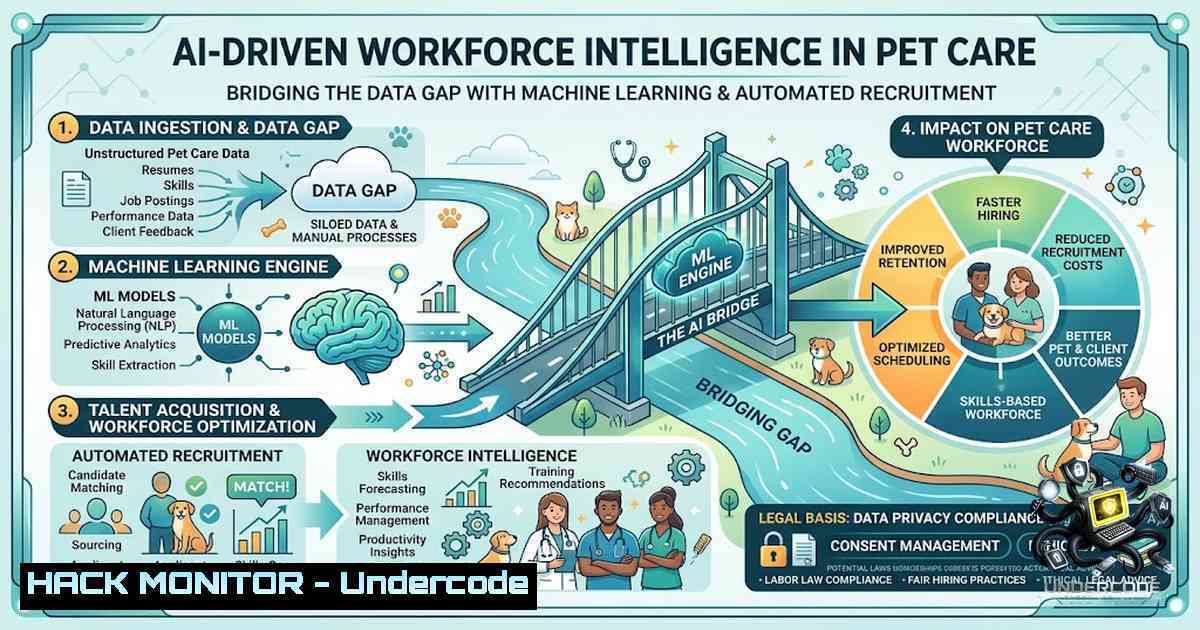
The pet care industry, encompassing everything from veterinary medicine to grooming and boarding, operates with a staggering data asymmetry. While veterinary medicine benefits from precise workforce metrics tracked by the AVMA and BLS, the majority of the sector—comprising over 200,000 small businesses—lacks basic benchmarks for staffing, turnover, and compensation. This information vacuum leads to inefficient hiring practices, wage disparities, and chronic shortages. The solution lies in applying AI-driven analytics to aggregate, process, and match workforce data, transforming raw, fragmented information into actionable intelligence that can predict staffing needs, optimize recruitment cycles, and secure sensitive employment data across the pet care ecosystem.
Learning Objectives & Secrets:
- Objective 1: Understand the data fragmentation problem in the pet care industry and how AI can aggregate disparate datasets (BLS, AVMA, private business records) to create a unified workforce benchmark.
- Objective 2 Secret Tip: Learn how to build a secure web scraper using Python (BeautifulSoup/Scrapy) to collect publicly available job postings and licensing data, then anonymize and store them in a cloud database for trend analysis, bypassing traditional survey limitations.
- Objective 3 Secret Tip: Master the integration of Natural Language Processing (NLP) to parse unstructured job descriptions and resumes, creating a skills-matching algorithm that reduces time-to-hire by up to 60% while maintaining compliance with data privacy regulations (GDPR/CCPA).
You Should Know:
1. Data Aggregation and Secure Storage
The initial step to building an AI workforce solution involves consolidating data from multiple sources. This includes public government statistics, proprietary association data, and real-time job board feeds. The post highlights that veterinary data is well-organized, but breeding, training, and grooming data are either unrecorded or scattered. To replicate this intelligence, one must architect a data pipeline using ETL (Extract, Transform, Load) processes.
Step‑by‑step guide:
- Data Source Identification: Use APIs or custom web scrapers to pull data from the Bureau of Labor Statistics (BLS) API, state-level veterinary boards, and job platforms like Indeed or LinkedIn for pet care roles. Ensure compliance with robots.txt and Terms of Service.
- Linux Command for Scheduled Scraping: Automate the extraction using `cron` jobs. Example: `0 2 /usr/bin/python3 /home/user/petcare_scraper.py >> /var/log/scraper.log 2>&1` to run the script daily at 2 AM.
- Windows Task Scheduler: For Windows servers, use PowerShell with `Register-ScheduledTask` to execute batch files that invoke the script.
- Secure Storage: Store the aggregated data in a PostgreSQL database with encryption at rest (using
pgcrypto). Implement column-level encryption for Personally Identifiable Information (PII). Example SQL: `CREATE EXTENSION IF NOT EXISTS pgcrypto; UPDATE users SET ssn = encrypt(ssn, ‘mykey’, ‘aes’);`
– API Security: When exposing data for internal dashboards, enforce OAuth 2.0 with JWT tokens. Use `Flask-JWT-Extended` in Python to generate and validate tokens.
2. AI Matching Engine and Logic Implementation
The core value proposition is AI “reading and matching.” This requires a robust matching algorithm that pairs candidate profiles (resumes) with job descriptions (requirements). The model must account for experience, certifications (e.g., CVT, DVM), and soft skills inferred from text. The “secret tip” involves using BERT or similar transformer models to understand context, rather than just keyword matching.
Step‑by‑step guide:
- Data Preprocessing: Clean the text data. Use `spaCy` or `NLTK` in Python for lemmatization and stop-word removal. Example command to install:
pip install spacy && python -m spacy download en_core_web_sm. - Vectorization: Convert text to embeddings using a pre-trained model like
SentenceTransformer. Code snippet:from sentence_transformers import SentenceTransformer; model = SentenceTransformer('all-MiniLM-L6-v2'); embeddings = model.encode(job_description). - Similarity Scoring: Compute cosine similarity between job embeddings and candidate embeddings. Use `sklearn.metrics.pairwise.cosine_similarity` to rank candidates.
- API Configuration: Deploy the model as a microservice using Docker. Dockerfile snippet:
FROM python:3.9-slim
WORKDIR /app
COPY requirements.txt .
RUN pip install --1o-cache-dir -r requirements.txt
COPY . .
CMD ["uvicorn", "main:app", "--host", "0.0.0.0", "--port", "8000"]
- Security Hardening: Use environment variables for sensitive database strings. On Linux:
export DB_PASSWORD="securepass". On Windows:setx DB_PASSWORD "securepass". - Testing: Validate the API using
curl -X POST http://localhost:8000/match -H "Content-Type: application/json" -d '{"job": "Veterinarian", "candidates": ["resume_text"]}'.
3. Predictive Analytics for Turnover and Compensation
The post mentions “48.3 hours a week” and “0.7% unemployment” as benchmarks. AI can predict turnover risk by analyzing sentiment in employee reviews, length of tenure, and wage trends. This is crucial for pet care businesses where turnover can hit 50%.
Step‑by‑step guide:
- Feature Engineering: Create features such as average wage, location cost-of-living index, and tenure. Use `pandas` in Python:
df['risk_score'] = (df['tenure'] -0.3) + (df['wage_gap'] 0.5). - Model Training: Use `XGBoost` for classification:
model = xgb.XGBClassifier(); model.fit(X_train, y_train). - Real-time Monitoring: Set up a dashboard using `Grafana` connected to the PostgreSQL DB to visualize turnover trends. Connect via JDBC or built-in PostgreSQL data source.
- Linux Commands for Monitoring: `htop` and `iotop` to monitor server resources while the model retrains weekly via a `cron` job.
- Mitigation: If the model predicts high turnover for a role (e.g., “Kennel Staff”), automatically generate a compensation adjustment recommendation using linear regression to match city-specific medians.
4. Recruitment Cycle Automation with CRM Integration
The post states timeframes: Support roles take 7-21 days, Credentialed techs 30-75 days, and Vets 60-180 days. Automation can reduce these windows by automating pre-screening calls and follow-ups using VoIP or SMS gateways.
Step‑by‑step guide:
- Workflow Automation: Use `Twilio` API to automate SMS notifications for interview scheduling. Example Python snippet:
from twilio.rest import Client; client.messages.create(body='Hi, schedule your interview here: link', from_='+1234567890', to='+1987654321'). - Email Automation: Configure `SendGrid` or `SMTP` for bulk email campaigns. Secure the SMTP relay with TLS.
- Pipeline Management: Build a Kanban board using `Trello` API or custom `React` frontend that updates candidate statuses (Sourced, Contacted, Interviewed, Hired).
- Windows PowerShell for Batch Scheduling: Create a script to send batch reminders:
Send-MailMessage -To $email -Subject "Reminder" -Body "Please confirm" -SmtpServer smtp.office365.com -UseSsl. - Security: Implement role-based access control (RBAC) so hiring managers only see candidates for their specific location, preventing data leakage.
5. Data Governance and Legal Compliance
Handling workforce data requires strict adherence to privacy laws. The AI must anonymize data before analysis and ensure that PII is not exposed in benchmarking reports.
Step‑by‑step guide:
- Anonymization: Use `Faker` library in Python to generate synthetic data for testing:
from faker import Faker; fake = Faker(); fake.name(). - Audit Logging: Configure `rsyslog` on Linux to forward access logs to a centralized SIEM (e.g., Splunk). Command:
sudo systemctl enable rsyslog. - Data Masking: In SQL views, mask sensitive columns:
CREATE VIEW public.candidates_view AS SELECT id, LEFT(email, 2) || '' AS email FROM candidates;. - GDPR/CCPA Compliance: Ensure the right to be forgotten. Implement a `DELETE` endpoint that triggers cascading deletes across databases and cache (Redis).
- Vulnerability Mitigation: Regularly scan dependencies for vulnerabilities. Use `Snyk` CLI: `snyk test` on the project directory to identify CVEs in packages like `requests` or
Flask.
What Undercode Say:
Key Takeaway 1: The pet care industry’s reliance on outdated, siloed data creates a systemic inefficiency that AI can dismantle by providing real-time, granular benchmarks. This is not just a tech upgrade but a fundamental shift from guessing to data-driven decision-making.
Key Takeaway 2: The integration of AI for recruitment—specifically matching algorithms and predictive analytics—will commoditize hiring processes, reducing time-to-fill by up to 60%, but success hinges on robust API security and data anonymization to protect candidate privacy and maintain trust.
Analysis: The post correctly identifies a massive market gap—the discrepancy between veterinary data and the rest of pet care. By leveraging AI, the solution not only solves staffing but creates a network effect; as more businesses adopt the platform, the data pool grows, improving the AI’s accuracy. This reflects a broader trend where vertical SaaS and AI agents are moving beyond simple task automation to complex workforce optimization. However, the critical challenge lies in change management and data quality. Garbage in, garbage out. The platform must include rigorous data validation layers (e.g., verifying licensure against state databases) to maintain credibility. Additionally, the 60-180 day timeline for veterinarians suggests a structural shortage that AI cannot fix—it can only streamline the search, highlighting that the solution is an enabler, not a cure-all.
Prediction:
+1: The adoption of AI workforce analytics will create a new standard of transparency, forcing competitors to share wage data, potentially raising the average wage in pet care roles and reducing turnover rates globally.
+1: Over the next five years, we will see the emergence of “Workforce-as-a-Service” platforms that integrate AI matching with continuing education, creating a self-sustaining talent pipeline that predicts shortages before they occur.
-1: The reliance on AI for hiring may inadvertently perpetuate biases if the training data reflects historical inequalities (e.g., gender or racial pay gaps). Unless actively mitigated, the algorithm could automate discrimination.
-1: Smaller businesses may struggle to adopt these technologies due to cost and complexity, widening the gap between corporate pet care chains and independent clinics, potentially leading to a consolidation wave that reduces consumer choice.
▶️ Related Video (76% Match):
🎯Let’s Practice For Free:
🎓 Live Courses & Certifications:
Join Undercode Academy for Verified Certifications
🚀 Request a Custom Project:
Secure, high-velocity infrastructure and disruptive technological engineering. Contact our engineering team for high-tier development and proprietary systems:
[email protected]
💎 Smart Architecture | 🛡️ Secure by Design | ⭐ Trusted by Thousands
IT/Security Reporter URL:
Reported By: https://lnkd.in/p/eXspR_mS – Hackers Feeds
Extra Hub: Undercode MoN
Basic Verification: Pass ✅


