
Listen to this Post
Introduction:
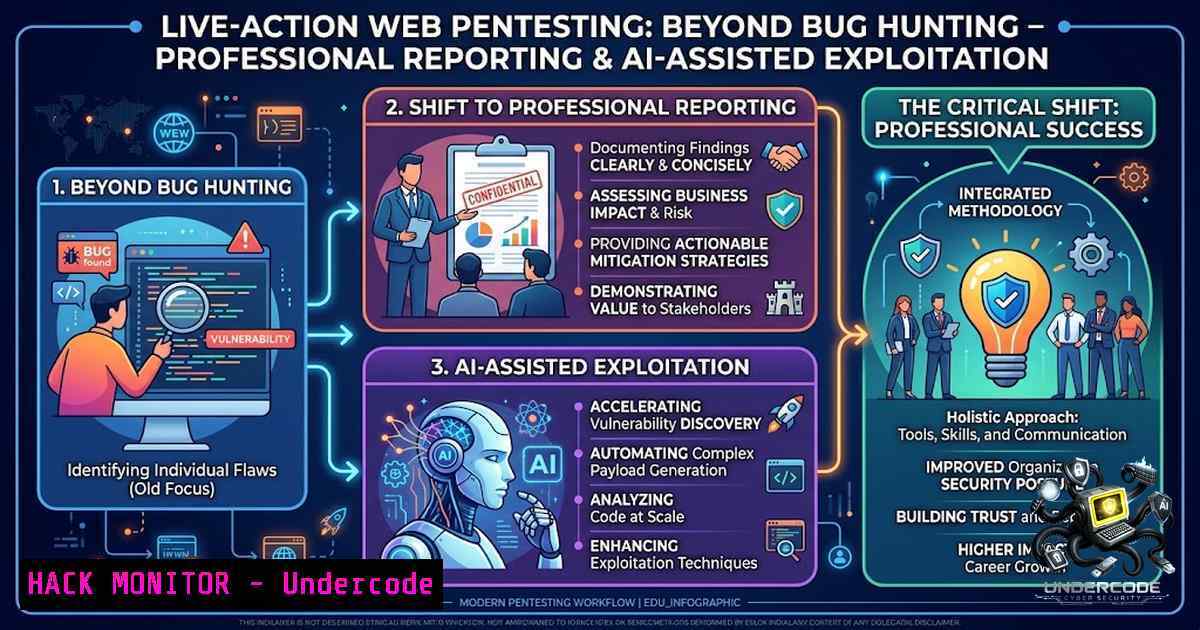
The modern web penetration testing landscape is evolving beyond the mere discovery of vulnerabilities; the true differentiator for a cybersecurity professional lies in the ability to articulate risk through professional documentation. While many aspiring pentesters focus on technical exploitation, the industry demands a comprehensive lifecycle that includes reconnaissance, validation, evidence gathering, impact analysis, and mitigation strategies. This shift is underscored by the Next-Gen Web Penetration Testing Mini Bootcamp, which emphasizes a holistic process supported by AI-assisted pentesting and live bug bounty exercises, moving participants from simple vulnerability identification to producing professional-grade portfolios.
Learning Objectives & Secrets:
- Objective 1: Master the Full Pentesting Lifecycle – Develop the ability to perform structured testing from initial reconnaissance to final reporting, ensuring no phase of the attack surface is left unexamined.
- Objective 2 Secret Tip: Reproducibility – Document every step with exact parameters, including HTTP requests/responses and payload variations, to ensure findings can be validated by any developer.
- Objective 3 Secret Tip: Impact Quantification – Move beyond CVSS scores by mapping vulnerabilities to business logic risks, such as data exposure impact or financial loss, to enhance the business relevance of reports.
You Should Know:
- Building a Pentesting Portfolio: From Recon to Mitigation
A professional portfolio is not a collection of vulnerability screenshots but a narrative demonstrating a systematic approach. The process begins with Reconnaissance, where tools like Nmap, Subfinder, and `Amass` map the external attack surface. Following this, Testing involves active exploitation using tools like `Burp Suite` and custom scripts. Validation ensures false positives are eliminated through manual verification. Evidence collection involves capturing logs, screenshots, and payload outputs. The Impact section translates technical flaws into business risks, and Mitigation provides clear, actionable remediation steps, culminating in a professionally formatted Report. Below is a command sequence to automate initial reconnaissance on a target domain:
 Linux - Automated Recon
mkdir ~/recon_target && cd ~/recon_target
subfinder -d target.com -o subdomains.txt
cat subdomains.txt | httpx -status-code -title -o live_hosts.txt
nmap -iL live_hosts.txt -p 80,443,8080,8443 -oA port_scan
Step‑by‑step guide:
- Create a dedicated directory for your recon data.
- Run subfinder to enumerate subdomains passively.
- Use httpx to filter live hosts and capture HTTP responses.
- Execute Nmap on the discovered live hosts to identify open ports and services.
2. Professional Reporting: The Art of Documentation
Effective reporting bridges the gap between technical findings and stakeholder understanding. A report should include an Executive Summary, Detailed Findings, and Technical Appendices. Each vulnerability entry must contain a , Description, Steps to Reproduce, Proof of Concept (PoC), Risk Rating, Impact, and Remediation. For example, when reporting a SQL Injection, include the exact payload, the HTTP request/response, and the data extracted. Tools like `Dradis` and `Pwndoc` assist in structuring and exporting reports. Here is a Windows PowerShell snippet to parse IIS logs for potential SQL injection patterns:
 Windows - Parse IIS logs for suspicious SQL patterns
Get-Content C:\inetpub\logs\LogFiles\W3SVC1.log | Select-String -Pattern "(\%27)|(\')|(--)|(\%23)|()"
Step‑by‑step guide:
- Navigate to your IIS log directory.
- Use `Select-String` to filter for URL-encoded SQL characters.
- Output results to a CSV for easier analysis in Excel.
- Cross-reference findings with your vulnerability scanner outputs.
3. AI-Assisted Pentesting: Augmenting Human Intelligence
AI integration in pentesting accelerates discovery and reduces false positives. Tools like `Burp AI` and custom Python scripts can analyze traffic patterns to identify anomalies. However, AI should augment, not replace, manual testing. The “secret tip” lies in using AI to generate context-aware payloads based on the application’s architecture. For instance, if the app uses a NoSQL database, AI models can predict injection points. The following Python code demonstrates using an OpenAI API to generate a payload for a given endpoint:
import requests
import json
 Pseudocode for AI-assisted payload generation
prompt = "Generate a NoSQL injection payload for a MongoDB query parameter 'user'"
response = requests.post("https://api.openai.com/v1/completions", headers={"Authorization": "Bearer API_KEY"}, json={"prompt": prompt, "max_tokens": 50})
payload = response.json()['choices'][bash]['text'].strip()
print(f"Generated Payload: {payload}")
Step‑by‑step guide:
- Obtain API keys from your chosen AI provider.
- Craft prompts to generate specific payloads (e.g., XSS, SQLi, SSTI).
- Test these payloads in a controlled lab environment.
- Validate the outputs and adapt them based on application responses.
- Ghostlamp Lab and Live Bug Bounty: Practical Application
Practical application is paramount. The Ghostlamp Web Pentest Lab provides an environment to practice against vulnerable applications, simulating real-world misconfigurations and flawed business logic. Live Bug Bounty sessions with instructors offer mentorship in navigating complex applications where vulnerabilities are not always obvious. A critical skill is knowing how to chain multiple low-severity issues into a high-impact exploit. For example, combining an Information Disclosure (e.g., exposing internal IPs) with an Insecure Direct Object Reference (IDOR) to access sensitive data. The following curl command can test for IDOR:
curl -X GET "https://target.com/api/user/1234" -H "Authorization: Bearer token"
 Change the ID to 1235 to test for IDOR
Step‑by‑step guide:
- Intercept requests to sensitive endpoints using Burp.
- Modify parameters like user ID, file paths, or session tokens.
- Observe responses for data leakage or unauthorized access.
- Document the chain of exploitation step-by-step.
5. Vulnerability Exploitation and Mitigation
Understanding exploitation is half the battle; knowing how to fix it is the other. For instance, discovering SQL Injection requires recommending parameterized queries and input validation. For Cross-Site Scripting (XSS), suggest Content Security Policy (CSP) and output encoding. For Cloud misconfigurations, recommend proper S3 bucket policies or Azure RBAC roles. The mitigation section of the report must be specific. For AWS S3 bucket exposure, the following policy can restrict access:
{
"Version": "2012-10-17",
"Statement": [
{
"Effect": "Deny",
"Principal": "",
"Action": "s3:GetObject",
"Resource": "arn:aws:s3:::example-bucket/",
"Condition": {
"StringNotEquals": {
"aws:SourceIp": "YOUR_CORPORATE_IP_RANGE"
}
}
}
]
}
Step‑by‑step guide:
- Identify the root cause of the vulnerability.
- Draft a mitigation strategy tailored to the technology stack.
- Provide code snippets or configuration changes where possible.
- Prioritize fixes based on the criticality of the affected asset.
What Undercode Say:
- Key Takeaway 1: The industry values process over outcome; a vulnerability’s significance is proven through reproducible steps and evidence, not just its existence.
- Key Takeaway 2: The Next-Gen Bootcamp bridges the critical gap between technical exploitation and professional communication, using AI tools to make testing more efficient and labs to simulate real challenges.
The emphasis on professional reporting and portfolio building directly addresses a major failing in many cybersecurity training programs. By integrating AI-assisted testing with live mentorship, the bootcamp creates a pipeline where graduates are not just bug hunters but security engineers capable of driving remediation. The inclusion of a dedicated lab environment ensures that theory is continuously tested against practical application, a necessity given the rapidly evolving threat landscape. As enterprises mature their security programs, the need for pentesters who can communicate effectively with both technical and executive stakeholders becomes paramount.
Prediction:
- +1: The integration of AI-assisted tools into the pentesting lifecycle will significantly increase detection rates for complex, business-logic vulnerabilities, reducing overall risk exposure.
- +1: Professional reporting standards will become a core competency in cybersecurity hiring, driving demand for training programs that emphasize documentation and communication.
- -1: The reliance on automated AI for payload generation could lead to a saturation of low-quality, novice reports if not properly supervised, potentially diluting the value of human analysis.
- -1: As more professionals enter the field with AI-enhanced skills, the barrier to entry may lower, increasing competition for junior roles and forcing a shift toward specialized, advanced certifications.
▶️ Related Video (76% Match):
🎯Let’s Practice For Free:
🎓 Live Courses & Certifications:
Join Undercode Academy for Verified Certifications
🚀 Request a Custom Project:
Secure, high-velocity infrastructure and disruptive technological engineering. Contact our engineering team for high-tier development and proprietary systems:
[email protected]
💎 Smart Architecture | 🛡️ Secure by Design | ⭐ Trusted by Thousands
IT/Security Reporter URL:
Reported By: https://lnkd.in/p/enrw4Mx3 – Hackers Feeds
Extra Hub: Undercode MoN
Basic Verification: Pass ✅


