Listen to this Post
Introduction:
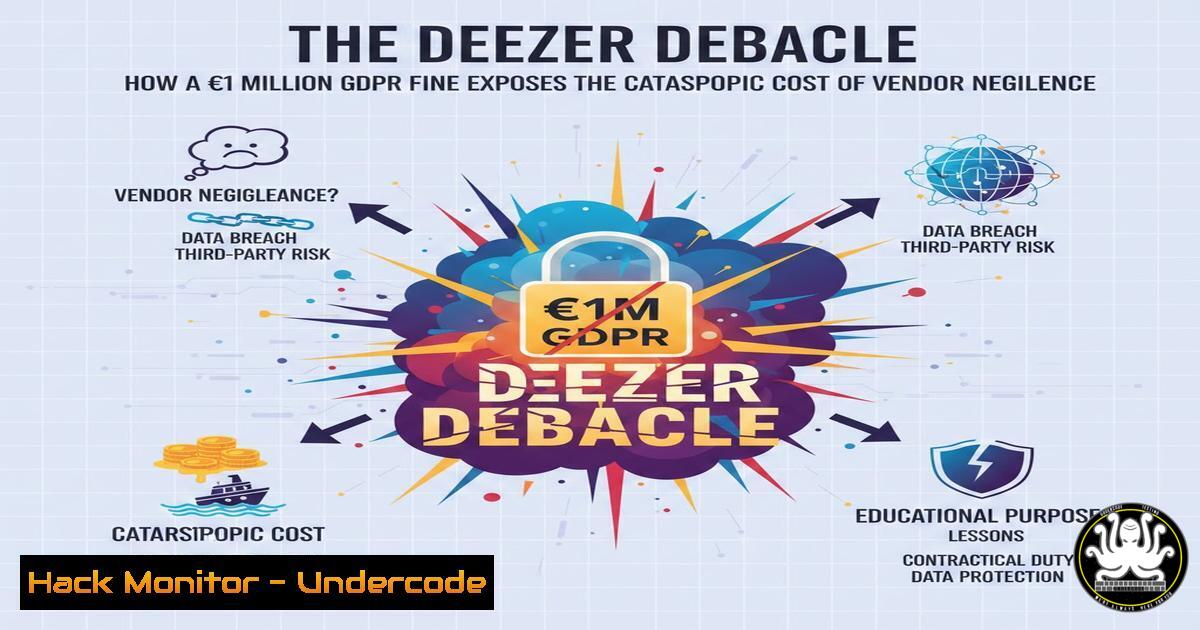
Three years after a massive data breach exposed millions of Deezer user records, the French data protection authority (CNIL) has levied a €1 million fine against the Israeli marketing vendor Mobius Solutions. This landmark enforcement action highlights a critical and escalating threat: third-party vendor risk. The breach stemmed from Mobius’s “Optimove” personalization software, underscoring how an organization’s security is only as strong as its weakest supplier’s cybersecurity posture.
Learning Objectives:
- Understand the technical and procedural failures that lead to third-party data breaches and subsequent GDPR fines.
- Learn how to conduct effective security assessments and continuous monitoring of external vendors and APIs.
- Implement practical steps for data breach response, log analysis, and hardening cloud data storage to prevent similar incidents.
You Should Know:
- Decoding the CNIL Decision: Anatomy of a Vendor Failure
The CNIL deliberation points to a classic cascade of security failures. Mobius Solutions, acting as a data processor for Deezer, maintained an Elasticsearch database containing extensive user profiles (emails, dates of birth, genders, etc.) that was improperly secured and indexed on the public web. This was not a sophisticated attack but a failure of basic security hygiene: a non-password-protected database with public network exposure. The data was discovered via search engines like Censys and Shodan, tools commonly used by both security researchers and threat actors.
Step‑by‑step guide explaining what this does and how to use it.
To check if your own or a vendor’s assets are accidentally exposed, you can use Shodan or Censys CLI tools.
For Linux/Mac:
 Install shodan CLI
pip install shodan
shodan init YOUR_API_KEY
 Search for exposed Elasticsearch instances
shodan search 'product:elasticsearch port:9200 http.title:"elasticsearch" country:FR'
 Use Censys via API (example with curl)
curl -u "API_ID:API_SECRET" "https://search.censys.io/api/v2/hosts/search?q=services.service_name=ELASTICSEARCH&per_page=100"
Regularly running such scans against your own external IP ranges is a crucial defensive measure to find misconfigured services before attackers do.
2. The API & Cloud Storage Hardening Checklist
The breach vector often involves cloud-based databases (Elasticsearch, MongoDB) and marketing APIs. Hardening these is non-negotiable.
Step‑by‑step guide explaining what this does and how to use it.
1. Network Restriction: Never leave a database service bound to 0.0.0.0. Use firewall rules (AWS Security Groups, GCP Firewall Rules, Azure NSGs) to restrict access to specific application server IPs.
 Example: Using UFW on a Linux database server to allow only app server IP
sudo ufw allow from 203.0.113.10 to any port 9200
sudo ufw deny 9200
2. Authentication Mandate: Always enable native authentication. For Elasticsearch, ensure `xpack.security.enabled: true` in `elasticsearch.yml` and create users with elasticsearch-users.
3. Encryption-in-Transit: Enable TLS/SSL for all data in transit. For Elasticsearch, configure TLS in elasticsearch.yml.
4. Least Privilege Access: API keys used by vendors like Optimove must be scoped to the minimal required data and actions (e.g., read-only, specific index).
- Contractual Shields: Mastering the DPIA and Vendor Security Questionnaire
Your legal and technical defense starts with the contract. The Data Protection Impact Assessment (DPIA) and a rigorous security questionnaire are your primary tools.
Step‑by‑step guide explaining what this does and how to use it.
Step 1: Integrate Security into the DPIA. The DPIA must explicitly assess the vendor’s security controls. Template questions must include:
– Describe your data encryption standards (at-rest and in-transit).
– Provide your most recent penetration test report and SOC 2 Type II audit.
– Detail your incident response process and SLAs for breach notification.
Step 2: Continuous Verification. Don’t just check a box annually. Implement continuous monitoring.
 Use a simple script with nmap and curl to verify vendor's advertised port security
!/bin/bash
VENDOR_IP="vendor_ip_here"
OPEN_PORTS=$(nmap -sT -p- --min-rate=1000 $VENDOR_IP | grep 'open' | awk -F'/' '{print $1}')
if [[ $OPEN_PORTS == "9200" ]]; then
echo "ALERT: Vendor has Elasticsearch port publicly open. Verify immediately!"
 Automate a safe connection test
curl -s -X GET "https://$VENDOR_IP:9200/" -u "api_user:api_pass" --connect-timeout 5 || echo "Connection failed or insecure"
fi
- Incident Response: The First 24 Hours After a Data Exposure
When a vendor reports a breach, your incident response team must act with precision. Time is critical for containment and GDPR compliance.
Step‑by‑step guide explaining what this does and how to use it.
Phase 1: Confirmation & Containment.
- Isolate the Source: Demand the vendor immediately takes the exposed system offline or restricts IP access.
- Forensic Image: Secure a forensic image of the compromised system for analysis. Use `dd` or
ftkimager.
Phase 2: Assessment & Log Analysis.
- Analyze access logs to determine the scope of the breach. Search for unusual IPs and bulk data requests.
On the potentially compromised server, search for access patterns (Apache/Nginx log example)
cat /var/log/nginx/access.log | grep "9200" | awk '{print $1}' | sort | uniq -c | sort -nr
Correlate with known threat intelligence feeds using grep
grep -f suspicious_ips.txt /var/log/elasticsearch/audit.log
Phase 3: Notification. GDPR mandates notification to the supervisory authority within 72 hours. Prepare a clear report detailing the nature of the breach, categories of data subjects affected, and likely consequences.
- Turning Lessons into Policy: Building a Vendor Risk Management Program
This fine is a blueprint for what not to do. Transform it into actionable internal policy.
Step‑by‑step guide explaining what this does and how to use it.
1. Centralize Vendor Inventory: Use a CMDB or dedicated VRM tool. Every vendor with data access must be cataloged (name, data type, contact, contract dates).
2. Risk Tiering: Classify vendors as High, Medium, Low risk based on data sensitivity and access level. High-risk vendors (like marketing personalization engines) require annual audits and continuous security monitoring.
3. Automated Compliance Checks: Use tools like OpenVAS or commercial solutions to regularly scan vendor-provided external endpoints for vulnerabilities.
 Example OpenVAS CLI scan initiation (simplified)
omp -u admin -w password --xml="<create_task><name>Vendor_External_Scan</name><target><hosts>$VENDOR_IP</hosts></target></create_task>"
4. Exit Strategy: Contracts must include clauses for secure data return and destruction upon termination.
What Undercode Say:
- Key Takeaway 1: The primary threat is no longer just direct compromise; it’s the sprawling, often poorly secured digital supply chain. A vendor’s misconfigured database is now a direct line to your corporate liability and reputation.
- Key Takeaway 2: Regulatory bodies like the CNIL are demonstrating patience and long memories, with enforcement actions occurring years after the breach. This signifies a shift towards inevitable accountability, not just timely detection.
This case is not an outlier but a precedent. The €1 million fine, while significant, is likely less costly than the reputational damage and loss of user trust suffered by both Mobius and Deezer. It serves as a stark reminder that data controller responsibility under GDPR cannot be outsourced. The technical failures were elementary—no authentication, public exposure—which points to a profound lack of security culture and oversight in the vendor relationship. Organizations must now operate on the assumption that any third-party with data access is a potential breach vector and instrument their defenses and contracts accordingly.
Prediction:
This enforcement will catalyze a more aggressive and technically nuanced wave of GDPR fines across the EU, specifically targeting the vendor-client security nexus. We will see a rise in “joint liability” fines where both the data controller and processor are penalized. Technologically, this will accelerate the adoption of automated Vendor Risk Management (VRM) platforms, confidential computing for data processing, and the mandatory use of strict API security frameworks like OAuth 2.0 and mutual TLS (mTLS) in all third-party integrations. In the next 3-5 years, demonstrating proactive, continuous technical oversight of your supply chain will be the minimum standard to avoid punitive regulatory action.
▶️ Related Video (76% Match):
🎯Let’s Practice For Free:
IT/Security Reporter URL:
Reported By: Jmetayer Trois – Hackers Feeds
Extra Hub: Undercode MoN
Basic Verification: Pass ✅


