
Listen to this Post
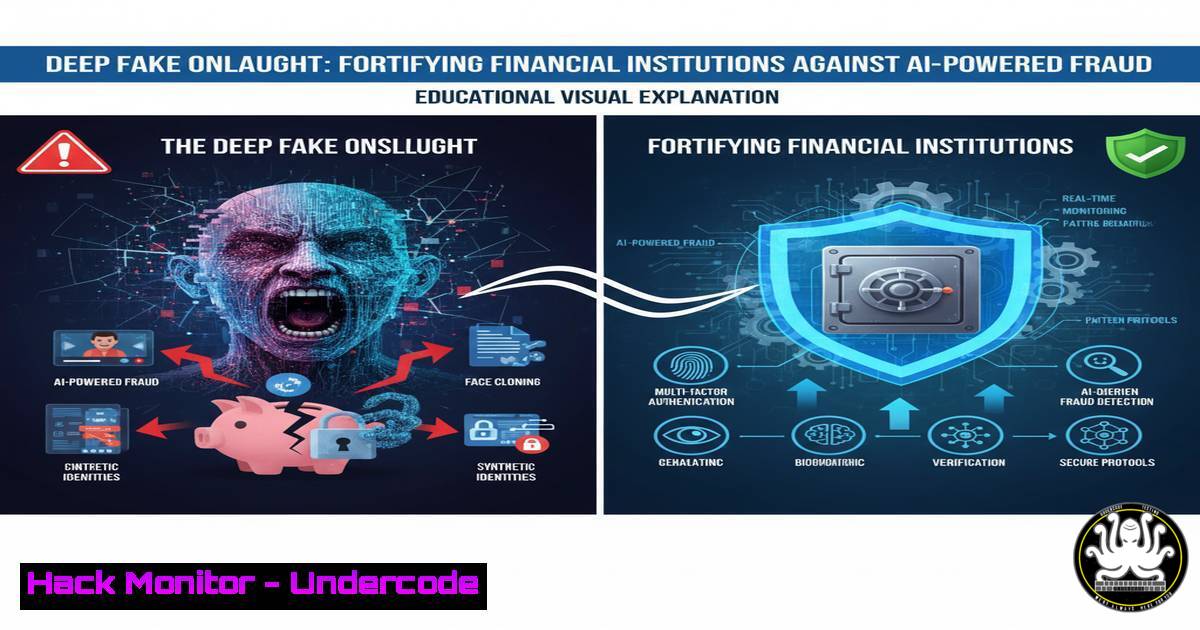
Introduction:
The rapid advancement of generative AI has ushered in a new era of sophisticated cyber threats, with deep fake technology posing a particularly severe risk to the financial sector. Banks and other institutions now face an unprecedented challenge: defending against hyper-realistic audio and video impersonations designed to bypass traditional authentication and social engineering controls. This article provides a technical blueprint for building defensive capabilities against these emerging AI-powered fraud vectors.
Learning Objectives:
- Understand the technical mechanisms behind deep fake-based attacks, including voice cloning and synthetic media generation.
- Implement practical command-line and tool-based defenses to detect and mitigate AI-facilitated social engineering.
- Develop a multi-layered security strategy that integrates technical controls, employee training, and process hardening.
You Should Know:
1. Voiceprint Analysis with Python
`import librosa`
`import numpy as np`
` Load audio file`
`y, sr = librosa.load(‘suspicious_call.wav’)`
` Extract Mel-Frequency Cepstral Coefficients (MFCCs)`
`mfccs = librosa.feature.mfcc(y=y, sr=sr, n_mfcc=40)`
` Calculate delta and delta-delta features`
`delta_mfccs = librosa.feature.delta(mfccs)`
`delta2_mfccs = librosa.feature.delta(mfccs, order=2)`
` Concatenate features for analysis`
`feature_vector = np.vstack([mfccs, delta_mfccs, delta2_mfccs])`
`print(f”Feature vector shape: {feature_vector.shape}”)`
Step-by-step guide explaining what this does and how to use it:
This Python script utilizes the Librosa library to analyze audio files for potential voice cloning. It extracts Mel-Frequency Cepstral Coefficients (MFCCs), which are representations of the short-term power spectrum of sound, crucial for identifying vocal characteristics. The first and second-order derivatives (delta and delta-delta) capture the dynamic features of speech. A genuine human voice will exhibit natural variations in these features, while AI-generated clones may show statistical anomalies or excessive smoothness. Security teams can use this to build a baseline of known employee voices and flag audio files that deviate significantly from these profiles.
2. Phishing Email Header Analysis
`curl -H “Authorization: Bearer
`python3 -m pip install dmarc`
`parse_dmarc -f suspected_phishing.eml –json`
Step-by-step guide explaining what this does and how to use it:
The first command queries the AbuseIPDB API to check the reputation of an IP address found in email headers, helping identify known malicious sources. The second command uses a DMARC parser to analyze an email’s authentication results (SPF, DKIM, DMARC), which are crucial for verifying sender legitimacy. Deep fake phishing campaigns often use sophisticated social engineering content but may fail proper email authentication. By automating these checks, security teams can quickly triage potentially malicious emails that use AI-generated content.
3. Network Traffic Anomaly Detection
`tcpdump -i eth0 -w capture.pcap host
`tshark -r capture.pcap -Y “sip” -T fields -e frame.time -e ip.src -e ip.dst -e sip.from.user -e sip.to.user`
Step-by-step guide explaining what this does and how to use it:
These commands capture and analyze SIP (Session Initiation Protocol) traffic, commonly used in VoIP systems that are targets for voice deep fake attacks. The first command captures packets to and from a suspected IP on the standard SIP port, saving them to a file. The second command uses TShark to filter and display relevant SIP fields, including caller and callee information. Unusual calling patterns, international routes, or SIP authentication failures can indicate attempted voice fraud using AI-cloned audio.
4. Video Deep Fake Detection with Metadata Analysis
`exiftool suspected_video.mp4 | grep -E “(Software|Creator|CreateDate|ModifyDate)”`
`ffmpeg -i suspected_video.mp4 -vf “signalstats=out=brng” -f null – 2>&1 | grep “BRNG”`
Step-by-step guide explaining what this does and how to use it:
The first command uses ExifTool to extract metadata from a video file, looking for inconsistencies in creation software or dates that might indicate synthetic generation. The second command uses FFmpeg’s signalstats filter to analyze color range anomalies; many deep fake generation tools produce videos with unusual color distributions or compression artifacts. Security teams implementing video call verification for high-value transactions should incorporate these checks as part of their authentication workflow.
5. API Security Hardening for Authentication Systems
` Generate secure API key`
`openssl rand -base64 32`
` Configure rate limiting in Nginx`
`limit_req_zone $binary_remote_addr zone=api:10m rate=10r/m;`
`location /api/voiceauth {`
` limit_req zone=api burst=5 nodelay;`
proxy_pass http://voice_auth_backend;`}`
<h2 style="color: yellow;">
Step-by-step guide explaining what this does and how to use it:
The first command generates a cryptographically secure API key that can be used for voice authentication services. The second configuration implements rate limiting in Nginx to prevent brute-force attacks against voice verification endpoints, which is critical when defending against automated deep fake submission attempts. By limiting requests to 10 per minute per IP address with a burst allowance of 5, organizations can slow down attackers trying to find weaknesses in their AI detection systems.
6. Windows Command Line for Suspicious Process Monitoring
`Get-CimInstance Win32_Process | Select-Name, ProcessId, CommandLine | Where-Object {$_.Name -like “ffmpeg” -or $_.Name -like “python”} | Export-Csv -Path “C:\monitoring\suspicious_processes.csv” -NoTypeInformation`
`Get-WinEvent -FilterHashtable @{LogName=’Security’;ID=4688} | Where-Object {$_.Message -like “ffmpeg” -or $_.Message -like “audio”} | Select-Object TimeCreated, Message | Format-Table -Wrap`
Step-by-step guide explaining what this does and how to use it:
These PowerShell commands help detect potential deep fake generation activities on corporate endpoints. The first command searches for processes related to media manipulation (like FFmpeg) or Python scripts that might be running voice cloning tools. The second command queries Windows Security logs for process creation events (Event ID 4688) that contain keywords related to audio or video processing. Monitoring for these artifacts can help identify compromised workstations being used to create synthetic media for fraud.
- Linux System Hardening for AI Tool Installation Prevention
`dpkg -l | grep -E “(python3-pip|ffmpeg|sox)”`
`apt remove –purge ffmpeg sox`
`echo “blacklist snd_hda_intel” >> /etc/modprobe.d/blacklist.conf`
`systemctl disable docker.service`
`iptables -A OUTPUT -p tcp –dport 8888 -j DROP`
Step-by-step guide explaining what this does and how to use it:
These commands help secure Linux systems against unauthorized installation of AI voice cloning tools, which often require specific multimedia libraries and development environments. The first command identifies and removes common multimedia processing packages. The second command blacklists audio drivers to prevent recording capabilities. The final commands disable Docker (often used to containerize AI tools) and block outbound traffic to common Jupyter notebook ports used for AI development. This hardening is particularly important for shared development environments in financial institutions.
What Undercode Say:
- The democratization of AI tools has created a asymmetric threat landscape where low-skill attackers can launch highly sophisticated fraud campaigns.
- Traditional multi-factor authentication is no longer sufficient; behavioral biometrics and continuous authentication must become standard practice.
- Financial institutions that delay implementing AI-specific defenses will face catastrophic fraud losses within the next 12-18 months.
The deep fake threat represents a fundamental shift in the cybersecurity landscape for financial services. Unlike previous fraud techniques that required significant technical expertise, open-source AI models have dramatically lowered the barrier to entry for creating convincing synthetic media. The technical controls outlined provide immediate defensive capabilities, but organizations must recognize that this is an arms race. Investment in AI-powered detection systems that can analyze behavioral cues beyond simple audio/visual fidelity is critical. Furthermore, the human element remains both the primary vulnerability and last line of defense—comprehensive social engineering awareness training must evolve to address these new synthetic media threats. Institutions that treat this as a future problem rather than a present danger are effectively leaving their vaults unlocked.
Prediction:
Within two years, we will witness the first billion-dollar bank heist executed primarily through deep fake technology, targeting inter-bank transfer systems or high-net-worth client accounts. This will trigger massive regulatory changes mandating real-time synthetic media detection for all financial transactions above threshold amounts. The financial industry will be forced to develop new standards for digital identity verification, potentially incorporating blockchain-based credentialing and mandatory hardware security keys. Institutions that fail to preemptively adapt their security postures will face not just financial losses but catastrophic reputational damage and regulatory penalties that could threaten their operational viability.
🎯Let’s Practice For Free:
IT/Security Reporter URL:
Reported By: Activity 7379446274397339648 – Hackers Feeds
Extra Hub: Undercode MoN
Basic Verification: Pass ✅


