
Listen to this Post
Introduction:
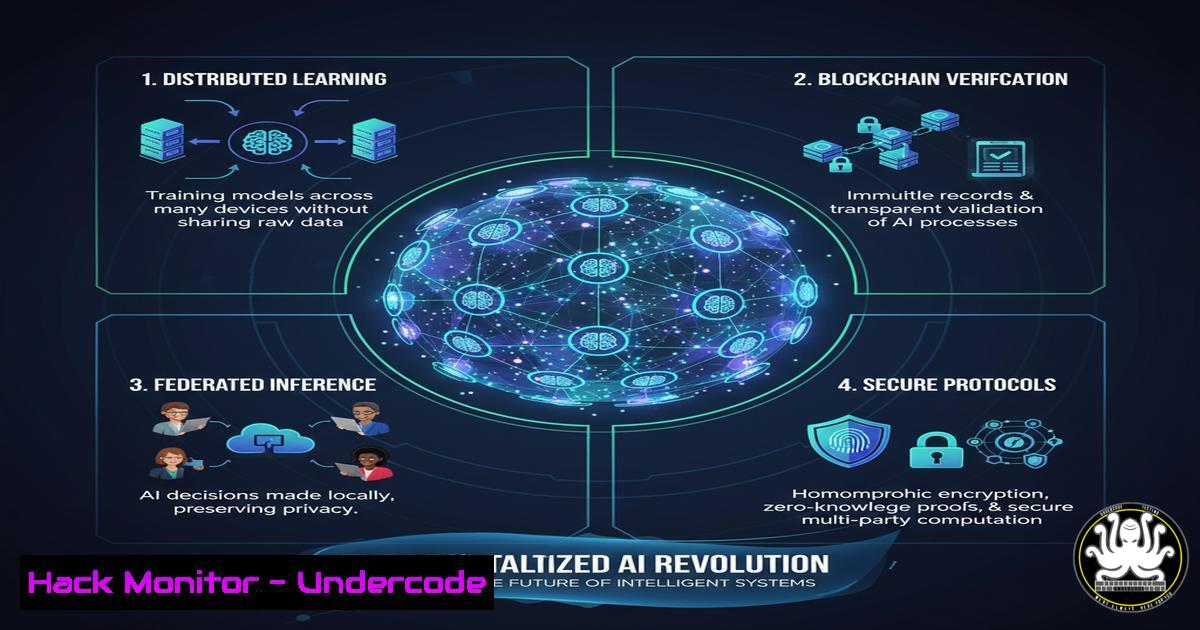
The rapid advancement of Artificial Intelligence is often met with trepidation, but the true paradigm shift lies not in the AI itself, but in its architectural control. Centralized AI models, controlled by a handful of tech giants, present significant risks to privacy, security, and innovation. This article explores the critical movement towards Decentralized AI (DAI) and provides the technical command-line and security knowledge necessary to understand, interact with, and secure these open, distributed networks.
Learning Objectives:
- Understand the core security differences between centralized and decentralized AI architectures.
- Learn to interact with blockchain-based AI networks and smart contracts.
- Implement security hardening for systems participating in decentralized AI ecosystems.
You Should Know:
- Interacting with a Decentralized AI Model on a Blockchain
The core of DAI often involves smart contracts on networks like Ethereum. Interacting with them requires tools like `web3.py` for Python.
 Install the necessary Python library
pip install web3

Basic Python script to call a hypothetical AI model smart contract
from web3 import Web3

Connect to an Ethereum node (e.g., using Infura)
w3 = Web3(Web3.HTTPProvider('https://mainnet.infura.io/v3/YOUR_PROJECT_ID'))

Contract address and ABI (Application Binary Interface)
contract_address = Web3.to_checksum_address('0xYourContractAddressHere')
contract_abi = '[bash]'

contract = w3.eth.contract(address=contract_address, abi=contract_abi)

Call a function to get a prediction, sending a data payload
data_payload = "Your input data for the AI model"
tx_hash = contract.functions.getPrediction(data_payload).transact({'from': w3.eth.accounts[bash]})
Step-by-step guide: This script connects to the Ethereum blockchain via a service like Infura. The contract ABI defines how to interact with the deployed smart contract that hosts the AI model logic. The `getPrediction` function is invoked, submitting a transaction that will be processed by the decentralized network, not a central server. This ensures transparency and auditability of the AI’s input and output.
- Securing Your Node in a Federated Learning Network
Federated Learning is a form of DAI where models are trained across decentralized devices. Securing the node participating in this network is paramount.
 Harden the node's firewall using UFW (Uncomplicated Firewall)
sudo ufw enable
sudo ufw default deny incoming
sudo ufw default allow outgoing
sudo ufw allow from 192.168.1.0/24 to any port 22 comment 'Allow SSH from local network'
sudo ufw allow from 10.0.0.5 to any port 8080 comment 'Allow Federated Learning server IP'

Check for listening ports and associated processes
sudo netstat -tulnp

Install and run an Intrusion Detection System (IDS) like AIDE
sudo apt install aide
sudo aideinit
sudo cp /var/lib/aide/aide.db.new /var/lib/aide/aide.db
sudo aide.wrapper --check
Step-by-step guide: A participant in a federated learning network must be a hardened endpoint. These commands first configure a firewall to only allow essential traffic from trusted sources (like the federated learning coordinator). Then, `netstat` is used to audit all open network ports. Finally, AIDE, a file integrity tool, is set up to create a database of system file checksums and can be run periodically to detect unauthorized changes, a critical defense against malware that could poison the local training data.
3. Querying a Decentralized Data Lake with IPFS
The InterPlanetary File System (IPFS) is often used in DAI for distributed, tamper-resistant data storage.
 Install IPFS CLI
wget https://dist.ipfs.tech/kubo/v0.22.0/kubo_v0.22.0_linux-amd64.tar.gz
tar -xvzf kubo_v0.22.0_linux-amd64.tar.gz
sudo ./kubo/install.sh

Initialize the local node and bring it online
ipfs init
ipfs daemon &

Add a local dataset to IPFS
ipfs add ./your_training_dataset.csv
 Output: added QmXoypizjW3WknFiJnKLwHCnL72vedxjQkDDP1mXWo6uco IYour_training_dataset.csv

Pin a critical dataset from the network to your node for persistence
ipfs pin add QmXoypizjW3WknFiJnKLwHCnL72vedxjQkDDP1mXWo6uco

Query data from the network
ipfs cat /ipfs/QmXoypizjW3WknFiJnKLwHCnL72vedxjQkDDP1mXWo6uco | head -n 10
Step-by-step guide: IPFS allows AI models to access data from a peer-to-peer network instead of a central database. The commands install the IPFS software, start the local node, and add a dataset, which returns a unique Content Identifier (CID). The `pin` command ensures the data remains available on the network. This decentralization prevents single points of failure and data censorship.
- Containerizing an AI Model for Distributed Execution with Docker
To ensure consistent execution across diverse nodes in a DAI network, AI models are often packaged as containers.
 Dockerfile
FROM python:3.9-slim

Set a non-root user for security
RUN useradd -m -u 1000 modeluser
USER modeluser

Copy model and dependencies
WORKDIR /app
COPY --chown=modeluser requirements.txt .
RUN pip install --user --no-cache-dir -r requirements.txt

COPY --chown=modeluser model.py .
COPY --chown=modeluser trained_model_weights.pth .

Expose the API endpoint
EXPOSE 5000

CMD ["python", "model.py"]
 Build the Docker image
docker build -t my-decentralized-ai-model .

Run the container with limited resources and read-only filesystem for security
docker run -d -p 5000:5000 --memory="1g" --cpus="1.0" --read-only -v /tmp:/tmp my-decentralized-ai-model
Step-by-step guide: This Dockerfile creates a secure, reproducible environment for the AI model. It runs as a non-root user to minimize privilege escalation risks. The `docker run` command starts the container with resource constraints to prevent a malicious model from consuming all host resources and mounts the `/tmp` directory as the only writable space, a common security practice for read-only containers.
5. Auditing Smart Contract Security with Slither
Before interacting with or investing in a DAI project, auditing its smart contracts is crucial.
 Install Slither, a static analysis framework for Solidity
pip install slither-analyzer

Clone the target project's repository
git clone https://github.com/example/DecentralizedAIToken.git
cd DecentralizedAIToken

Run a basic security audit
slither .

Run a specific detector for reentrancy vulnerabilities
slither . --detect reentrancy-eth

Generate a visual inheritance graph of the contracts
slither . --print inheritance-graph
Step-by-step guide: Slither analyzes the Solidity code of smart contracts for known vulnerabilities without executing them. Running it on a project’s codebase can automatically detect critical flaws like reentrancy attacks, integer overflows, and improper access controls. This is a vital step for security researchers and developers to ensure the underlying infrastructure of a DAI system is sound before deployment.
6. Implementing Zero-Knowledge Proofs for Private AI Inference
Zero-Knowledge Proofs (ZKPs) allow a user to get a result from an AI model without revealing their input data.
 Using the circom language and snarkjs library to create a ZK circuit for a simple model.
 First, install the tools via npm
npm install -g circom snarkjs

Compile a circuit that verifies a simple AI inference (e.g., y = relu(x))
circom simple_ai.circom --r1cs --wasm --sym

Start a new powers-of-tau ceremony (trusted setup)
snarkjs powersoftau new bn128 12 pot12_0000.ptau -v
snarkjs powersoftau contribute pot12_0000.ptau pot12_0001.ptau --name="First contribution" -v

Generate the proving and verification keys
snarkjs plonk setup simple_ai.r1cs pot12_final.ptau circuit_final.zkey
snarkjs zkey export verificationkey circuit_final.zkey verification_key.json
Step-by-step guide: This process, while complex, creates a cryptographic circuit. A user can run their private data through this circuit to generate a “proof” that they obtained a valid result from the AI model (e.g., “the model classified my image as a cat”). They send only this proof to the network for verification, never the original image, thus preserving complete data privacy.
- Monitoring and Threat Hunting in a DAI Environment
Security in DAI is continuous. Monitoring node and network activity is essential.
 Use journalctl to monitor system logs for suspicious activity on a Linux node
sudo journalctl -u ipfs-daemon -f | grep -i "error|fail|malicious"

Use tcpdump to capture and analyze network traffic for anomalies
sudo tcpdump -i any -w dai_node_traffic.pcap host 10.0.0.5 and port 8080

Analyze the capture file with Wireshark for protocol-level attacks
wireshark dai_node_traffic.pcap

Set up a Prometheus query to monitor node resource usage for anomalies
up{job="ai_node"}  Check if node is up
rate(container_memory_usage_bytes{name="ai_model"}[bash])  Monitor memory usage of model container
Step-by-step guide: Proactive monitoring is the key to operational security. These commands allow an operator to track the health and security of their DAI node in real-time. `journalctl` watches logs, `tcpdump` captures raw network data for deep inspection, and Prometheus queries can alert on performance degradation or resource exhaustion attacks, which are common in decentralized systems.
What Undercode Say:
- Control is the New Currency: The primary value proposition of Decentralized AI is not just technological superiority but the redistribution of control. Security practices must evolve from protecting perimeter walls to ensuring the integrity and confidentiality of computations and data across a trustless, open network.
- The Attack Surface Multiplies and Transforms: While DAI eliminates the single point of failure of a central server, it creates a vast new attack surface involving smart contract logic, P2P communication protocols, and participant nodes. The security focus shifts from defending one castle to fortifying an entire, dynamic village.
The analysis suggests that the cybersecurity industry’s traditional, centralized models of defense are becoming obsolete in the face of DAI. The future security professional will need to be adept in cryptography, smart contract auditing, and distributed systems hardening. The very principles of confidentiality, integrity, and availability are being redefined, requiring tools and mindsets that can operate effectively in an environment where no single entity is in charge.
Prediction:
The successful implementation of robust, secure Decentralized AI frameworks will trigger a massive shift in enterprise technology adoption within the next 5-7 years. We will see the emergence of “AI Bazaars” where algorithms and data can be traded and composed securely on open networks, drastically reducing the monopolistic power of current AI platforms. This will simultaneously create a new gold rush for developers and a new frontline for cybercriminals, leading to specialized security fields focused entirely on the economic and technical layers of decentralized intelligent systems. The organizations that invest now in mastering the security of these open networks will be the ones to dictate the rules of the next digital economy.
🎯Let’s Practice For Free:
IT/Security Reporter URL:
Reported By: Alanglazier Decentralized – Hackers Feeds
Extra Hub: Undercode MoN
Basic Verification: Pass ✅


