
Listen to this Post
Introduction:
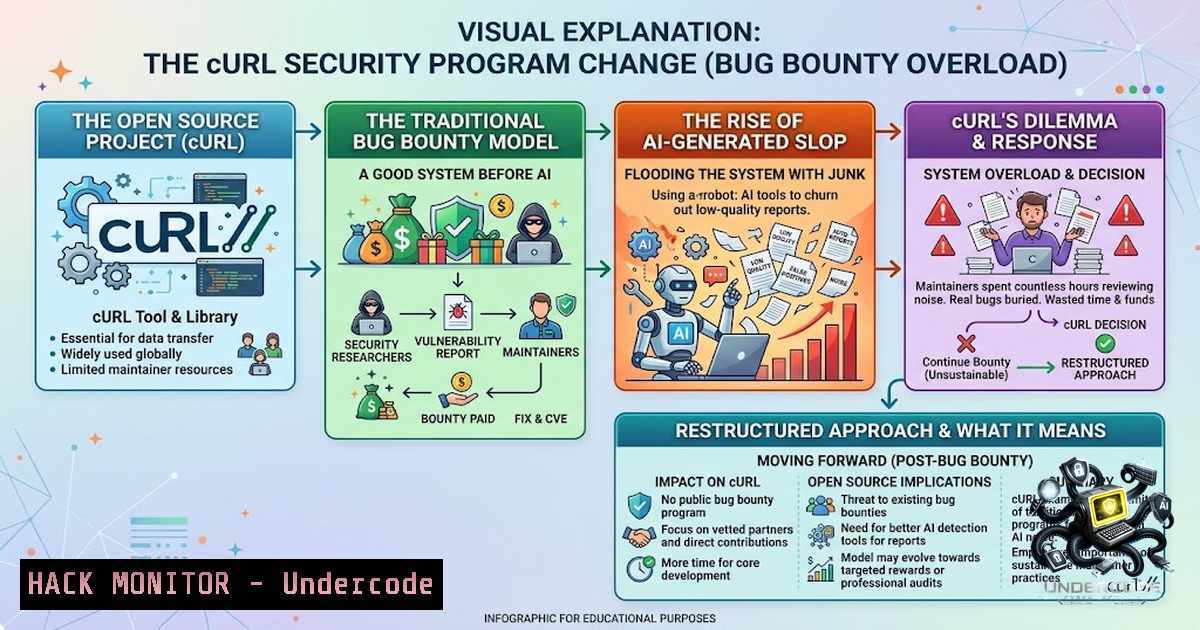
The open-source ecosystem is facing an unprecedented crisis as AI-generated content threatens to undermine the very foundations of collaborative security research. In January 2026, Daniel Stenberg, the creator and lead maintainer of cURL—a command-line utility installed on an estimated 20–50 billion devices worldwide—announced the termination of the project’s six-year-old bug bounty program. The decision came after maintainers were overwhelmed by a flood of low-quality, AI-generated vulnerability reports that consumed valuable triage time while yielding almost no actionable security findings. By mid-2025, only about 5% of submissions to cURL’s bug bounty were genuine vulnerabilities, with roughly 20% consisting of what Stenberg termed “AI slop”—reports that sound technical and plausible but contain nothing of substance. This crisis has forced the security community to confront a fundamental question: when AI can generate convincing but worthless vulnerability reports at scale, how do we preserve the integrity of open-source security research?
Learning Objectives & Secrets:
- Objective 1: Understand the AI Slop Crisis – Grasp how large language models have enabled the mass generation of superficially convincing security reports that overwhelm triage teams and degrade the signal-to-1oise ratio in bug bounty programs.
-
Objective 2 Secret Tip: Implement Triage Automation with Code Canaries – Deploy honeypot-style “code canaries” (decoy vulnerabilities) in your codebase to automatically identify and filter AI-generated slop reports. Tools like `honeyslop` embed unique UUIDs, fake function names, and fabricated CVE identifiers that self-identify when ingested by automated scanners.
-
Objective 3 Secret Tip: Establish AI Contribution Policies – Adopt clear, enforceable policies that require contributors to disclose AI assistance and demonstrate understanding of their submissions. Projects like LLVM, Django, and Selenium have already implemented such policies to combat low-quality AI contributions.
You Should Know:
- Understanding the AI Slop Epidemic: What Happened to cURL
The numbers paint a stark picture. cURL’s bug bounty program, run through HackerOne since 2019, had paid out approximately $86,000 across 78 confirmed vulnerabilities over its lifetime. But by 2025, the program was drowning. In the first 21 days of 2026 alone, cURL received 20 submissions—seven of them arriving within a single 16-hour window—and after careful analysis by the security team, zero actual vulnerabilities were found.
What made AI slop so insidious was its sophistication. These reports didn’t look like traditional spam; they used technical language, referenced specific functions and code paths, and described plausible attack scenarios. But when maintainers attempted to reproduce the claimed vulnerabilities, nothing materialized. The AI had learned to mimic the structure of security reports without understanding what makes something actually exploitable.
Stenberg’s attempts to combat the problem proved futile. In May 2025, he implemented an instant-ban policy for AI-generated submissions—it didn’t work. By July 2025, submission volumes had spiked to eight times the normal rate. The breaking point came when Stenberg realized the math no longer added up: every fake report stole time from real bug fixes and new feature development. As he wrote, “We need to make moves to ensure our survival and intact mental health”.
The GitHub commit that ended the program was starkly titled: “BUG-BOUNTY.md: we stop the bug-bounty end of Jan 2026”. Starting February 1, 2026, all security reports would go directly through GitHub with no monetary rewards, accompanied by a clear warning: submit garbage, and you will be banned and publicly ridiculed.
2. The Attribution Problem: Why Merit Systems Pivoted
While cURL was drowning in slop, former a16z investment engineer Sam Ragsdale spent a year building Merit Systems—a project designed to solve what he called the “attribution problem” in open-source software. The vision was ambitious: create what looked like “a cap table for every open-source repository” so that capital could flow directly to codebases and contributors would be paid based on their merit.
Merit Systems raised $10 million in seed funding co-led by a16z crypto and Blockchain Capital at a $55.5 million valuation. The protocol was designed to add rich attribution information to version control systems like GitHub, allowing capital sources to route funds to codebases and incentivize builders directly.
But the same AI problem that killed cURL’s bug bounty also undermined Merit Systems’ core premise. “The ability for people to freely contribute to anything and accept code contributions was really messed up by the fact that it was really hard to tell if contributions were high quality or slop,” Ragsdale observed. The incentive model that gave the company its name stopped working. Merit Systems pivoted to agentic commerce, abandoning its original vision of merit-based open-source funding.
The irony is painful: AI simultaneously destroyed the economic incentives for security research (by flooding bug bounties with noise) and made it impossible to reliably reward quality contributions (by making it impossible to distinguish genuine work from AI-generated slop).
- Practical Defense: How to Protect Your Open-Source Project from AI Slop
3.1 Implementing Code Canaries with honeyslop
One emerging defense against AI-generated vulnerability reports is the use of “code canaries”—deliberate decoys planted in your codebase that trap automated scanners. The `honeyslop` tool, developed by security researchers, embeds unique identifiers, fake function names (like zqx_tarnish_v3), and fabricated CVE identifiers (such as CVE-2025-99919) that self-identify slop reports when ingested.
Step-by-step guide:
- Install honeyslop from the GitHub repository: `git clone https://github.com/gadievron/honeyslop.git`
2. Deploy code canaries by inserting the provided canary functions into your codebase. These functions are never called and serve no legitimate purpose—they exist solely as tripwires.
3. Configure your triage workflow to automatically flag any vulnerability report that references the canary functions or fabricated CVE IDs.
4. Automate slop detection using grep: `grep -r “CVE-2025-99919” ./` to identify reports generated by scanners that ingested your canaries. - Quarantine flagged reports using tools like
slopguard, a GitHub App that applies a `slop-quarantine` label to suspicious PRs and issues, keeping them in a holding queue for human review.
3.2 Establishing AI Contribution Policies
Several major open-source projects have implemented formal AI contribution policies that can serve as templates:
- LLVM’s AI Policy: Requires contributors to disclose AI assistance and take responsibility for all submitted code.
- Django’s Approach: Implemented a commit requiring AI-assisted contributions to be explicitly labeled.
- Node.js on HackerOne: Implemented stricter “signal” requirements, meaning researchers must demonstrate a track record of valid reports before their submissions are prioritized.
Recommended policy template:
AI-Assisted Contribution Policy:
1. Contributors must disclose the use of any AI tools in generating submissions.
2. All AI-generated content must be reviewed and validated by a human contributor who takes full responsibility.
3. Submissions that cannot be reproduced or validated will be rejected.
4. Repeated submission of low-quality or AI-generated slop will result in a ban.
5. Security reports must include a proof-of-concept or reproduction steps that actually work.
3.3 Trust Scoring with Good Egg and Vouch
New tools are emerging to help maintainers assess contributor trustworthiness:
- Good Egg: Mines a contributor’s merged PR history across the GitHub ecosystem and computes a trust score relative to your project.
- Vouch: A trust management system with GitHub integration that can auto-close PRs from unvouched users and lets maintainers vouch or denounce people.
- Slopper: An open-source initiative that detects AI slop and low-quality PRs by analyzing author trust, code quality, and behavioral signals.
4. The Linux Foundation’s $12.5 Million Response
In March 2026, the Linux Foundation announced a $12.5 million initiative backed by Anthropic, AWS, GitHub, Google, Microsoft, and OpenAI to help open-source projects manage the surge in AI-generated vulnerability reports. The funding supports both the Alpha Omega initiative and the Open Source Security Foundation (OpenSSF) in developing tools and processes to filter AI slop while preserving legitimate AI-assisted security research.
5. Verifying Vulnerability Reports: A Command-Line Toolkit
For maintainers overwhelmed by submissions, here are essential commands and techniques for rapid triage:
Linux/macOS Commands:
 Quickly search for evidence of the reported vulnerability in your codebase
grep -rn "function_name" --include=".c" --include=".h" .

Check if a reported CVE actually exists in your version
git log --grep="CVE-2024-"

Reproduce a reported issue in an isolated environment
docker run --rm -it ubuntu:22.04 bash -c "apt update && apt install -y curl && curl --version"

Check for known vulnerabilities in your dependencies
 Using OSV (Open Source Vulnerabilities)
curl -s https://api.osv.dev/v1/query -H "Content-Type: application/json" -d '{"package":{"name":"curl","ecosystem":"Debian"}}'

Verify if a reported memory corruption issue is real using Valgrind
valgrind --leak-check=full ./your_application [bash]

Static analysis with Clang
clang --analyze -Xanalyzer -analyzer-checker=core,alpha.security,unix .c

Check for suspicious AI-generated patterns in recent commits
git log --since="1 month ago" --oneline | wc -l
Windows PowerShell Commands:
 Search for functions in codebase
Select-String -Path ".c",".h" -Pattern "function_name"

Check curl version and build info
curl --version

Verify environment variables that might affect security
Get-ChildItem Env: | Where-Object {$_ -match "SSL|CURL|PROXY"}

Check for known vulnerable library versions
Get-ChildItem -Path . -Recurse -Include .dll | ForEach-Object { $_.VersionInfo }
6. Triage Workflow for Security Reports
Recommended step-by-step process for handling vulnerability submissions:
- Initial Filter: Run all reports through automated checks—search for canary identifiers, verify CVE references against NVD, check for reproducible proof-of-concept.
- Signal Check: Verify the submitter’s history. On HackerOne, check the reporter’s “signal” score; for GitHub, check contribution history and trust scores from tools like Good Egg.
- Reproduction Attempt: In an isolated environment, attempt to reproduce the claimed vulnerability exactly as described. Document each step.
- Code Path Analysis: Trace the claimed vulnerable code path and verify it’s actually reachable in production configurations.
- Severity Assessment: If confirmed, assess CVSS score and impact. Document clearly.
- Response: For valid reports, coordinate patch and disclosure. For slop: reject with clear explanation, and consider banning repeat offenders.
What Undercode Say:
- Key Takeaway 1: The cURL bug bounty shutdown represents a canary in the coal mine for the entire open-source security ecosystem. When AI-generated noise overwhelms legitimate research to the point where only 5% of submissions are genuine, the economic incentives for security research collapse. This isn’t just cURL’s problem—it’s a systemic failure that threatens the sustainability of open-source security.
-
Key Takeaway 2: Merit Systems’ pivot from merit-based contribution funding to agentic commerce illustrates a deeper crisis: AI has made it nearly impossible to distinguish high-quality human contributions from AI-generated slop. The very premise of rewarding based on merit requires the ability to accurately assess quality—a capability that AI has simultaneously enhanced and destroyed.
Analysis: The convergence of these two stories reveals a fundamental paradox of the AI era. The same technology that can generate convincing vulnerability reports at scale (causing the collapse of bug bounties) also makes it impossible to reliably attribute and reward quality contributions (undermining Merit Systems’ model). This isn’t a technical problem—it’s an economic and trust problem. The solution won’t come from better AI detection alone; it requires rethinking the entire incentive structure of open-source security. The Linux Foundation’s $12.5 million initiative is a start, but it’s a drop in the bucket compared to the scale of the challenge. The most immediate defense may be the most human one: public shaming of slop submitters, as Stenberg has threatened, combined with trust-scoring systems that reward proven contributors. The future of open-source security depends on restoring the signal-to-1oise ratio—and that means making it costly to submit garbage, while making it rewarding to submit genuine research.
Prediction:
- +1 The Linux Foundation’s $12.5 million initiative will catalyze the development of AI-powered triage tools that can filter slop at scale, restoring some sanity to open-source security workflows within 12-18 months.
-
-1 The cURL decision will trigger a cascade of bug bounty program cancellations across major open-source projects, reducing financial incentives for security research and potentially leaving critical vulnerabilities undiscovered.
-
-1 AI-generated slop will continue to evolve, becoming increasingly sophisticated and harder to distinguish from legitimate research, creating an escalating arms race between slop generators and detection systems.
-
+1 Trust-scoring systems like Good Egg and Vouch will become standard infrastructure for open-source contribution management, creating a reputation-based economy that rewards proven researchers while filtering out low-quality contributors.
-
-1 The collapse of economic incentives for security research will disproportionately affect smaller open-source projects without corporate backing, widening the security gap between well-funded and volunteer-maintained software.
-
+1 The crisis will accelerate the development of formal AI contribution policies across open-source foundations, creating industry standards that balance the benefits of AI-assisted research with the need to prevent slop.
-
-1 The “public shaming” approach championed by Stenberg may deter legitimate researchers who fear reputational damage, potentially reducing the total volume of vulnerability reports—including genuine ones.
-
+1 Code canary techniques like honeyslop will become a standard defensive measure, dramatically reducing the triage burden on maintainers by automatically filtering the most obvious slop.
-
-1 The fundamental attribution problem—how to reliably distinguish human from AI contributions—may remain unsolved for years, continuing to undermine merit-based funding models like the one Merit Systems attempted to build.
-
+1 The crisis will ultimately force the development of cryptographic provenance systems for code contributions, creating tamper-evident ledgers that track AI versus human authorship at the commit level—a necessary evolution for the open-source ecosystem.
▶️ Related Video (62% Match):
https://www.youtube.com/watch?v=-ibRc98Ndy0
🎯Let’s Practice For Free:
🎓 Live Courses & Certifications:
Join Undercode Academy for Verified Certifications
🚀 Request a Custom Project:
Secure, high-velocity infrastructure and disruptive technological engineering. Contact our engineering team for high-tier development and proprietary systems:
[email protected]
💎 Smart Architecture | 🛡️ Secure by Design | ⭐ Trusted by Thousands
IT/Security Reporter URL:
Reported By: https://lnkd.in/p/ekYiCcHv – Hackers Feeds
Extra Hub: Undercode MoN
Basic Verification: Pass ✅


