
Listen to this Post
Introduction:
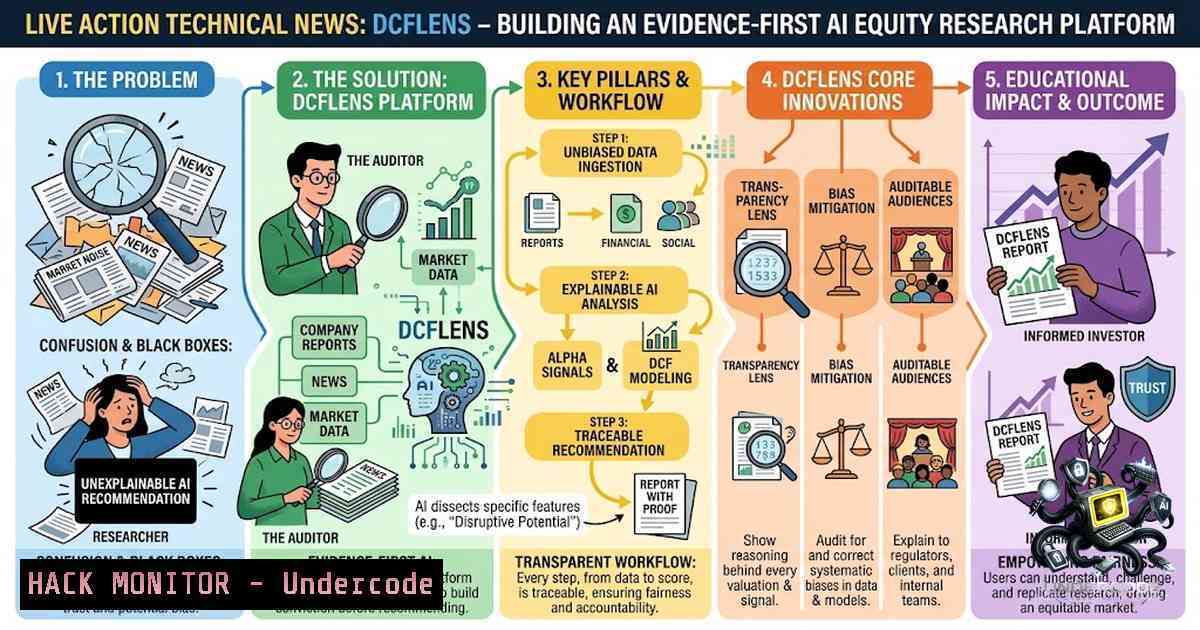
The intersection of artificial intelligence and financial technology (FinTech) is rapidly evolving, moving beyond simple automation to tackle complex analytical challenges. At the recent PEC Hacks 4.0, a team developed DCFLens, a platform designed to address the critical need for transparency and reliability in stock valuation by leveraging an “evidence-first” approach. This project highlights the growing trend of using AI to augment traditional financial analysis, specifically through the lens of Discounted Cash Flow (DCF) modeling, to create more robust and auditable investment insights.
Learning Objectives & Secrets:
- Objective 1: Understand the Architecture of an AI-Powered FinTech Application. Learn how to structure a modern web application that integrates a frontend user interface with a backend AI model for financial data processing.
- Objective 2: Master the Deployment of Scalable Web Apps on Render (Secret Tip). A key to success in such hackathons is rapid deployment. Utilize `render.yaml` for Infrastructure as Code (IaC) to ensure consistent and repeatable deployments. This eliminates manual configuration errors and accelerates the release cycle.
- Objective 3: Implement a Basic AI Model for Financial Sentiment and Valuation Analysis (Secret Tip). Instead of building a full DCF model from scratch, use a pre-trained language model (like a smaller, efficient BERT variant) to parse financial news and earnings call transcripts, generating sentiment scores that can influence the discount rate or growth projections in a DCF calculation, adding a dynamic “secret sauce” to the platform.
You Should Know:
- Core Technology Stack for a Real-Time Financial Dashboard
Building a platform like DCFLens requires a careful selection of technologies to handle real-time data and complex computations. The frontend is likely built with a reactive framework like React.js to provide a seamless user experience for viewing stock data and valuation metrics. The backend, powering the AI, is probably a Python-based framework like FastAPI or Flask, which is excellent for serving machine learning models. To handle financial data, the application would integrate with APIs like Yahoo Finance or Alpha Vantage to fetch historical stock prices and financial statements. A key component for reliability is a robust database, such as PostgreSQL, to store user queries, processed data, and model outputs for audit trails. -
Step-by-Step Guide: Deploying a Full-Stack App on Render
The project was shortlisted for the Render Track Prize, making deployment a critical skill. Here is a guide to replicating their success.
Step 1: Prepare your application repository.
Ensure your project has a `requirements.txt` (for Python) or `package.json` (for Node.js) at the root. Your frontend build commands should be defined.
Step 2: Create a `render.yaml` file.
This file defines your services. Below is an example for a service with a web service and a background worker.
services:
- type: web
name: dcf-lens-backend
env: python
buildCommand: pip install -r requirements.txt
startCommand: uvicorn main:app --host 0.0.0.0 --port $PORT
envVars:
- key: PYTHON_VERSION
value: 3.9.0
- key: DATABASE_URL
fromDatabase:
name: dcf-lens-db
property: connectionString
- type: web
name: dcf-lens-frontend
env: node
buildCommand: npm install && npm run build
startCommand: npm run start
envVars:
- key: REACT_APP_API_URL
fromService:
name: dcf-lens-backend
type: web
property: host
Step 3: Push to a Git provider (GitHub/GitLab) and connect to Render.
Render will automatically detect the `render.yaml` file and provision your services.
Step 4: Set environment variables.
Securely store API keys for financial data providers using Render’s environment variable management to prevent hardcoding secrets.
- Setting Up a Python Environment for Financial AI
To replicate the AI component, you’ll need to set up a local environment for development.
Linux/macOS:
python3 -m venv venv
source venv/bin/activate
pip install numpy pandas scikit-learn transformers torch fastapi uvicorn
Windows (Command Prompt):
python -m venv venv
venv\Scripts\activate
pip install numpy pandas scikit-learn transformers torch fastapi uvicorn
Once the environment is active, you can create a simple FastAPI endpoint that loads a sentiment analysis model to return a “bullish” or “bearish” score based on input text.
4. Enhancing DCF Models with Sentiment Analysis
Traditional DCF models rely on historical data and assumptions. Integrating AI allows for a dynamic adjustment based on market sentiment.
Code Snippet: A simplified sentiment endpoint.
from fastapi import FastAPI
from transformers import pipeline

app = FastAPI()
 Load a small, fast model for sentiment analysis
sentiment_pipeline = pipeline("sentiment-analysis", model="distilbert-base-uncased-finetuned-sst-2-english")

@app.post("/analyze_sentiment/")
async def analyze_sentiment(text: str):
result = sentiment_pipeline(text)[bash]
 Convert result to a score: -1 (negative) to +1 (positive)
score = result['score'] if result['label'] == 'POSITIVE' else -result['score']
 This score could then be used to adjust the terminal growth rate in a DCF
return {"sentiment_score": score}
This approach demonstrates how a hackathon project can quickly prototype a cutting-edge feature.
5. Database Integration for Data Persistence
To make the platform evidence-first, all analyses must be traceable. PostgreSQL is ideal for this.
Linux/macOS/Windows (via Docker):
 Run a PostgreSQL container
docker run --1ame dcf-db -e POSTGRES_PASSWORD=mysecretpassword -d -p 5432:5432 postgres
Connecting to the database from Python:
You can use `psycopg2` to connect and create tables for storing ticker symbols, analysis timestamps, and the AI-generated sentiment scores.
CREATE TABLE IF NOT EXISTS analyses (
id SERIAL PRIMARY KEY,
ticker VARCHAR(10) NOT NULL,
analysis_date TIMESTAMP DEFAULT CURRENT_TIMESTAMP,
sentiment_score FLOAT,
dcf_value FLOAT
);
This ensures that every valuation is backed by data, fulfilling the “evidence-first” promise.
6. API Security and Secrets Management
When dealing with financial data, securing API keys is paramount. For the `render.yaml` deployment, you can use Render’s secrets management. Locally, use a `.env` file.
FINANCE_API_KEY=your_alpha_vantage_key
SENTIMENT_MODEL_PATH=./models/sentiment
Loading `.env` in Python:
from dotenv import load_dotenv
import os

load_dotenv()
api_key = os.getenv("FINANCE_API_KEY")
Never commit the `.env` file to version control. Ensure it’s added to .gitignore.
7. Cloud Hardening for FinTech Applications
Deploying a financial application requires basic security hardening.
- Rate Limiting: Implement rate limiting (e.g., using `slowapi` in FastAPI) to prevent API abuse.
- CORS Configuration: Restrict Cross-Origin Resource Sharing to only your frontend domain.
- Input Validation: Use Pydantic models in FastAPI to validate all incoming data, preventing injection attacks.
from pydantic import BaseModel</li>
</ul>

class TickerRequest(BaseModel):
ticker: str
 Add validators to ensure the ticker is a valid string
– HTTPS: Render automatically provisions HTTPS for your domains. Ensure all traffic is encrypted.
What Undercode Say:
- Key Takeaway 1: The Power of Containerization and IaC. The ability to deploy a complex application to a platform like Render using a simple `render.yaml` file is a game-changer for hackathons and rapid prototyping. It abstracts away infrastructure management, allowing developers to focus on the application logic.
- Key Takeaway 2: Democratizing Financial Analysis. Projects like DCFLens are pushing towards democratizing equity research. By making the AI’s “reasoning” traceable through an evidence-first model, they lower the barrier to entry for retail investors who might not have access to expensive Bloomberg terminals, potentially shifting the market from opaque institutional analysis to more transparent, data-driven individual investing.
Prediction:
- +1: The success of events like PEC Hacks 4.0 will accelerate the adoption of AI in FinTech, leading to a new wave of “explainable AI” tools that bridge the gap between complex algorithms and user trust.
- -1: While democratizing finance is positive, the increased reliance on AI-driven platforms poses a risk of creating “black box” trading systems that may amplify market volatility due to homogeneous sentiment inputs and herd behavior.
- +1: The integration of real-time news sentiment analysis into DCF models will become a standard feature in the next 3-5 years, much like technical indicators are today, forcing traditional financial institutions to adopt more agile, data-centric approaches.
- -1: The accessibility of these tools raises regulatory concerns. Without proper oversight and validation, platforms built for hackathon demos could be rapidly commercialized without rigorous testing, potentially leading to catastrophic financial missteps for users who rely on them for investment decisions.
▶️ Related Video (82% Match):
🎯Let’s Practice For Free:
🎓 Live Courses & Certifications:
Join Undercode Academy for Verified Certifications
🚀 Request a Custom Project:
Secure, high-velocity infrastructure and disruptive technological engineering. Contact our engineering team for high-tier development and proprietary systems:
[email protected]
💎 Smart Architecture | 🛡️ Secure by Design | ⭐ Trusted by ThousandsIT/Security Reporter URL:
Reported By: https://lnkd.in/p/eqifwJJG – Hackers Feeds
Extra Hub: Undercode MoN
Basic Verification: Pass ✅🔐JOIN OUR CYBER WORLD [ CVE News • HackMonitor • UndercodeNews ]
📢 Follow UndercodeTesting & Stay Tuned:


