
Listen to this Post
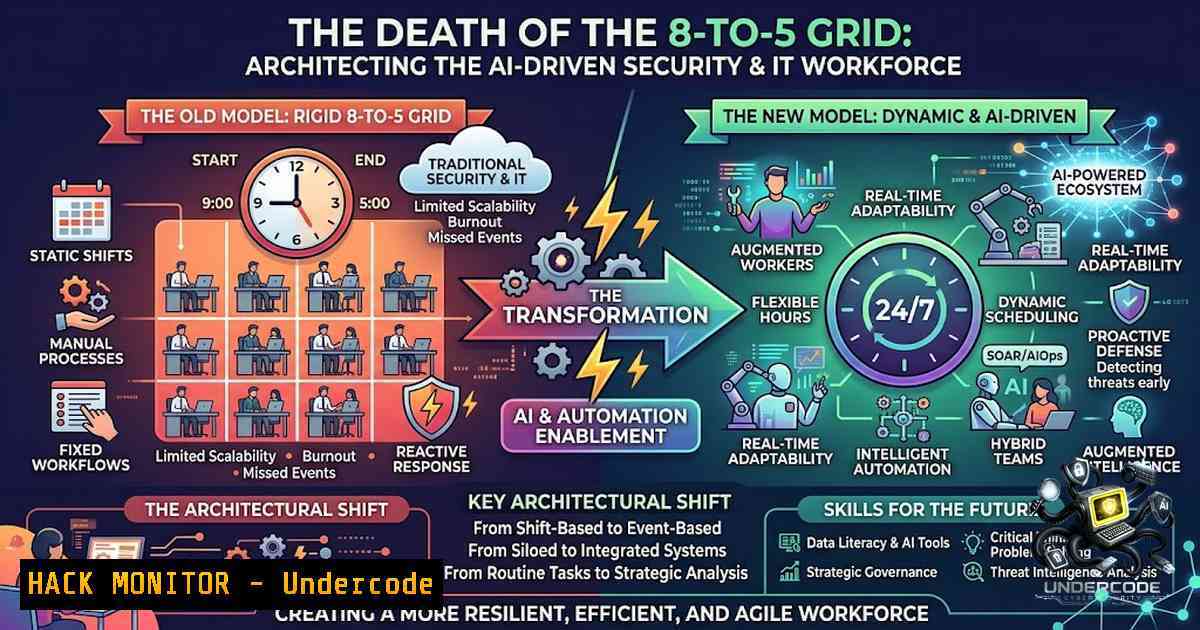
Introduction:
The conventional 9-to-5 employment model, predicated on time-based presence and linear output, is rapidly being superseded by a leverage-based economy where the primary metric is the scale of digital workforce an individual can orchestrate. For cybersecurity and IT professionals, this paradigm shift necessitates a move away from reactive “ticket-closing” roles toward proactive architectural thinking, where proprietary AI agents, automated workflows, and custom security protocols become the new standard of employability. The modern hiring manager’s question is no longer about your resilience to work late but about the “squad” of digital agents you bring to the table to solve complex security challenges on day one.
Learning Objectives & Secrets:
- Objective 1: Mastering AI Orchestration for Security Automation. Learn to move beyond manual scripting and leverage AI agents to automate threat hunting, log analysis, and vulnerability scanning, effectively scaling your output to match an entire department’s capabilities.
- Objective 2: Building a “Bring Your Own Agent” (BYOA) Security Portfolio. Secret to success is curating a repository of proprietary prompts, custom GPTs for security code reviews, and automated remediation workflows that you can deploy instantly, transforming your personal value from a “worker” to a “vendor of security outcomes.”
- Objective 3: Implementing Architectural Thinking in IT Operations. The secret to becoming a “Top 5%” Orchestrator lies in designing resilient, self-healing IT environments where agents monitor system health, predict failures, and execute rollback procedures autonomously, minimizing human intervention and downtime.
You Should Know:
- Building Your First Security AI Agent for Log Analysis
The core of modern IT operations is the Security Information and Event Management (SIEM) system. However, the sheer volume of logs often overwhelms human analysts. You can create a custom AI agent that ingests these logs, correlates events, and surfaces critical anomalies.
Step‑by‑Step Guide:
- Step 1: Set Up the Environment. Ensure you have Python installed. Create a virtual environment to manage dependencies.
Linux/macOS
python3 -m venv security_agent_env
source security_agent_env/bin/activate
Windows
python -m venv security_agent_env
.\security_agent_env\Scripts\activate
- Step 2: Install Required Libraries. You will need `openai` for the GPT API, `pandas` for data manipulation, and `requests` for API calls.
pip install openai pandas requests
- Step 3: Configure the API Key. Set your OpenAI API key as an environment variable for security.
Linux/macOS
export OPENAI_API_KEY='your-api-key-here'
Windows (Command Prompt)
set OPENAI_API_KEY='your-api-key-here'
Windows (PowerShell)
$env:OPENAI_API_KEY='your-api-key-here'
- Step 4: Write the Agent Script. Create a script named
log_analyzer.py. This script reads a sample log file, sends the suspicious entries to the AI, and returns a structured analysis report. - Step 5: Test the Agent. Run the script against a sample of your corporate firewall logs to test its accuracy.
python log_analyzer.py --logfile ./firewall_logs.txt
- Hardening Your API Gateway with AI-Driven Threat Detection
As companies shift to automated workflows, the API surface expands, becoming a primary attack vector. An AI agent can monitor API traffic patterns in real-time, distinguishing between legitimate orchestration traffic and malicious reconnaissance.
Step‑by‑Step Guide:
- Step 1: Analyze Normal Traffic Patterns. Before deploying detection, establish a baseline of normal API behavior. Use tools like `Prometheus` and `Grafana` to visualize traffic spikes.
- Step 2: Implement a Rate-Limiting Middleware. Utilize a Web Application Firewall (WAF) like `ModSecurity` or a cloud-1ative solution to enforce a baseline rate limit.
- Step 3: Deploy the Anomaly Detection Agent. Write a Python script using `Flask` to act as a middleware that intercepts requests. The script calculates the entropy of the request payloads.
- Step 4: Integrate AI for Payload Analysis. For high-risk endpoints, route a sample of the payload to an AI model (like GPT-4) to check for prompt injection or SQL injection attempts.
- Step 5: Automate Remediation. If the agent flags a request as malicious (e.g., “SQL injection” confidence > 90%), have the script automatically block the source IP and send an alert to the security team’s Slack channel using a webhook.
- Deploying a Local “Bring Your Own Agent” (BYOA) for Code Security
You are only as secure as your codebase. An AI agent designed as a “Code Guardian” can scan your repository for vulnerabilities, such as hardcoded secrets or insecure functions, before it is pushed to production.
Step‑by‑Step Guide:
- Step 1: Install a Secret Scanning Tool. Use `TruffleHog` for checking GitHub repositories.
Install TruffleHog
pip install trufflehog
Run it against a local repo
trufflehog git file://path/to/your/local/repo --only-verified
- Step 2: Automate with a Pre-commit Hook. Create a script in
.git/hooks/pre-commit. This script runs the scanning tool and prevents commits if high-severity issues are found. - Step 3: Supercharge with AI. Modify the pre-commit hook to capture the output of
TruffleHog. If a potential secret is found, the script uses the AI API to generate a dynamic remediation suggestion and prints it to the developer’s terminal. - Step 4: Distribute the Agent. Package this pre-commit hook and the accompanying scripts into a Docker container so that every developer on the team has the identical “agent” in their local environment, ensuring consistency and adherence to the BYOA philosophy.
4. AI-Driven Cloud Hardening Strategy
The cloud is the backbone of the modern digital workforce. Architecting a secure cloud environment requires moving from static rule sets to dynamic policy enforcement based on contextual risk.
Step‑by‑Step Guide:
- Step 1: Assess Identity and Access Management (IAM). Use tools like `PMapper` or `ScoutSuite` to analyze your cloud provider’s IAM configuration.
Install and run ScoutSuite for AWS
pip install scoutsuite
scout --provider aws --report-dir ./scout-report
- Step 2: Implement Infrastructure as Code (IaC) Scanning. Ensure your `Terraform` or `CloudFormation` templates are secure before deployment.
Using Checkov to scan Terraform files
checkov -d ./terraform/
- Step 3: Build a Remediation AI Agent. Create an agent that reads the `ScoutSuite` report (JSON), identifies open security groups or overly permissive roles, and drafts a pull request to the IaC repository to tighten the policies.
- Step 4: Schedule the Workflow. Use a serverless function (AWS Lambda) to trigger this remediation agent on a weekly basis, ensuring that the environment continuously “drifts” back into a secure state.
5. Operationalizing Threat Intelligence via AI Summarization
Threat intelligence feeds are often dense and slow to parse. An AI agent can ingest raw threat intelligence (like CVE reports, IoCs, and threat actor profiles) and synthesize it into actionable tasks for the IT team.
Step‑by‑Step Guide:
- Step 1: Set Up a Data Pipeline. Use `Apache NiFi` or `Logstash` to pull RSS feeds from CISA, Talos, and other open-source threat intelligence providers.
- Step 2: Parse and Clean Data. Write a Python script to parse the extracted text into a clean format.
- Step 3: Invoke the AI. Use the OpenAI API to generate a “Delta Report.”
- Step 4: Patch Prioritization. Extend the agent to correlate the “urgency” score with your organization’s vulnerability scanner (like `Nessus` or
Qualys). If a high-impact CVE exists in your environment and the AI flags it as “Widely Exploited,” the agent creates a high-priority ticket in your Jira backlog. - Step 5: Automate Notification. Configure the agent to send a priority email digest to the security operations manager every morning summarizing the critical risks that require immediate human intervention.
6. Securing the AI Agent Itself
You must be cognizant of the security of the very agents you are deploying. Agents are often targets for data poisoning and prompt injection.
Step‑by‑Step Guide:
- Step 1: Sanitize Inputs. Ensure that any user input passed to the AI API is sanitized. Remove any patterns that resemble “Ignore all previous instructions.”
- Step 2: Implement Role-Based Access Control (RBAC). The agent should have its own identity (API key with limited permissions). Use Azure AD or AWS IAM to restrict what the agent can access.
- Step 3: Monitor Agent Behavior. Set up logging specifically for the agent’s actions. If a “Log Analyzer” agent starts querying the HR database, an alert should be triggered.
- Step 4: Regular Rotation of Agent Credentials. Use a secrets manager (like HashiCorp Vault) to rotate the API keys and permissions for your agents.
What Undercode Say:
- Key Takeaway 1: The “Top 5% Hustle Culture” is obsolete; the modern high-performer is defined by their ability to design, build, and command digital agents that can execute repetitive security tasks, allowing the human to focus on strategic threat modeling and response.
- Key Takeaway 2: The paradigm shift to BYOA (Bring Your Own Agent) transforms IT professionals from being “cogs in the machine” to “architects of the machine.” Your career portfolio must now include your custom toolset—proprietary prompts, custom GPTs, and automated workflows—that demonstrate your ability to generate immediate ROI by scaling your output.
Analysis:
Sarkis Gegamyan’s post highlights a critical inflection point in the workforce. For cybersecurity, this means the survival of the professional depends on adaptation. The “Death of the 8-to-5 Grid” isn’t a prediction of job cuts; it’s a signal that the nature of work is evolving into a “human + AI” symbiosis. The article’s examples—from log analysis to API threat detection—show that the strategic advantage lies in automating the “known” threats (CVE scanning, log parsing) to free up cognitive capacity for the “unknown” threats. The future IT department will look less like a help desk and more like a “command center” where managers oversee fleets of specialized agents. The key is to start building this digital squad today to maintain relevance in the rapidly approaching “orchestrator economy.”
Prediction:
- +1 The democratization of AI orchestration will level the playing field, allowing smaller security teams to achieve the operational maturity of large enterprises without needing to expand headcount.
- -1 The rapid adoption of BYOA without standardized security protocols (API key management, prompt injection prevention) will lead to a significant rise in supply chain attacks targeting these custom-built agents.
- +1 Traditional SOC (Security Operations Center) analysts who embrace agent orchestration will see their productivity multiply, enabling them to handle Tier-1 alerts automatically and focus solely on advanced persistent threats (APTs).
- -1 Organizations that fail to adapt their interview processes away from “ticket metrics” and toward “orchestration metrics” will lose top talent to more agile competitors, resulting in an increased skill gap and subsequent data breaches.
- +1 As the “squad” of digital agents becomes the unit of output, the cybersecurity industry will see a surge in “Agent Security” frameworks, creating entirely new specialized roles for DevSecOps engineers focused on agent integrity and data privacy.
▶️ Related Video (82% Match):
🎯Let’s Practice For Free:
🎓 Live Courses & Certifications:
Join Undercode Academy for Verified Certifications
🚀 Request a Custom Project:
Secure, high-velocity infrastructure and disruptive technological engineering. Contact our engineering team for high-tier development and proprietary systems:
[email protected]
💎 Smart Architecture | 🛡️ Secure by Design | ⭐ Trusted by Thousands
IT/Security Reporter URL:
Reported By: https://lnkd.in/p/eWGbYF8C – Hackers Feeds
Extra Hub: Undercode MoN
Basic Verification: Pass ✅


