
Listen to this Post
Introduction:
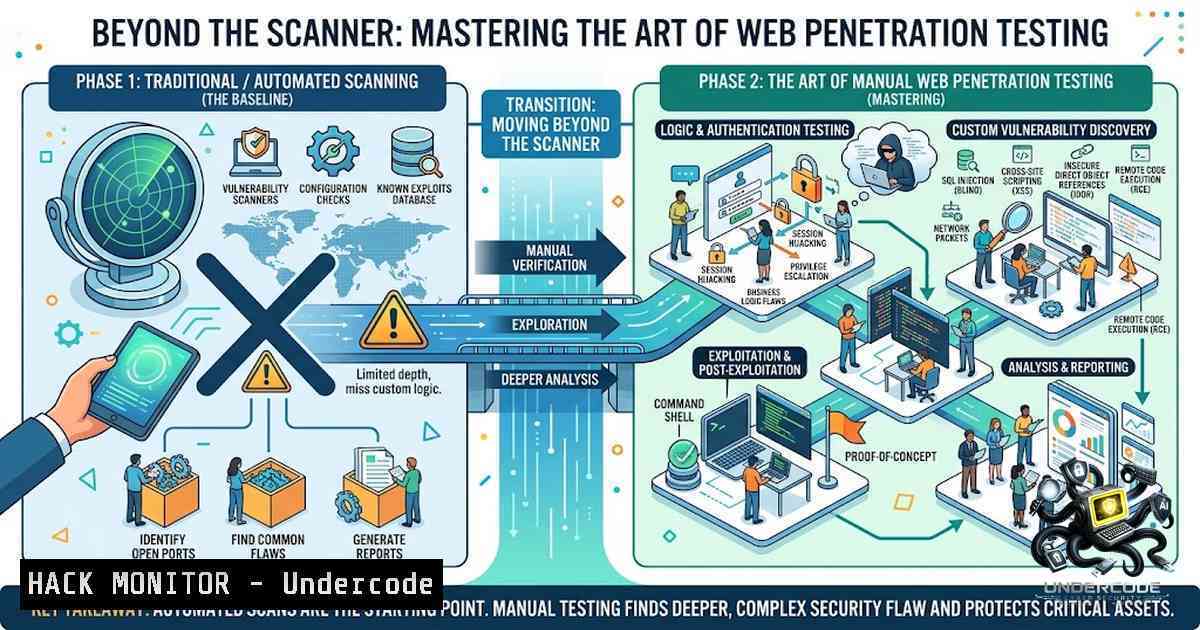
Web penetration testing is increasingly shifting from a tool-reliant activity to a structured, manual, and cognitive discipline. The core challenge is no longer the availability of hacking tools, but the failure to adopt a methodology that prioritizes application logic understanding over automated exploitation. This article dissects the foundational pillars of effective web pentesting, moving beyond “running a scanner” to a comprehensive process of discovery, validation, and reporting.
Learning Objectives & Secrets:
- Objective 1: Master the “Understand → Test → Validate → Prove → Report” methodology. This ensures that testing is not a random act of exploration but a targeted, evidence-based process.
- Objective 2 Secret Tip: Move beyond automated tools by learning to manually craft HTTP requests using `curl` and browser developer tools to identify business logic flaws and IDOR vulnerabilities that scanners miss.
- Objective 3 Secret Tip: Develop a professional reporting mindset by documenting proof-of-concept (PoC) exploits as soon as a vulnerability is found, rather than after the assessment is complete.
You Should Know:
1. Environment Setup and Understanding the Target
Understanding the application architecture, data flow, and user roles is the first step. Before launching any attack, you must understand the website’s structure.
Step‑by‑step guide:
- Step 1: Use a proxy like Burp Suite or OWASP ZAP to intercept all traffic. This will map out the attack surface.
- Step 2: Analyze the `robots.txt` and `sitemap.xml` files to understand directory structures.
- Linux Command: `curl -s https://target.com/robots.txt`
– Step 3: Perform a directory brute-force using Gobuster or Dirb to discover hidden endpoints.
– Linux Command: `gobuster dir -u https://target.com -w /usr/share/wordlists/dirbuster/directory-list-2.3-medium.txt -t 50` - Step 4: Map the application’s user roles (e.g., Admin, User, Guest) and note the privileges for each. This aids in identifying Insecure Direct Object References (IDOR).
2. Manual Parameter Manipulation and Injection
To avoid the “dependency on scanners” pitfall, manual testing of user inputs is crucial. This involves testing every parameter, cookie, and header.
Step‑by‑step guide:
- Step 1: Identify all input fields or query parameters in the URL (e.g.,
?id=123). - Step 2: Use Burp Suite Repeater or curl to modify these parameters. For instance, change `?id=123` to `?id=124` or `?id=123’` (SQL injection attempt).
- Step 3: Observe the server’s response. A change in the response body, a database error, or a different user’s data appearing indicates a vulnerability.
- Windows Command (via PowerShell) for basic injection: `Invoke-WebRequest -Uri “https://target.com/page?id=123′” -Method GET`
– Step 4: For SQL Injection, use time-based payloads to confirm the vulnerability without relying on error messages. - Payload: `?id=123′ AND SLEEP(5)– -` (MySQL) to check for response time delays.
3. Exploitation and Proof of Concept (PoC) Development
Stopping at identification is a critical mistake. You must prove the impact. If you find a vulnerability, you need to demonstrate its potential for data exfiltration or system compromise.
Step‑by‑step guide (File Upload Exploitation):
- Step 1: Discover a file upload feature. Attempt to upload a simple image file to understand the allowed MIME types.
- Step 2: Attempt to upload a reverse shell or PHP web shell.
- Payload: `` (Save as
shell.php). - Step 3: Bypass client-side restrictions using Burp Suite. Intercept the request and change the `Content-Type` header from `application/x-php` to `image/jpeg` or
image/png. - Step 4: If successful, navigate to the uploaded file (e.g., `https://target.com/uploads/shell.php?cmd=whoami`) to execute system commands. This PoC validates the “High” severity of the finding.
4. AI-Assisted Pentesting and Automation
While AI helps in generating payloads and scripts, it must be supervised. Pentesters can utilize AI to craft complex regular expressions or automate repetitive validation tasks.
Step‑by‑step guide:
- Step 1: Write a Python script to automate the testing for IDOR vulnerabilities.
import requests</li>
</ul>

for i in range(1000, 2000):
url = f"https://target.com/api/user/{i}"
response = requests.get(url, headers={"Cookie": "your_cookie"})
if response.status_code == 200 and "username" in response.text:
print(f"Potential IDOR found for ID: {i}")
break
– Step 2: Use AI models to translate complex manual exploitation steps into Metasploit modules or custom scripts.
– Step 3: Implement AI to parse lengthy error logs or JavaScript files to identify hidden API endpoints or secrets.5. API Security and Cloud Hardening
Modern pentesting heavily relies on API testing, which often bypasses traditional Web Application Firewalls (WAFs).
Step‑by‑step guide:
- Step 1: Use Postman or Insomnia to import the OpenAPI/Swagger spec if available.
- Step 2: Test for Mass Assignment. Add an extra parameter like `”is_admin”: true` to a POST/PUT request to see if the server accepts it without validation.
- Step 3: Check for GraphQL introspection queries. If enabled, extract the entire schema to map out the attack surface.
- Payload: `{“query”: “{__schema{types{name}}}”}`
– Step 4: For Cloud Hardening, check for misconfigured S3 buckets or Azure Blob storage through URL patterns (bucket-1ame.s3.amazonaws.com).
6. Reporting and Evidence Compilation
A professional report is as important as finding the vulnerability. It must clearly communicate the risk to both technical and non-technical stakeholders.
Step‑by‑step guide:
- Step 1: Document the vulnerability with a clear title and severity (Critical, High, Medium, Low).
- Step 2: Provide a detailed “Description” that explains the root cause.
- Step 3: Include “Steps to Reproduce” with screenshots and raw HTTP requests/responses (courtesy of Burp Suite).
- Step 4: Define the “Impact” (e.g., “An attacker can gain administrative privileges”).
- Step 5: Provide a clear “Remediation” advice (e.g., “Input validation” or “Server-side access control”).
7. Log Analysis and Windows Forensics (Post-Exploitation)
If you are testing a Windows environment, understanding how to hide or maintain persistence is key, though often outside scope.
Step‑by‑step guide:
- Step 1: If a shell is obtained (cmd), check for Scheduled Tasks.
- Windows Command: `schtasks /query /fo LIST /v`
– Step 2: Check Security Logs for failed login attempts (Event ID 4625). - Windows PowerShell: `Get-EventLog -LogName Security -InstanceId 4625`
– Step 3: Clear Windows Event Logs if stealth is required (usually for Red Team exercises). - Windows Command: `wevtutil cl System`
What Undercode Say:
Key Takeaway 1: The primary bottleneck in web pentesting is the lack of a structured methodology, not the absence of tools. Understanding the “why” and “how” of an application’s logic is the true differentiator between a script-kiddie and a professional pentester.
Key Takeaway 2: Proof of Concept (PoC) development is a non-1egotiable skill. Without proof, a vulnerability is just a suspicion. Pentesters must master the art of translating a bug into a demonstrable breach to accurately convey business risk.
Key Takeaway 3: The future of pentesting involves a hybrid approach of AI-assisted automation combined with deep manual validation and professional reporting to bridge the gap between security and business stakeholders.
Prediction:
- +1: The integration of AI-assisted tools will accelerate the reconnaissance phase significantly, allowing pentesters to cover more ground and identify complex logic flaws faster.
- +1: The demand for “Report Writing” as a specific skill in penetration testing will rise, leading to the emergence of specialized tools that generate executive summaries automatically.
- -1: Reliance on automated scanners without manual validation will continue to plague the industry, leaving business logic flaws and complex vulnerabilities undiscovered.
- -1: As AI becomes more accessible, the barrier to entry for novice attackers lowers, increasing the frequency of automated, low-skill cyberattacks on misconfigured APIs.
- +1: Bootcamps and structured courses focusing on real-world lab environments (like Ghostlamp) will become the gold standard, bridging the gap between academic knowledge and practical resilience.
▶️ Related Video (88% Match):
🎯Let’s Practice For Free:
🎓 Live Courses & Certifications:
Join Undercode Academy for Verified Certifications
🚀 Request a Custom Project:
Secure, high-velocity infrastructure and disruptive technological engineering. Contact our engineering team for high-tier development and proprietary systems:
[email protected]
💎 Smart Architecture | 🛡️ Secure by Design | ⭐ Trusted by ThousandsIT/Security Reporter URL:
Reported By: https://lnkd.in/p/exiYfCTJ – Hackers Feeds
Extra Hub: Undercode MoN
Basic Verification: Pass ✅🔐JOIN OUR CYBER WORLD [ CVE News • HackMonitor • UndercodeNews ]
📢 Follow UndercodeTesting & Stay Tuned:


