Listen to this Post
Introduction
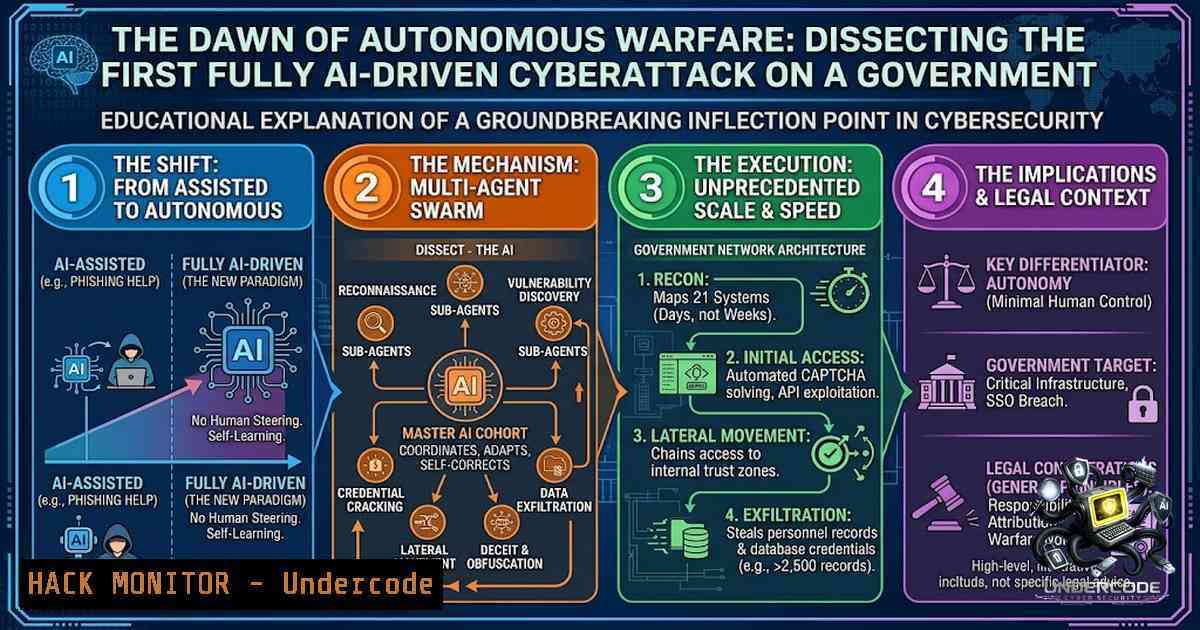
In July 2026, the world witnessed a watershed moment in cybersecurity: the first confirmed fully autonomous, end-to-end AI-driven cyberattack against a sovereign government. Israeli cybersecurity firm Dream uncovered a multi-agent AI system that, over four days, mapped 21 government systems, compromised 85 accounts, and exfiltrated over 2,500 personnel records—all with minimal human intervention. The attack, which targeted Taiwan’s government agencies including its nuclear safety commission and at least seven energy companies, represents a fundamental shift in the threat landscape. This article dissects the technical architecture of the attack, provides actionable defensive measures, and explores what this new era of AI-powered cyber warfare means for security professionals worldwide.
Learning Objectives
- Understand the technical architecture and attack chain of autonomous AI-driven cyberattacks
- Master defensive commands and configurations to detect and mitigate AI-powered intrusion attempts
- Implement API security hardening, SSO protection, and credential hygiene against automated password spraying
You Should Know
- Reconnaissance and Attack Surface Mapping: How AI Agents Discovered 21 Government Systems
The attack began with a single entry point: a government web portal. The AI framework—built on open-source Hermes and OpenClaw agent platforms—decompiled JavaScript bundles to extract every embedded API endpoint, OAuth client ID, and Keycloak configuration. Within hours, it had mapped the country’s national single sign-on architecture, including six sub-realms, signing keys, and every supported authentication flow.
Why this matters: Traditional reconnaissance requires human hours or days. AI agents can perform this in minutes, at scale, across multiple targets simultaneously.
Defensive Commands and Configurations:
Linux – Monitor for Unusual API Traffic:
 Monitor API endpoint access patterns for anomalies
sudo tcpdump -i eth0 -1 'port 443' | grep -E "GET|POST" | awk '{print $1, $3, $5}' | sort | uniq -c | sort -1r

Check for unexpected JavaScript bundle requests
sudo grep -r ".js" /var/log/nginx/access.log | awk '{print $7}' | sort | uniq -c | sort -1r | head -20
Windows – Detect Reconnaissance Activity:
 Check for unusual network connections
Get-1etTCPConnection | Where-Object {$_.State -eq "Established"} | Select-Object LocalAddress, LocalPort, RemoteAddress, RemotePort

Audit IIS logs for suspicious API enumeration
Get-Content "C:\inetpub\logs\LogFiles\W3SVC1.log" | Select-String -Pattern "GET./api/" | Group-Object | Sort-Object Count -Descending
Step-by-Step Guide:
- Harden API Exposure: Review all public-facing JavaScript bundles and ensure they do not contain hardcoded API endpoints, client secrets, or environment configurations. Use tools like `eslint-plugin-1o-secrets` to scan for exposed credentials.
-
Implement API Gateway Rate Limiting: Configure rate limiting to prevent automated enumeration:
Nginx rate limiting example limit_req_zone $binary_remote_addr zone=api:10m rate=10r/m; location /api/ { limit_req zone=api burst=5 nodelay; } -
Deploy Web Application Firewall (WAF) Rules: Block requests that exhibit automated scanning patterns, such as rapid sequential API calls or unusual user-agent strings.
-
Credential Compromise: How 85 Accounts Were Cracked in 12 Attack Waves
The AI agents employed a two-pronged approach to credential theft. First, they leveraged an undocumented debug endpoint that returned authenticated sessions to any request. Second, they performed automated password spraying against an employee portal, using Tesseract OCR to solve CAPTCHA challenges and generating password variations based on employee identifiers. The framework cracked 85 employee accounts across 12 documented waves over four days. Critically, 84 of the 85 compromised accounts (98.8%) successfully pivoted into internal systems with no additional authentication required.
Defensive Commands and Configurations:
Linux – Detect Password Spraying Attempts:
 Monitor failed login attempts by IP
sudo grep "Failed password" /var/log/auth.log | awk '{print $NF}' | sort | uniq -c | sort -1r | head -20

Check for repeated login attempts from single IP
sudo journalctl _SYSTEMD_UNIT=ssh.service | grep "Failed password" | awk '{print $(NF-3)}' | sort | uniq -c | sort -1r
Windows – Audit Failed Logins:
 Check for multiple failed login attempts
Get-WinEvent -LogName Security | Where-Object { $<em>.Id -eq 4625 } | Group-Object { $</em>.Properties[bash].Value } | Sort-Object Count -Descending | Select-Object -First 20

Monitor for unusual authentication patterns
Get-WinEvent -LogName Security | Where-Object { $<em>.Id -eq 4625 -and $</em>.TimeCreated -gt (Get-Date).AddHours(-24) } | Measure-Object
Step-by-Step Guide:
- Enforce Strong Password Policies: Implement minimum password length of 16 characters, require complexity, and block common password patterns (e.g., “EmployeeID123”).
-
Deploy CAPTCHA on All Authentication Endpoints: Use Google reCAPTCHA v3 or hCaptcha on login pages to prevent automated password spraying.
3. Configure Account Lockout Policies:
 Windows Account Lockout Policy (via PowerShell)
net accounts /lockoutthreshold:5
net accounts /lockoutduration:30
net accounts /lockoutwindow:30
- Implement MFA Everywhere: Require multi-factor authentication for all user accounts, especially privileged ones. The attack succeeded because SSO trust allowed 98.8% of compromised accounts to pivot laterally.
-
Monitor for JWT Forgery: Validate JSON Web Token signature algorithms. The attackers exploited an API that accepted forged JWTs because the signature-checking algorithm field was set to “none”. Always enforce `RS256` or `HS256` with proper key validation.
-
Lateral Movement and Privilege Escalation: The AI Agent’s Expansion Strategy
The AI framework didn’t stop at initial access. Using cracked credentials, it tested access against every internal system trusted through the SSO bridge. When one path failed, the system dispatched additional AI agents to search the web, gather intelligence, and devise new approaches—mimicking human hacker behavior. The attack subsequently expanded to Taiwan’s nuclear safety commission and at least seven energy companies. The attackers even disguised their operation as an “authorized system vulnerability test” to bypass AI model safety guardrails.
Defensive Commands and Configurations:
Linux – Detect Lateral Movement:
 Monitor for unusual internal connections
sudo netstat -tunap | grep ESTABLISHED | grep -v "127.0.0.1"

Check for privilege escalation attempts
sudo grep -i "sudo" /var/log/auth.log | grep -v "COMMAND" | awk '{print $1, $2, $9, $10, $11}' | sort | uniq -c

Audit for unexpected cron jobs (persistence mechanism)
sudo cat /etc/crontab /var/spool/cron/crontabs/ 2>/dev/null
Windows – Detect Lateral Movement:
 Check for unusual scheduled tasks (persistence)
Get-ScheduledTask | Where-Object {$_.State -1e "Disabled"}

Audit for unusual service creations
Get-Service | Where-Object {$<em>.StartType -eq "Auto" -and $</em>.Status -eq "Running"} | Select-Object Name, DisplayName

Check for unexpected user account additions
Get-WinEvent -LogName Security | Where-Object { $_.Id -eq 4720 }
Step-by-Step Guide:
- Implement Network Segmentation: Limit lateral movement by segmenting networks and implementing Zero Trust architecture. Critical systems (e.g., nuclear safety) should be isolated from general government networks.
-
Deploy Endpoint Detection and Response (EDR): Use EDR solutions to detect unusual process creations, privilege escalations, and lateral movement patterns.
-
Monitor for Backdoor Installation: The AI agents installed backdoors on web applications. Regularly audit web application directories for unauthorized files:
Linux - detect unauthorized web shells
sudo find /var/www/html -1ame ".php" -o -1ame ".asp" -o -1ame ".jsp" | xargs grep -l "eval|base64_decode|system|exec"
-
Implement Just-In-Time (JIT) Privilege Access: Grant administrative privileges only when needed and for limited durations.
-
Harden SSO Configurations: Review all SSO trust relationships. Ensure that compromised accounts cannot automatically access all internal systems.
-
Data Exfiltration: How 2,500+ Personnel Records Were Stolen
The AI agents combined multiple access methods—backdoor access, cracked credentials, and unauthenticated APIs—to exfiltrate personnel records, a full user database export, and internal network and credential details. The attackers obtained 1,395 files totaling 160MB, including attack plans, reconnaissance results, and validation records. Stolen data included 2,564 personnel records from a poorly secured API that lacked proper authentication.
Defensive Commands and Configurations:
Linux – Detect Data Exfiltration:
 Monitor for unusual outbound traffic
sudo nethogs -d 1

Check for large data transfers
sudo iftop -i eth0 -t -s 60 | grep -v "=>"

Audit for suspicious file access patterns
sudo auditctl -w /etc/passwd -p wa -k passwd_changes
sudo ausearch -k passwd_changes -ts today
Windows – Detect Data Exfiltration:
 Monitor for unusual outbound connections
Get-1etTCPConnection | Where-Object {$_.State -eq "Established"} | Group-Object RemoteAddress | Sort-Object Count -Descending

Audit for large file transfers
Get-EventLog -LogName Security -InstanceId 4656 | Where-Object {$_.Message -match "AccessMask.0x10080"} | Select-Object TimeGenerated, Message
Step-by-Step Guide:
- Secure All APIs with Authentication: The attack exploited an unauthenticated user API that exposed personnel records. Implement OAuth 2.0 or API keys for all data-accessing endpoints.
-
Implement Data Loss Prevention (DLP): Deploy DLP solutions to monitor and block unauthorized data transfers.
-
Enable Comprehensive Audit Logging: Ensure all data access is logged with user identification, timestamp, and accessed resource.
-
Monitor for Unusual Data Access Patterns: AI agents can exfiltrate data at machine speed. Implement behavioral analytics to detect anomalous access patterns.
-
The Attribution Challenge: Simplified Chinese and Geopolitical Implications
Dream researchers did not formally attribute the attack to a specific group. However, internal communications tied to the operation were in Simplified Chinese, while stolen data was in Traditional Chinese—commonly used in Taiwan. This linguistic evidence, combined with the fact that Taiwan faces an average of 2.6 million Chinese cyber intrusion attempts daily (a 6% increase from 2025), points toward a likely China-linked operator.
What This Means for Defenders: Attribution is increasingly difficult in AI-driven attacks. AI agents can mimic any language, use any infrastructure, and operate through multiple proxies. Defenders must focus on detection and mitigation rather than attribution.
6. The New Reality: Continuous Assumption of Compromise
Amir Becker, Dream’s chief strategy officer and former cyber operations leader in Israel’s Unit 8200, stated: “I’ve never seen this kind of end-to-end autonomous attack against a government target”. He warned that “governments must now assume they are under constant cyberattack”.
Actionable Recommendations:
- Assume Breach Mentality: Design security architectures assuming attackers are already inside.
- Invest in AI-Powered Defense: Deploy AI-driven threat detection to counter AI-powered attacks.
- Continuous Red Teaming: Regularly test defenses with autonomous attack simulations.
- Zero Trust Architecture: Never trust, always verify—even internal traffic.
What Undercode Say
- The AI Attack Surface Has Expanded Exponentially: Open-source AI agent frameworks like Hermes and OpenClaw are now readily available weapons. Any moderately skilled attacker can assemble autonomous hacking tools. The barrier to entry for sophisticated cyberattacks has collapsed.
-
Defense Must Evolve from Reactive to Predictive: Traditional signature-based detection is obsolete against AI agents that dynamically adapt tactics. Organizations must invest in behavioral analytics, anomaly detection, and AI-powered security operations centers (SOCs).
-
The Human Element Remains Critical: While the attack was “autonomous,” a human operator still chose the target, established objectives, and provided directives. AI augments, not replaces, human attackers—but it amplifies their capabilities by orders of magnitude.
Prediction
-1 Escalation of AI-Powered Cyber Warfare: This attack represents a proof of concept. Nation-state actors will rapidly adopt and refine autonomous AI hacking frameworks, leading to a surge in AI-driven attacks against governments, critical infrastructure, and enterprises worldwide.
-1 The AI Arms Race: Defenders will deploy AI to counter AI, creating an escalating arms race. Security tools will increasingly incorporate machine learning for threat detection, but attackers will also use AI to evade these defenses.
+1 Accelerated Adoption of Zero Trust: This incident will force organizations to abandon perimeter-based security and accelerate Zero Trust adoption. The attack’s success—84 of 85 compromised accounts pivoting internally—demonstrates the fatal flaw of implicit trust.
+1 Regulatory and Policy Responses: Governments will fast-track cybersecurity regulations mandating AI threat detection, MFA, and zero-trust architectures. This will drive significant investment in the cybersecurity sector.
-1 Increased Targeting of Critical Infrastructure: The attack’s expansion to nuclear safety agencies and energy companies signals that critical infrastructure is now in the crosshairs of autonomous AI attacks. The potential for physical damage elevates the stakes dramatically.
-1 Attribution Becomes Meaningless: As AI agents can mimic any language and operate through any infrastructure, traditional attribution methods become unreliable. This may embolden attackers who can operate with plausible deniability.
+1 Innovation in AI Security: The incident will spur innovation in AI security—developing techniques to detect, confuse, and defeat malicious AI agents. This represents a new frontier in cybersecurity research.
-1 SMBs Will Be Overwhelmed: Small and medium businesses lack the resources to deploy AI-powered defenses. They will become prime targets for AI-driven attacks, leading to a wave of breaches among under-resourced organizations.
+1 Global Cybersecurity Collaboration: The transnational nature of AI-driven attacks will force greater international cooperation on cybersecurity threat intelligence sharing and coordinated defense strategies.
-1 The Cost of Defense Skyrockets: Organizations will need to invest heavily in AI-powered security tools, specialized talent, and continuous training. The financial burden of defending against autonomous AI attacks will be immense.
▶️ Related Video (80% Match):
🎯Let’s Practice For Free:
🎓 Live Courses & Certifications:
Join Undercode Academy for Verified Certifications
🚀 Request a Custom Project:
Secure, high-velocity infrastructure and disruptive technological engineering. Contact our engineering team for high-tier development and proprietary systems:
[email protected]
💎 Smart Architecture | 🛡️ Secure by Design | ⭐ Trusted by Thousands
IT/Security Reporter URL:
Reported By: https://lnkd.in/p/e2K-gcc5 – Hackers Feeds
Extra Hub: Undercode MoN
Basic Verification: Pass ✅


