Listen to this Post
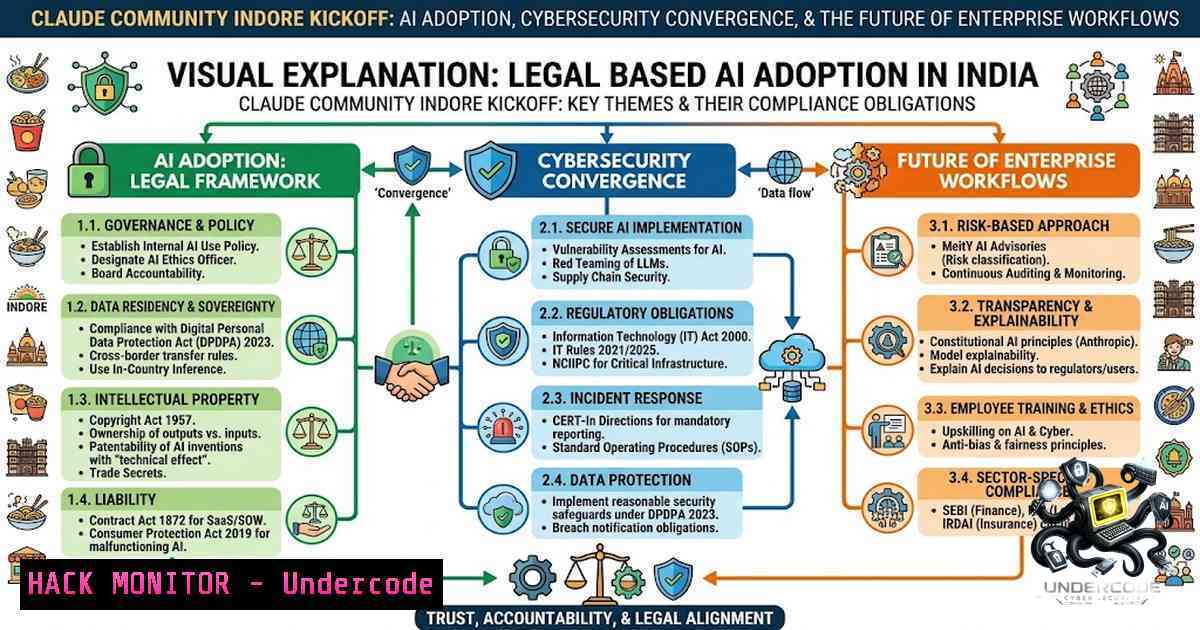
Introduction:
The convergence of generative AI with enterprise IT and cybersecurity is no longer a theoretical discussion—it is an operational reality. The recent Claude Community meetup in Indore, officially supported by Anthropic, brought together a diverse cohort of IT veterans with 21+ years of experience, ethical hackers, founders, and developers to dissect how AI is reshaping workflows and security postures. The event highlighted a critical inflection point: organizations are moving beyond experimentation to full-scale integration, necessitating a deep understanding of AI model governance, API security, and infrastructure hardening.
Learning Objectives:
- Understand the core security implications of integrating large language models (LLMs) like Claude into enterprise environments.
- Identify practical steps for hardening AI infrastructure and managing API keys to prevent data leakage.
- Learn how to combine AI troubleshooting with traditional system administration (Linux/Windows) for hybrid operational resilience.
You Should Know:
- Risk Assessment and Governance for AI Models in Enterprise IT
The discussions in Indore centered heavily on how professionals are “adopting AI and preparing their teams.” A critical first step is establishing a governance framework that treats AI models as third-party vendors with significant data access. This involves mapping data flows—what data is sent to the API, where it is stored, and how it is used for training. Organizations must implement data loss prevention (DLP) policies that restrict sensitive information from being pasted into public models.
Step‑by‑step guide to audit AI usage:
- Inventory: List all AI tools (Claude, ChatGPT, etc.) used across departments.
- Data Classification: Tag data based on sensitivity (e.g., PII, financial, intellectual property).
- Policy Creation: Draft a policy defining “acceptable use” and prohibited data types.
- Implementation: Use browser extensions or proxy servers to block requests containing regex patterns for credit cards or SSNs.
-
Linux Command (Audit Logs): To monitor outbound traffic to AI endpoints on a Linux gateway, use:
sudo tcpdump -i eth0 -1 dst host api.anthropic.com or dst host api.openai.com
- Windows Command (Firewall Rule): To block specific AI endpoints except for authorized IPs on Windows, use:
New-1etFirewallRule -DisplayName "Block AI API Outbound" -Direction Outbound -RemoteAddress 123.123.123.0/24 -Action Block
- Securing API Keys and Secrets Management for Claude Integration
A recurring theme in the meetup was the need for organizations to prepare for the “next era.” This preparation must include rigorous secrets management. Hardcoding API keys in scripts or repositories is a critical vulnerability that can lead to financial theft or data breaches. Leveraging environment variables and vault solutions is non-1egotiable.
Step‑by‑step guide to secure API keys:
- Remove Hardcoded Keys: Scan repositories using `gitleaks` or
trufflehog. - Use Environment Variables: Store keys in `.env` files (never commit them).
- Rotate Keys: Implement a rotation policy (e.g., every 90 days).
-
Linux Command (GitLeaks Installation and Scan):
wget https://github.com/zricethezav/gitleaks/releases/download/v8.16.0/gitleaks_8.16.0_linux_x64.tar.gz
tar -xvf gitleaks_8.16.0_linux_x64.tar.gz
./gitleaks detect --source . --report-format json --report-path leaks.json
- Tutorial (Windows – Environment Variable):
Open Command Prompt as Administrator and run:
setx CLAUDE_API_KEY "your-api-key-here" /M
(Note: Use `/M` for system-wide, which requires admin rights).
3. AI-Assisted Incident Response and Threat Hunting
With the energy described in the meetup, it is clear that professionals are enthusiastic about AI’s potential. For security teams, this translates into using LLMs to parse large log files and summarize threat intelligence. However, this requires caution; AI outputs must be verified. You can create a “security sandbox” prompt to analyze suspicious scripts.
Step‑by‑step guide to using Claude for log analysis (safely):
– Sanitize Logs: Remove IPs and usernames before sending to the AI.
– Prompt Engineering: Ask the AI to “Summarize the top 5 critical errors in this syslog format and provide potential mitigation steps.”
– Validation: Cross-reference the AI’s suggestions with standard security databases (e.g., CVE).
- Linux Command (Extract Critical Logs for AI):
grep -i "error|critical|fail" /var/log/syslog | head -1 20 > sanitized_logs.txt
- Tutorial (Windows – Event Log Extraction):
Use PowerShell to export specific events (e.g., Event ID 4625 for failed logons) for analysis:Get-WinEvent -LogName Security | Where-Object { $_.Id -eq 4625 } | Export-Csv -Path failed_logons.csv -1oTypeInformation
4. Cloud Infrastructure Hardening for AI Workloads
As founders and developers shared stories of building startups, the conversation naturally touched on cloud deployment. AI workloads often require significant compute power, leading to misconfigurations in IAM (Identity and Access Management) roles and S3 buckets. Attackers frequently target exposed storage containing training data or model weights.
Step‑by‑step guide to hardening cloud AI infrastructure:
- Restrict S3 Bucket Policies: Ensure buckets are not public.
- Enable MFA Delete: Prevent accidental deletion of critical model files.
- Use VPC Endpoints: Prevent models from accessing the public internet unnecessarily.
-
CLI Example (AWS – Check S3 Public Access):
aws s3api get-public-access-block --bucket your-ai-bucket-1ame
- Tutorial (Azure – Managed Identity):
Instead of storing secrets, use Azure Managed Identities to authenticate to Azure AI services.az webapp identity assign --1ame myAIApp --resource-group myResourceGroup
- Cross-Functional Collaboration: Bridging the Gap Between Dev, Sec, and Ops
The meetup highlighted a mix of “ethical hacking & cybersecurity” and “developers.” This is the essence of DevSecOps. The friction between velocity (developers wanting to use AI) and security (preventing data leaks) must be resolved through shared responsibility. Implementing “Security Champions” within AI projects ensures that security is involved from the design phase (Shift-Left Security).
Step‑by‑step guide to fostering collaboration:
- Mandatory Security Review: Implement a “security review checklist” for any new AI integration.
- Shadowing Sessions: Encourage security engineers to shadow developers during coding sessions with AI.
- Shared Dashboards: Create a unified dashboard showing API costs and potential security anomalies.
Tutorial (Linux/Windows – Setting up a Shared Log Monitor):
Use `rsyslog` on Linux to forward logs to a central SIEM or a simple shared folder:
. @192.168.1.100:514 Forward all logs to SIEM
What Undercode Say:
- Key Takeaway 1: The energy and diversity of the Indore meetup underscore that AI literacy is rapidly becoming a baseline requirement for all IT professionals, from ethical hackers to system architects.
- Key Takeaway 2: The integration of AI is not just about productivity; it is a security and governance challenge that requires a proactive, community-driven approach to avoid introducing new attack vectors.
Analysis:
The “Claude Community Indore” event signifies a cultural shift. The presence of veterans with 21 years of experience alongside startup founders suggests that the barrier to AI adoption has lowered, but the stakes have simultaneously increased. For cybersecurity teams, this means AI itself becomes a new “perimeter” to defend. The sharing of experiences in the meetup is a microcosm of a larger industry need: knowledge exchange. As organizations race to deploy Claude and other LLMs, the shortage of skilled personnel who understand both the AI capabilities and the underlying infrastructure security is palpable. This underscores the importance of continuous education and hands-on experimentation in safe environments.
Prediction:
- +1 Community-driven events like this Indore meetup will be the primary drivers of organic AI security guidelines, filling the gaps left by slow-moving regulatory bodies.
- +1 The integration of AI with DevOps will create a new “AIOps” niche, accelerating incident response times by 40% as teams learn to leverage AI for preliminary log analysis.
- -1 The democratization of AI access will lead to a “Shadow AI” crisis in 2026, where unauthorized model usage exposes sensitive data, forcing CISOs to mandate strict API traffic monitoring similar to DLP solutions.
- +1 Cross-pollination between ethical hackers and AI developers will result in “Red-Teaming” becoming a standard feature in LLM development lifecycles, making future models inherently more robust against prompt injections.
▶️ Related Video (80% Match):
🎯Let’s Practice For Free:
🎓 Live Courses & Certifications:
Join Undercode Academy for Verified Certifications
🚀 Request a Custom Project:
Secure, high-velocity infrastructure and disruptive technological engineering. Contact our engineering team for high-tier development and proprietary systems:
[email protected]
💎 Smart Architecture | 🛡️ Secure by Design | ⭐ Trusted by Thousands
IT/Security Reporter URL:
Reported By: https://lnkd.in/p/einbw6Bu – Hackers Feeds
Extra Hub: Undercode MoN
Basic Verification: Pass ✅


