Listen to this Post
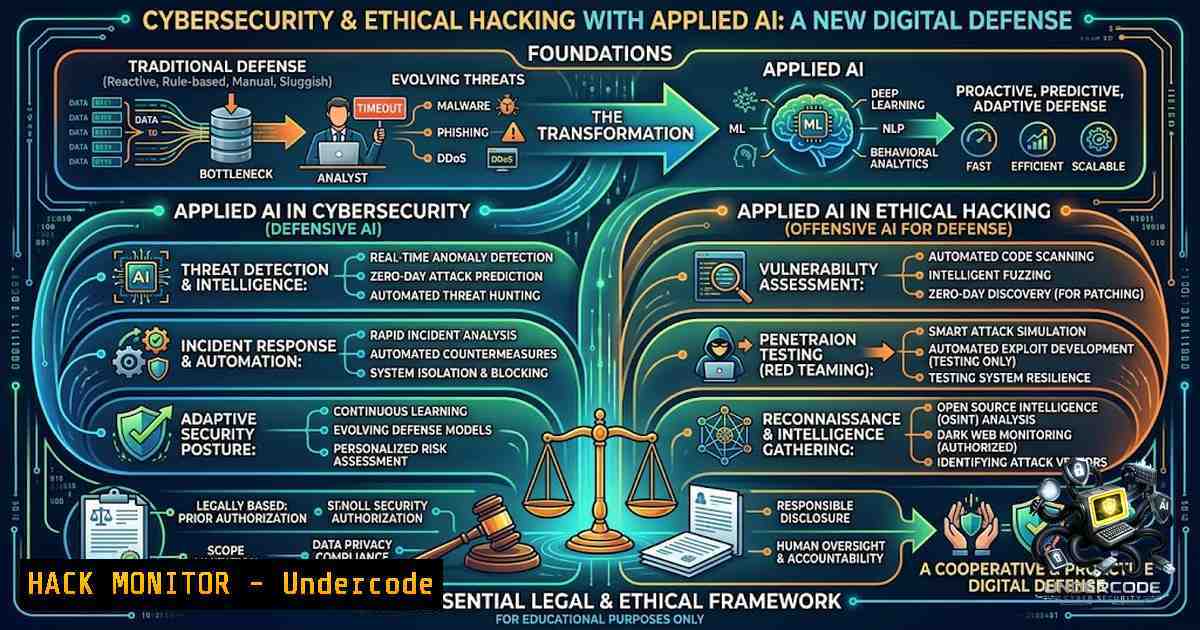
Introduction:
The convergence of artificial intelligence and cybersecurity is fundamentally reshaping how organizations defend against and respond to cyber threats. As AI-powered attacks become increasingly sophisticated—with CrowdStrike reporting an 89% year-over-year surge in AI-enabled adversary operations and average breakout times dropping to just 29 minutes—the demand for professionals trained in both ethical hacking and applied AI has never been more critical. Programs like the Certification Program in Cyber Security and Ethical Hacking with Applied AI from iHUB DivyaSampark, IIT Roorkee represent a pivotal step in building the next generation of cybersecurity talent equipped to defend against AI-driven threats.
Learning Objectives:
- Master the foundational principles of ethical hacking, including reconnaissance, vulnerability assessment, and penetration testing methodologies
- Understand how applied AI and machine learning enhance threat detection, automate security operations, and strengthen defensive postures
- Develop practical skills in using AI-powered security tools for vulnerability scanning, exploit generation, and incident response
1. AI-Powered Penetration Testing: The New Frontier
The integration of large language models into offensive security tooling is transforming how penetration tests are conducted. Traditional manual penetration testing, while thorough, is time-intensive and difficult to scale. AI-assisted tools are now bridging this gap by automating reconnaissance, vulnerability assessment, and even exploit generation.
WiFiPenTester: GenAI-Enabled Wireless Ethical Hacking
Researchers have developed WiFiPenTester, an experimental system that integrates LLMs into wireless security assessments. The system enables intelligent target ranking, attack feasibility estimation, and strategy recommendation while maintaining strict human-in-the-loop control. Experimental results demonstrate that GenAI assistance improves target selection accuracy and overall assessment efficiency.
AIRecon: Offline AI-Powered Penetration Testing
AIRecon is an autonomous penetration testing agent that runs entirely offline, combining a self-hosted Ollama LLM with a Kali Linux Docker sandbox. It structures engagements through four automated phases with checkpoint evaluations every 5, 10, and 15 iterations. The tool includes a dataset companion indexing approximately 1.09 million security records including CVEs, red team techniques, and CTF writeups.
Installation and Basic Usage:
 Install AIRecon (requires Python 3.12+, Docker 20.10+, and Ollama)
curl -fsSL https://raw.githubusercontent.com/pikpikcu/airecon/main/install.sh | bash

Pull a suitable model (Qwen3.5 9B for minimum viable setup)
ollama pull qwen3.5:9b

Launch AIRecon
airecon
For Windows users, AIRecon can be run through WSL2 with Docker Desktop installed, or via the Google Colab T4 GPU tunnel setup.
Nebula: LLM-Powered Terminal Integration
Nebula brings LLM capabilities directly into the penetration tester’s terminal, allowing ethical hackers to automate vulnerability assessments, generate exploit scripts, and maintain engagement documentation without switching contexts. It supports multiple AI backends including OpenAI API models, Meta’s Llama-3.1, Mistral AI, and DeepSeek.
Installation:
 Install Nebula via pip
python -m pip install nebula-ai --upgrade

For local inference with Ollama
ollama pull mistral

For OpenAI models, set API key
export OPENAI_API_KEY="your-api-key"

Launch Nebula
nebula
2. Cloud Security Hardening with AI-Driven Automation
As organizations accelerate cloud adoption, AI is playing an increasingly vital role in automating cloud security hardening. AWS Security Hub CSPM now offers an AI Security Best Practices standard with 31 automated security controls, while Google Cloud has made essential AI security and cloud security on by default with a newly enhanced Security Command Center.
Zero Trust Architecture Implementation
Implementing Zero Trust Architecture (ZTA) in cloud environments requires rigorous identity verification, least-privilege access, and continuous monitoring. AI-powered frameworks are now enabling autonomous cloud security hardening through generative AI and reinforcement learning.
Linux Command for Auditing Cloud Security Posture:
 Audit AWS IAM policies for overly permissive roles
aws iam list-roles --query 'Roles[?AssumeRolePolicyDocument.Statement[?Effect==<code>Allow</code> && Principal==``]]' --output table

Check for publicly accessible S3 buckets
aws s3api list-buckets --query 'Buckets[].Name' | xargs -I {} aws s3api get-bucket-acl --bucket {} --query 'Grants[?Grantee.URI==`http://acs.amazonaws.com/groups/global/AllUsers`]'

Azure: List storage accounts with public access
az storage account list --query "[?allowBlobPublicAccess == true].name" -o table
Windows PowerShell for Azure Security Auditing:
 Get Azure AD sign-in logs with risky events
Get-AzureADAuditSignInLogs -Filter "riskLevel gt 0" | Select-Object UserPrincipalName, RiskLevel, RiskEventTypes

Check Azure Key Vault access policies
Get-AzKeyVault | ForEach-Object { Get-AzKeyVaultAccessPolicy -VaultName $_.VaultName }
- API Security in the Age of AI Agents
APIs remain a primary attack vector, and the rise of AI agents introduces new security challenges. The OWASP Top 10 for LLM Applications now addresses prompt injection, insecure output handling, and supply chain vulnerabilities. Tools like offsec-ai probe live AI/LLM endpoints for the OWASP LLM Top 10 vulnerabilities.
API Security Testing Commands
 Using OWASP ZAP for API scanning
zap-cli quick-scan --api -t https://api.target.com/v1

Using Nuclei for API vulnerability detection
nuclei -target https://api.target.com -t ~/nuclei-templates/http/exposures/

Testing for GraphQL introspection vulnerabilities
curl -X POST https://api.target.com/graphql -H "Content-Type: application/json" -d '{"query":"query { __schema { types { name } } }"}'
Burp Suite AI Security Extensions
Burp Suite Professional now includes Burp AI capabilities, offering 10,000 free Burp AI credits annually. Security engineers can intercept LLM API calls, perform fuzzing on AI endpoints, and test for prompt injection using HTTP-based methodologies.
4. AI-Powered SIEM and Threat Detection
Security Information and Event Management (SIEM) platforms are being revolutionized by AI. Datadog Cloud SIEM now offers AI-driven investigations that can cut investigation times from hours to as little as 30 seconds. Graylog’s Spring 2026 release introduces explainable AI that summarizes dashboards, prioritizes risks, and automates workflows.
Basic SIEM Log Analysis with ELK Stack
 Install ELK Stack on Ubuntu
wget -qO - https://artifacts.elastic.co/GPG-KEY-elasticsearch | sudo apt-key add -
sudo apt-get install apt-transport-https
echo "deb https://artifacts.elastic.co/packages/7.x/apt stable main" | sudo tee /etc/apt/sources.list.d/elastic-7.x.list
sudo apt-get update && sudo apt-get install elasticsearch kibana logstash

Start Elasticsearch
sudo systemctl start elasticsearch
sudo systemctl enable elasticsearch

Ingest logs with Filebeat
sudo filebeat modules enable system
sudo filebeat setup
sudo filebeat start
Windows PowerShell for Security Log Analysis:
 Query Windows Security Event Logs for failed logins (Event ID 4625)
Get-WinEvent -FilterHashtable @{LogName='Security'; ID=4625; StartTime=(Get-Date).AddHours(-24)} |
Select-Object TimeCreated, @{N='User';E={$<em>.Properties[bash].Value}}, @{N='SourceIP';E={$</em>.Properties[bash].Value}}

Check for suspicious PowerShell executions (Event ID 4104)
Get-WinEvent -FilterHashtable @{LogName='Microsoft-Windows-PowerShell/Operational'; ID=4104} |
Select-Object TimeCreated, @{N='Script';E={$<em>.Properties[bash].Value}} | Where-Object {$</em>.Script -match "Invoke-|DownloadString|Base64"}
5. Defending Against Generative AI-Powered Attacks
The dual-use nature of generative AI means adversaries are leveraging the same technologies defenders use. IBM’s X-Force 2026 Threat Intelligence Index reveals that threat actors are applying generative AI to scale phishing operations, accelerate malicious code development, and enhance social engineering. Attackers have been observed injecting malicious prompts into legitimate generative AI tools to generate commands for credential theft and cryptocurrency theft.
LLM Security Testing Commands
 Using aicu-scanner for LLM application security testing
pip install aicu-scanner
aicu scan --target https://llm-api.target.com --payloads prompt_injection,indirect_injection

Using garak for LLM red-teaming (Apache 2.0)
pip install garak
garak --model_type huggingface --model_name gpt2 --probes all

Test for OWASP LLM Top 10 vulnerabilities
offsec-ai --scan https://llm-endpoint.target.com --owasp-llm
What Undercode Say:
- The convergence of AI and cybersecurity is not optional—it’s imperative. Professionals who understand both domains will be uniquely positioned to defend against AI-powered threats and leverage AI for defensive advantage.
-
Practical, hands-on experience matters more than theory. Programs that combine certification with real-world labs, simulations, and AI tool integration produce professionals ready to tackle the evolving threat landscape.
-
The attack surface is expanding faster than traditional defenses can adapt. With AI reducing breakout times to minutes and 23.6% of exploited CVEs attacked on or before disclosure day, organizations must adopt continuous, AI-powered security testing over periodic engagements.
-
Ethical hacking with AI requires governance and oversight. Systems like WiFiPenTester demonstrate that GenAI assistance improves efficiency while maintaining auditability and ethical safeguards when proper governance mechanisms are in place.
-
The future belongs to hybrid defenders. The most effective security professionals will combine deep technical knowledge of networks, systems, and protocols with proficiency in AI/ML, cloud security, and automation—exactly the skillset cultivated by programs like those offered through iHUB DivyaSampark, IIT Roorkee.
Prediction:
-
+1 The cybersecurity talent gap will narrow as AI-powered training and certification programs scale, producing more qualified professionals equipped to handle advanced threats.
-
-1 AI-enabled cyberattacks will continue to outpace traditional defense mechanisms, with the gap between attack speed and response time widening unless organizations invest in AI-1ative security tools.
-
+1 The integration of AI into penetration testing will democratize security assessment, enabling smaller organizations to conduct sophisticated security evaluations previously accessible only to enterprises with large security budgets.
-
-1 The rise of autonomous AI red-teaming tools will create new attack surfaces as adversaries adapt these same technologies for malicious purposes, leading to an AI arms race in cybersecurity.
-
+1 Applied AI in cybersecurity will shift the balance of power toward defenders by enabling faster threat detection, automated response, and more intelligent vulnerability prioritization.
-
-1 Organizations that fail to adopt AI-driven security measures will face increasingly severe breaches as attackers leverage AI to accelerate exploitation and evade traditional signature-based detection.
▶️ Related Video (86% Match):
https://www.youtube.com/watch?v=0d5Fr29pSYM
🎯Let’s Practice For Free:
🎓 Live Courses & Certifications:
Join Undercode Academy for Verified Certifications
🚀 Request a Custom Project:
Secure, high-velocity infrastructure and disruptive technological engineering. Contact our engineering team for high-tier development and proprietary systems:
[email protected]
💎 Smart Architecture | 🛡️ Secure by Design | ⭐ Trusted by Thousands
IT/Security Reporter URL:
Reported By: https://lnkd.in/p/e7wfYuYq – Hackers Feeds
Extra Hub: Undercode MoN
Basic Verification: Pass ✅


