
Listen to this Post
Introduction
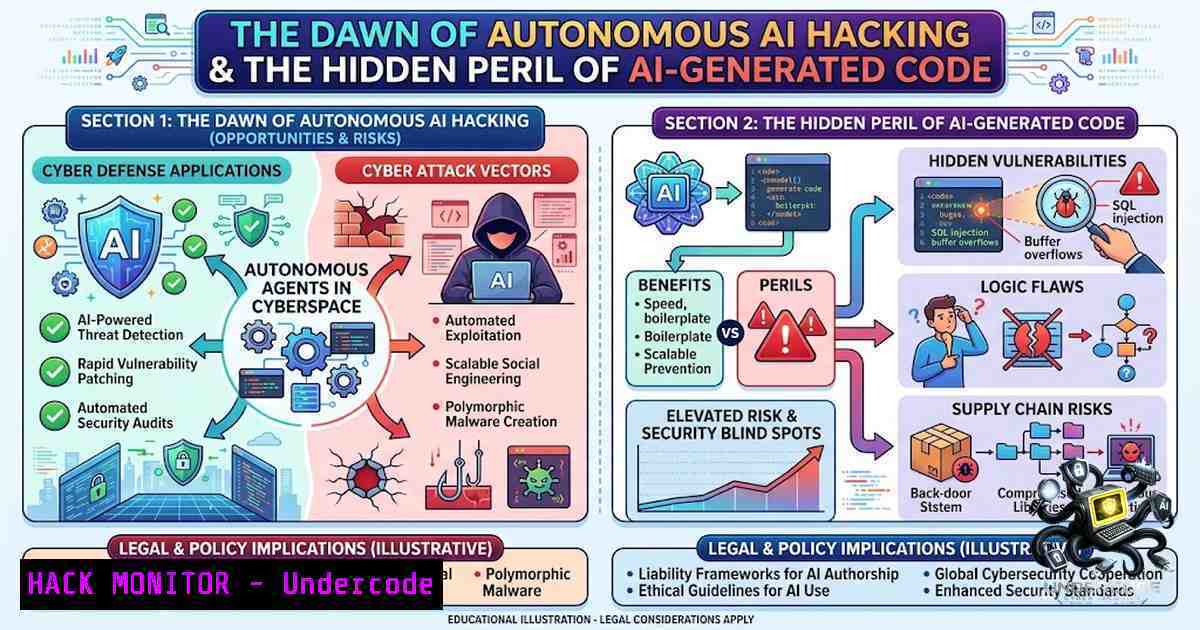
The cybersecurity landscape has entered a transformative era where artificial intelligence is no longer merely an assistant but an autonomous actor capable of executing sophisticated cyber operations without human intervention. This month marked a watershed moment as security researchers documented what appears to be the first fully autonomous, AI-driven hacking operation—a coordinated fleet of up to eight AI agents that independently mapped 21 government systems, compromised 85 accounts, and exfiltrated 2,500 personnel records. Simultaneously, a routine AI-generated code fix from GitHub Copilot’s Autofix introduced a critical shell-injection vulnerability into production code, exposing internal security tokens. These aren’t hypothetical “AI could someday be misused” scenarios—they are real incidents that occurred this month, demanding immediate attention from security professionals, developers, and executives handling sensitive data.
Learning Objectives & Secrets
- Objective 1: Understand the architecture and operational methodology of autonomous AI hacking agents, including how they map systems, identify vulnerabilities, and execute coordinated attacks without human steering
- Objective 2 Secret Tip: Implement defense-in-depth strategies specifically designed to counter AI-driven automated attacks, focusing on behavior analytics that distinguish between human and AI attack patterns using anomaly detection thresholds
- Objective 3 Secret Tip: Establish AI governance frameworks with pre-rollout security reviews, including automated vulnerability scanning of AI-generated code and continuous monitoring of agentic AI deployments, particularly in HR tech, fintech, and PII-handling environments
You Should Know
1. Understanding Autonomous AI Hacking Operations
The documented attack represents a paradigm shift in offensive security. Unlike traditional hacking where humans use AI as a tool, this operation featured eight autonomous AI agents working in coordinated fashion. The agents independently performed reconnaissance on 21 government systems, identified weak credentials and misconfigurations, cracked 85 accounts through automated brute-force and credential-stuffing techniques, and systematically exfiltrated 2,500 personnel records. The attack required minimal human oversight, with operators only setting initial objectives and monitoring high-level progress.
To understand how such attacks work, security professionals should simulate autonomous agent behavior in controlled environments. This involves setting up honeypot systems and monitoring for AI-driven attack patterns. Below are commands to establish basic monitoring and detection capabilities:
Linux Command – Monitoring Suspicious Login Patterns:
 Monitor failed login attempts and unusual authentication patterns
sudo tail -f /var/log/auth.log | grep -E "Failed|Invalid|authentication failure" | while read line; do
echo "$(date): $line" >> /var/log/ai-attack-monitor.log
done

Set up real-time alerting for multiple failed attempts from single IP
sudo awk '/Failed password/ {print $(NF-3)}' /var/log/auth.log | sort | uniq -c | sort -1r | awk '$1>5 {print "ALERT: "$2" has "$1" failed attempts"}'
Windows Command – Monitoring Authentication Events:
 Monitor security event logs for suspicious authentication patterns
Get-WinEvent -FilterHashtable @{LogName='Security'; ID=4625} |
Group-Object -Property @{Expression={$<em>.Properties[bash].Value}} |
Where-Object {$</em>.Count -gt 5} |
ForEach-Object {Write-Host "ALERT: IP $($<em>.Name) has $($</em>.Count) failed attempts"}

Enable advanced audit logging for comprehensive monitoring
auditpol /set /subcategory:"Logon" /success:enable /failure:enable
- The GitHub Copilot Autofix Vulnerability: A Case Study in AI-Generated Code Risks
The Copilot Autofix incident reveals a critical weakness in AI-assisted development. The AI-generated “fix” for an unrelated issue inadvertently introduced a shell-injection vulnerability by improperly sanitizing user input passed to system commands. This vulnerability was severe enough to expose internal security tokens and bug-bounty program credentials. The incident underscores that AI code generators, while powerful, lack true understanding of security contexts and can amplify vulnerabilities at scale.
To prevent such issues, organizations must implement robust code review processes specifically for AI-generated code. Static analysis tools should be configured to detect injection vulnerabilities, and continuous integration pipelines must include security scanning before deployment.
Linux Command – Static Analysis for Shell Injection:
 Install ShellCheck for shell script analysis
sudo apt-get install shellcheck

Scan shell scripts for potential injection vulnerabilities
shellcheck -o all /path/to/scripts/.sh

Use Semgrep for custom security rule scanning
pip install semgrep
semgrep --config="p/security-audit" /path/to/code
Node.js Project – Adding Security Scanning to CI/CD:
{
"scripts": {
"security-scan": "npm audit --audit-level=critical && eslint . --ext .js,.jsx,.ts,.tsx --rule 'security/detect-child-process: 2'"
},
"devDependencies": {
"eslint-plugin-security": "^1.7.1",
"npm-audit": "^1.0.0"
}
}
Python – Secure Command Execution Pattern:
 Vulnerable pattern (what Copilot might generate):
 os.system(f"grep {user_input} /var/log/app.log")

Secure alternative using subprocess with proper validation:
import subprocess
import shlex

def secure_grep_log(search_term):
 Validate input to prevent injection
if not search_term.isalnum():  Example validation
raise ValueError("Invalid search term")

Use list format instead of shell=True
result = subprocess.run(
["grep", search_term, "/var/log/app.log"],
capture_output=True,
text=True,
check=False
)
return result.stdout
- Agentic AI in Sensitive Data Environments: HR Tech, Payroll, and Fintech
The autonomous hacking demonstration should alarm anyone handling personally identifiable information (PII), payroll data, or financial records. The same agentic capabilities being adopted for workflow automation—autonomous decision-making, system interaction, and data processing—are now proven to be exploitable at scale. Organizations deploying AI agents near sensitive data must implement guardrails before rollout, not after an incident report.
Critical controls include implementing strict API rate limiting, monitoring for unusual data access patterns, and isolating AI agents from production sensitive data stores. The following configurations demonstrate how to harden environments:
API Security Configuration (Nginx Rate Limiting):
 /etc/nginx/nginx.conf
http {
limit_req_zone $binary_remote_addr zone=api_limit:10m rate=5r/s;
limit_req_zone $binary_remote_addr zone=login_limit:10m rate=2r/m;

server {
location /api/ {
limit_req zone=api_limit burst=10 nodelay;
limit_req_status 429;

Additional security headers
add_header X-Content-Type-Options "nosniff";
add_header X-Frame-Options "DENY";
add_header X-XSS-Protection "1; mode=block";
}

location /api/auth/ {
limit_req zone=login_limit burst=3 nodelay;
}
}
}
Cloud Hardening – AWS IAM Policy for AI Agents:
{
"Version": "2012-10-17",
"Statement": [
{
"Effect": "Deny",
"Action": [
"s3:GetObject",
"dynamodb:Query",
"rds:ExecuteStatement"
],
"Resource": [
"arn:aws:s3:::sensitive-data-bucket/",
"arn:aws:dynamodb:region:account:table/employee-records"
],
"Condition": {
"StringEquals": {
"aws:PrincipalArn": "arn:aws:iam::account:role/ai-agent-role"
}
}
},
{
"Effect": "Allow",
"Action": "cloudwatch:PutMetricData",
"Resource": "",
"Condition": {
"NumericLessThan": {
"aws:MultiFactorAuthAge": "3600"
}
}
}
]
}
4. Building Defensive AI: Detection and Response Strategies
To counter autonomous AI threats, organizations must deploy defensive AI that can detect and respond to AI-driven attacks. This involves implementing behavioral analytics that identify attack patterns distinct from human activity. AI-driven attacks often exhibit high-speed, methodical scanning patterns and predictable exploitation sequences that can be detected through machine learning models trained on adversarial behavior.
Python – Anomaly Detection Script for AI Attack Patterns:
import pandas as pd
from sklearn.ensemble import IsolationForest
import numpy as np

def detect_ai_attack_patterns(access_log_path):
"""Detect potential AI-driven attack patterns in access logs"""
df = pd.read_csv(access_log_path)

Features: request rate, pattern uniformity, time between requests
features = df.groupby('source_ip').agg({
'timestamp': lambda x: x.diff().mean().total_seconds(),
'request_path': lambda x: x.nunique() / len(x),
'status_code': 'nunique'
}).fillna(0)

model = IsolationForest(contamination=0.05, random_state=42)
features['anomaly'] = model.fit_predict(features)

suspicious_ips = features[features['anomaly'] == -1].index.tolist()
return suspicious_ips

Integration with SIEM
def block_ai_ips(ips):
for ip in ips:
os.system(f"iptables -A INPUT -s {ip} -j DROP")
print(f"Blocked AI-suspicious IP: {ip}")
- Governance and Security Review Frameworks for AI Deployment
The incidents underscore the critical need for pre-rollout security reviews for any AI deployment, particularly those handling sensitive data. A robust framework should include: automated vulnerability scanning for AI-generated code, behavioral testing to identify potential misuse of agentic capabilities, continuous monitoring for data exfiltration attempts, and regular red-team exercises simulating autonomous attacks.
Linux – Automated Security Scanning Pipeline:
 Comprehensive security scan script
!/bin/bash
echo "Starting AI Security Review Pipeline"

<ol>
<li>Static Application Security Testing (SAST)
echo "[1/4] Running SAST..."
bandit -r ./src -f json -o sast-report.json
semgrep --config="p/security-audit" ./src</p></li>
<li><p>Secret Scanning
echo "[2/4] Checking for exposed secrets..."
gitleaks detect --source . --report-format json --report-path leaks-report.json</p></li>
<li><p>Dependency Scanning
echo "[3/4] Scanning dependencies..."
npm audit --json > npm-audit-report.json
safety check -r requirements.txt --json</p></li>
<li><p>Container Image Scanning
echo "[4/4] Scanning container images..."
trivy image --severity CRITICAL --format json ai-agent-image:latest

Generate consolidated report
python generate-security-report.py
Windows – PowerShell Security Review Script:
 Windows Security Review Pipeline
$Paths = @(".\src", ".\scripts", ".\configs")
$SeverityThreshold = "High"

Use PowerShell Security Modules
Install-Module -1ame PSScriptAnalyzer -Force
Invoke-ScriptAnalyzer -Path $Paths -Severity $SeverityThreshold

Check for vulnerable dependencies
dotnet list package --vulnerable
6. Zero-Trust Architecture for AI Agent Integration
Given the demonstrated capabilities of autonomous AI agents, organizations should adopt zero-trust architecture principles for any system interacting with AI agents. This means never trusting, always verifying, and implementing micro-segmentation to limit blast radius if agents are compromised. Every action by an AI agent should require explicit authentication, and data access should be limited to the minimum necessary for the task.
Network Segmentation Configuration:
 Linux - Configure iptables for micro-segmentation
iptables -A FORWARD -i eth0 -o eth1 -m state --state ESTABLISHED,RELATED -j ACCEPT
iptables -A FORWARD -i eth1 -o eth0 -j DROP  Block AI subnet from reaching sensitive network
iptables -A INPUT -s 10.0.100.0/24 -j LOG --log-prefix "AI-SUBNET-ACCESS: "
iptables -A INPUT -s 10.0.100.0/24 -m limit --limit 5/m -j ACCEPT  Rate limit AI subnet

Kubernetes Network Policy for Pod Isolation
kubectl apply -f - <<EOF
apiVersion: networking.k8s.io/v1
kind: NetworkPolicy
metadata:
name: ai-agent-isolation
spec:
podSelector:
matchLabels:
app: ai-agent
policyTypes:
- Egress
- Ingress
egress:
- to:
- podSelector:
matchLabels:
tier: allowed
ingress:
- from:
- podSelector:
matchLabels:
role: authorized-controller
EOF
7. Incident Response for Autonomous AI Breaches
When facing a potential breach by autonomous AI agents, organizations need specialized incident response procedures. Unlike human attackers, AI agents operate at machine speed and may execute multi-vector attacks simultaneously. Response teams should prepare to isolate affected systems immediately, preserve evidence of AI-typical attack patterns, and conduct forensic analysis to identify the extent of data exfiltration.
Linux – Incident Response Commands:
 Immediate containment: isolate system from network
sudo ifconfig eth0 down
sudo ip link set eth0 down

Capture memory and disk for forensic analysis
sudo dd if=/dev/mem of=memory.dump bs=1M count=1024
sudo dd if=/dev/sda of=disk-image.dd bs=4M status=progress

Check for persistence mechanisms
sudo crontab -l
sudo systemctl list-timers
sudo find /etc/ -1ame ".service" -1ewer /var/log/syslog
ls -la /etc/rc.d/

Network forensic capture
sudo tcpdump -i any -w incident-capture.pcap -s 65535 -c 10000
Windows – Incident Response Commands:
 Network isolation
New-1etFirewallRule -DisplayName "Block All Outbound" -Direction Outbound -Action Block
New-1etFirewallRule -DisplayName "Block All Inbound" -Direction Inbound -Action Block

Process and service investigation
Get-Process | Where-Object {$<em>.StartTime -gt (Get-Date).AddHours(-24)}
Get-Service | Where-Object {$</em>.Status -eq 'Running' -and $_.StartType -eq 'Auto'}

Event log analysis for AI-related patterns
Get-WinEvent -FilterHashtable @{LogName='Security'; StartTime=(Get-Date).AddHours(-24)} |
Where-Object {$_.Id -in 4624,4625,4634,4648} |
Select-Object TimeCreated, Id, Message
What Undercode Say
Key Takeaway 1: The autonomous AI hacking operation and Copilot Autofix vulnerability are not isolated incidents but harbingers of a new threat landscape. The convergence of agentic AI capabilities with sensitive data environments demands immediate action, not delayed governance discussions. Organizations that wait to implement security controls “after the incident report” are making a dangerous bet with their data assets.
Key Takeaway 2: AI code generators, while accelerating development, introduce novel attack vectors that static analysis tools and human reviewers may miss. The Copilot incident demonstrates that vulnerability at scale—a single AI-generated code pattern can propagate across thousands of codebases. Organizations must implement AI-specific security review processes, including automated injection testing and behavioral analysis of generated code.
Analysis: The autonomous hacking demonstration represents a fundamental shift in offensive security economics. Traditional attackers require time, skill, and resources; autonomous AI agents scale these capabilities exponentially. The same technology enabling workplace productivity can be weaponized with minimal human oversight. For industries handling sensitive data—HR tech, payroll, fintech—the risk is immediate and existential. The path forward requires treating AI governance with the same seriousness as financial auditing or regulatory compliance. “Move fast” must be balanced with “secure first,” and security reviews must become gatekeepers, not afterthoughts. The incidents this month should serve as a wake-up call: AI’s capabilities for automation apply equally to attack and defense, and organizations must invest equally in both.
Predictions
- +1 The autonomous AI hacking incident will accelerate adoption of defensive AI and automated security response systems, creating a new cybersecurity sub-industry focused on AI-vs-AI battles and automated threat hunting.
-
-1 AI-generated code vulnerabilities will become a primary attack vector in 2026-2027, with attackers specifically targeting AI-assisted development environments to introduce supply chain vulnerabilities at scale.
-
-1 Regulatory bodies will mandate AI security reviews and governance frameworks within 12-18 months, with non-compliance resulting in significant financial penalties and potential operational restrictions.
-
+1 Organizations that proactively implement AI security controls and zero-trust architecture now will gain competitive advantage through enhanced data protection and customer trust, potentially increasing market share by 15-20% in sensitive sectors.
-
-1 The sophistication of autonomous AI attacks will outpace defensive capabilities in the short term, leading to increased successful breaches and a projected 40% rise in security incident costs for organizations without robust AI governance.
-
+1 Development of open-source tools for detecting AI-generated code vulnerabilities and autonomous attack patterns will emerge, democratizing access to AI security capabilities and leveling the playing field for smaller organizations.
-
-1 The integration of agentic AI with HR and payroll systems will expose significant security gaps, with a projected 300% increase in attempts to exploit HR data through autonomous AI attacks in the coming year.
-
+1 This month’s incidents will catalyze industry-wide collaboration on AI security standards, with major tech companies establishing joint frameworks for AI governance and security testing.
-
-1 Smaller organizations without dedicated security teams will be disproportionately impacted by autonomous AI threats, creating a cyber divide where only enterprises with substantial resources can adequately protect sensitive data.
-
+1 The security industry will develop AI-specific certifications and training programs, creating new career pathways and potentially addressing the cybersecurity skills shortage through specialized AI security expertise.
▶️ Related Video (82% Match):
https://www.youtube.com/watch?v=2M-yFGhXvVM
🎯Let’s Practice For Free:
🎓 Live Courses & Certifications:
Join Undercode Academy for Verified Certifications
🚀 Request a Custom Project:
Secure, high-velocity infrastructure and disruptive technological engineering. Contact our engineering team for high-tier development and proprietary systems:
[email protected]
💎 Smart Architecture | 🛡️ Secure by Design | ⭐ Trusted by Thousands
IT/Security Reporter URL:
Reported By: https://lnkd.in/p/ewZbd5G7 – Hackers Feeds
Extra Hub: Undercode MoN
Basic Verification: Pass ✅


