
Listen to this Post
Introduction
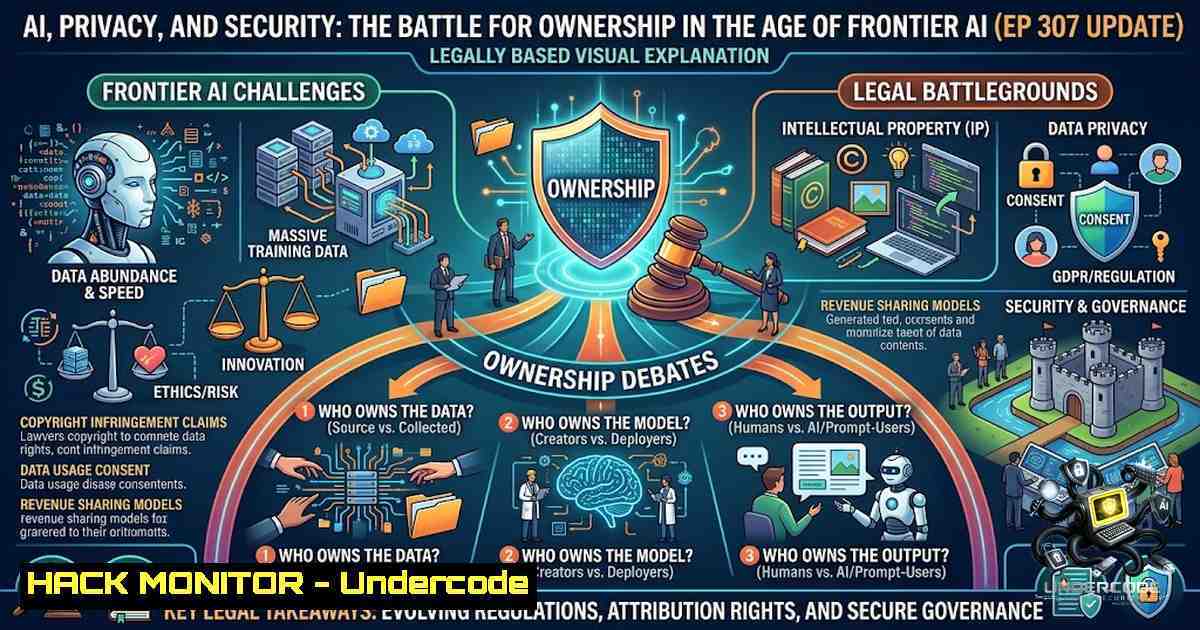
The central theme of this week’s cybersecurity and technology landscape is not data breaches or zero-day exploits—it is ownership. From Australia’s ban on fully AI-generated music from its charts to Anthropic facing a multi-billion dollar copyright lawsuit from Sony and Warner, the question of who owns creative output, user attention, and personal data is being fought on multiple fronts simultaneously. Simultaneously, the Bank of England has issued a stark warning that frontier AI could destabilize the global financial system by making cyberattacks faster, cheaper, and infinitely more scalable. This week’s update dissects these converging threats and provides actionable technical insights for security professionals navigating this new reality.
Learning Objectives & Secrets
- Objective 1: Understand the Technical Mechanics of Ultrasonic Browser Fingerprinting. Learn how the Web Audio API can be exploited to generate inaudible soundwaves for device fingerprinting, and how to detect and mitigate this tracking technique.
- Objective 2 Secret Tips: Hardening Systems Against AI-Driven Cyber Threats. Discover advanced configurations for Linux, Windows, and cloud environments to defend against the increased scale and speed of AI-powered attacks highlighted by the Bank of England.
- Objective 3 Secret Tips: Implementing Privacy-First Architectures. Explore how to leverage privacy-hardened operating systems like GrapheneOS and configure enterprise endpoints to maintain data sovereignty in an era of aggressive data collection.
You Should Know
1. Defeating Ultrasonic Fingerprinting (AliExpress Technique)
The recent discovery that AliExpress used inaudible soundwaves via the Web Audio API to fingerprint browsers highlights a sophisticated tracking method. This technique generates an ultrasonic tone at zero volume and measures the unique analog imperfections of your device’s audio hardware to create a persistent identifier.
Step‑by‑Step Guide to Mitigate Ultrasonic Fingerprinting:
- On Firefox: Navigate to `about:config` and set `media.webspeech.synth.enabled` to
false. Firefox has been noted to effectively block this technique. - On Chrome/Chromium: Install extensions like `AudioContext Fingerprint Defender` which slightly alter the audio output to prevent consistent fingerprint generation.
- Linux Command (Audio Permissions): Restrict browser access to audio devices using PipeWire or PulseAudio. For a hardened approach, use `systemd` to run your browser in a private `/dev/snd` namespace:
systemd-run --user -p PrivateDevices=yes -p ProtectClock=yes firefox
- Windows Registry (Disable WebAudio): While not recommended for all users, you can disable the WebAudio API entirely via Group Policy. Navigate to `Computer Configuration > Administrative Templates > Google Chrome > Enable WebAudio` and set to Disabled.
- Network-Level Detection: Monitor for unusual WebSocket traffic to domains known for fingerprinting. Use `tcpdump` to capture and analyze outgoing packets:
sudo tcpdump -i any -1 'host aliExpress.com and port 443' -v
- Securing AI Development Pipelines (Anthropic Copyright & Financial Sector Risk)
The lawsuit against Anthropic underscores that AI models are trained on vast datasets, often containing copyrighted or sensitive material. For enterprises building or deploying AI, this poses significant legal and security risks. Furthermore, the Bank of England’s warning indicates that AI models themselves can be weaponized to identify and exploit vulnerabilities at machine speed.
Step‑by‑Step Guide to Secure AI/ML Pipelines:
- Data Provenance and Sanitization: Implement strict data provenance tracking. Use tools like `DVC` (Data Version Control) to track the origin of every dataset. Before training, sanitize data using scripts to remove PII and copyrighted material:
Pseudocode for data sanitization
import re
def sanitize_text(text):
Remove potential copyrighted lyrics or code snippets
text = re.sub(r'©.?(\n|$)', '', text)
return text
- Model Hardening (Adversarial Training): Protect against adversarial inputs that could cause model failure. Implement adversarial training using libraries like `CleverHans` or `Foolbox` to inject perturbations during training, making the model robust to manipulation.
- API Security (Cloud): Secure your AI model endpoints. On AWS, use API Gateway with WAF to restrict anomalous request patterns that could indicate a prompt injection attack.
AWS CLI command to enable WAF on API Gateway aws wafv2 create-web-acl --1ame AI-API-WAF --scope REGIONAL --default-action Block={} --visibility-config SampledRequestsEnabled=true,CloudWatchMetricsEnabled=true,MetricName=AIWAF - Linux Hardening for AI Workloads: Run training jobs in isolated containers with minimal privileges.
docker run --security-opt=no-1ew-privileges:true --cap-drop=ALL --read-only -v /data:/data:ro my-ai-image
3. Implementing Privacy-Hardened Endpoints (Motorola & GrapheneOS)
Motorola’s plan to offer GrapheneOS on 2027 flagship devices signals a growing demand for privacy-first mobile operating systems. GrapheneOS is a hardened Android variant that provides enhanced security through features like hardened memory allocators and strict network permission controls.
Step‑by‑Step Guide for Enterprise Privacy Hardening:
- Deploying GrapheneOS: For enterprises, consider piloting GrapheneOS on supported devices (currently Pixel, expanding to Motorola in 2027). Use the GrapheneOS web installer for a secure flashing process.
- Windows Configuration (Enterprise): Implement Windows Defender Application Control (WDAC) to restrict which applications can run, preventing unauthorized data exfiltration tools.
PowerShell: Generate a WDAC policy
New-CIPolicy -FilePath C:\WDAC\Policy.xml -Level Publisher -UserPEs
Convert to binary and deploy
Convert-CIPolicy -FilePath C:\WDAC\Policy.xml -BinaryFilePath C:\WDAC\Policy.p7b
- Linux Configuration (Auditd): Set up audit rules to monitor access to sensitive files (e.g.,
/etc/shadow,/home/).auditctl -w /etc/shadow -p wa -k shadow_changes auditctl -w /home/ -p r -k home_read
- Navigating Age Verification & Data Collection (New Zealand Social Media Ban)
New Zealand’s proposed ban on under-16s using social media, enforced via facial age estimation and digital ID, raises significant privacy concerns. While aimed at child safety, the infrastructure for biometric collection introduces new attack surfaces.
Step‑by‑Step Guide for Secure Biometric Data Handling:
- Data Minimization: Implement processes to delete biometric data immediately after age verification is complete. Use `cron` jobs on Linux servers to purge temporary directories.
- Encryption: Ensure all biometric data is encrypted at rest and in transit using AES-256.
Linux: Encrypt a directory containing biometric logs
gpg --symmetric --cipher-algo AES256 biometrics_logs.tar
- Windows: Use BitLocker to encrypt entire drives where user data is stored.
- Network Segmentation: Isolate servers handling biometric data on a separate VLAN with strict firewall rules.
iptables rule to restrict access to biometric server
iptables -A INPUT -p tcp --dport 443 -s 192.168.10.0/24 -j ACCEPT
iptables -A INPUT -p tcp --dport 443 -j DROP
What Undercode Say
- Key Takeaway 1: The “ownership” crisis is the next frontier in cybersecurity. Whether it’s music, code, or personal data, the legal and technical frameworks for proving and protecting ownership in an AI-driven world are critically inadequate.
- Key Takeaway 2: Defenders must prepare for AI-accelerated attacks. The Bank of England’s warning is not theoretical; we are entering an era where AI can autonomously conduct reconnaissance, identify vulnerabilities, and execute exploits faster than human teams can respond.
Analysis: The convergence of AI capabilities with existing data monetization strategies (like ultrasonic fingerprinting) creates a perfect storm for privacy erosion. The technical community must prioritize developing and deploying privacy-preserving technologies (PETs) and robust data provenance systems. Furthermore, the legal battles, such as the one against Anthropic, will likely set precedents that define the boundaries of “fair use” for AI training, impacting how all future models are built. The market’s response—Apple rushing AI-capable Macs to market and Motorola embracing GrapheneOS—indicates that both enterprise and consumer demand is shifting toward solutions that offer greater control over data and computational power.
Prediction
- +1 The legal pressure on AI companies will accelerate the development of transparent and auditable AI training datasets, creating a new market for “clean” data and compliance tools.
- -1 The adoption of biometric age verification will normalize mass biometric data collection, significantly increasing the attack surface for identity theft and surveillance.
- -1 AI-powered cyberattacks will become commoditized, enabling even low-skill threat actors to launch sophisticated, scalable campaigns against financial infrastructure.
- +1 The enterprise demand for AI hardware will drive rapid innovation in secure enclaves and confidential computing, making hardware-based security more mainstream.
▶️ Related Video (72% Match):
🎯Let’s Practice For Free:
🎓 Live Courses & Certifications:
Join Undercode Academy for Verified Certifications
🚀 Request a Custom Project:
Secure, high-velocity infrastructure and disruptive technological engineering. Contact our engineering team for high-tier development and proprietary systems:
[email protected]
💎 Smart Architecture | 🛡️ Secure by Design | ⭐ Trusted by Thousands
IT/Security Reporter URL:
Reported By: https://lnkd.in/p/eyUCp8MB – Hackers Feeds
Extra Hub: Undercode MoN
Basic Verification: Pass ✅


