Listen to this Post
Introduction:
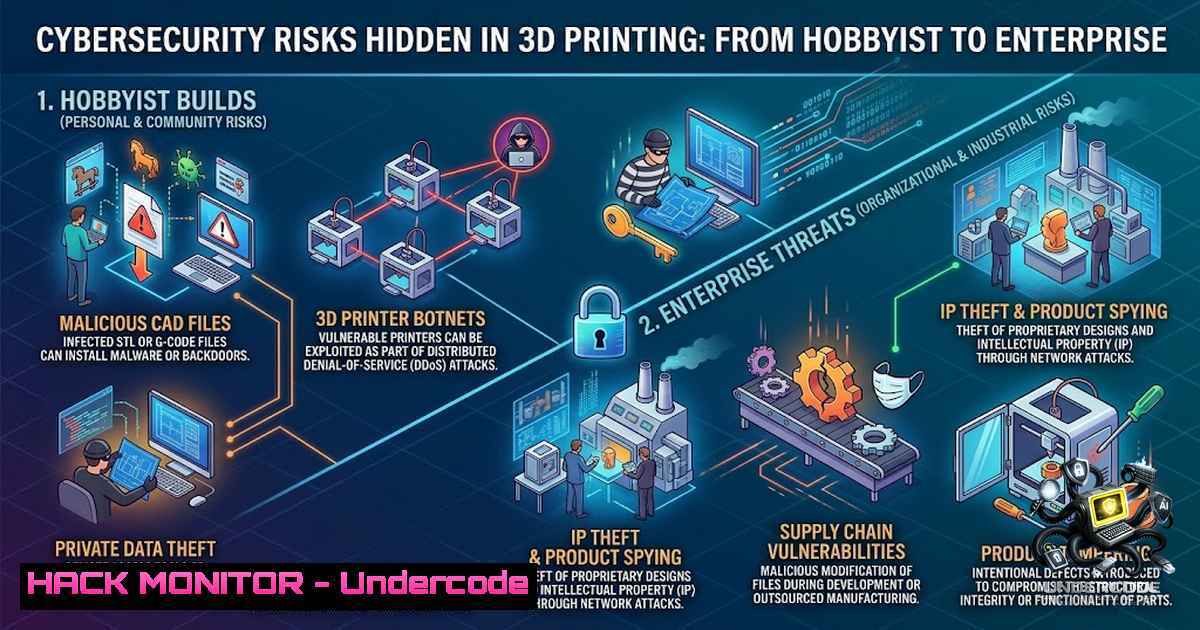
The rapid adoption of additive manufacturing (AM) across industries—from aerospace prototyping to medical device production—has introduced a new and often overlooked attack surface: the 3D printing ecosystem. What many view as a harmless hobby, as demonstrated by a security professional’s recent Agamemnon helmet build using Galactic Armory STL files, actually represents a complex cyber-physical supply chain with significant vulnerabilities. As AM processes become increasingly digitised and interconnected, they introduce critical cybersecurity risks including intellectual property theft, design manipulation, counterfeit production, and even physical sabotage of printed parts. Understanding these threats is no longer optional—it is essential for any organisation leveraging 3D printing technology.
Learning Objectives & Secrets:
- Objective 1: Identify the attack surface of the 3D printing lifecycle — Map the entire digital thread from STL file creation and download, through slicing and G-code generation, to network-connected printer operation and post-processing, recognising that each stage presents unique exploitation opportunities.
-
Objective 2: Master STL and G-code threat detection (secret tip) — Most security teams overlook 3D design files as potential malware vectors. STL files contain steganographic channels that can be used to exfiltrate sensitive data or infiltrate malicious software into secure environments. Use file integrity monitoring (FIM) tools to hash STL files before and after download; any hash mismatch indicates potential tampering.
-
Objective 3: Harden network-connected printers against IoT attacks (secret tip) — Internet-connected 3D printers are vulnerable to cross-site request forgery (CSRF), code injection, and man-in-the-middle (MITM) exploits that manipulate G-code instructions. Isolate printers in dedicated VLANs and disable all unnecessary network services—many printers ship with MQTT and web APIs that lack TLS encryption.
You Should Know:
- The STL File Threat Vector: Malware Disguised as Design
The STL (stereolithography) file format—the industry standard for 3D printing—has been proven to contain exploitable vulnerabilities. Research has demonstrated that STL design files contain steganographic channels capable of covert data exfiltration and malware infiltration. Attackers can modify STL files to include malicious instructions that weaken printed parts, a technique successfully demonstrated in attacks that sabotaged drone propeller designs.
Step-by-step guide to STL file security verification:
Linux (using file hashing and analysis):
 Generate SHA-256 hash of original STL file for integrity baseline
sha256sum model_original.stl > model_hash.txt

Verify integrity after download
sha256sum model_downloaded.stl | diff - model_hash.txt

Use strings to inspect for hidden commands or anomalies
strings model_downloaded.stl | grep -E "G-code|M[0-9]{3}|G[0-9]{2}"

Install and use an STL analysis tool (example: mesh analysis)
apt-get install assimp-utils
assimp info model_downloaded.stl
Windows (PowerShell):
 Generate file hash for integrity verification
Get-FileHash -Path "C:\3DModels\model.stl" -Algorithm SHA256 | Out-File model_hash.txt

Verify hash after download
$original = Get-Content model_hash.txt
$current = Get-FileHash -Path "C:\Downloads\model.stl" -Algorithm SHA256
if ($original -eq $current.Hash) { Write-Host "File integrity verified" } else { Write-Host "WARNING: File tampered" }
2. G-Code Manipulation: The Silent Sabotage
G-code—the machine language that controls 3D printers—represents one of the most dangerous attack vectors. Researchers have identified 278 potentially malicious G-code commands across attack categories including Information Disclosure, Denial of Service, and Model Manipulation. Attackers can intercept G-code during transmission (MITM attacks) or inject malicious commands directly into uploaded files.
Step-by-step guide to G-code security:
Verify G-code integrity before printing:
 Python script to validate G-code commands against a whitelist
import re

def validate_gcode(file_path):
 Define whitelisted safe commands
safe_commands = {'G0', 'G1', 'G28', 'G29', 'M104', 'M109', 'M140', 'M190', 'M106', 'M107'}
suspicious_patterns = [r'M[0-9]{3,}', r'G[0-9]{3,}', r'M112', r'G10', r'G11']  M112 = emergency stop

with open(file_path, 'r') as f:
for line_num, line in enumerate(f, 1):
for pattern in suspicious_patterns:
if re.search(pattern, line):
print(f"WARNING: Suspicious pattern {pattern} found at line {line_num}")
 Check for unknown commands
tokens = line.strip().split()
for token in tokens:
if token.startswith(('G', 'M')):
cmd = token.split()[bash] if ' ' in token else token
if cmd not in safe_commands:
print(f"INFO: Unknown command {cmd} at line {line_num}")
Network-level protection for G-code transmission:
 Set up iptables to restrict printer access (Linux firewall)
 Allow only local subnet access to printer
iptables -A INPUT -p tcp --dport 80 -s 192.168.1.0/24 -j ACCEPT
iptables -A INPUT -p tcp --dport 80 -j DROP

Monitor for unusual network activity from printer
tcpdump -i eth0 host <PRINTER_IP> -w printer_traffic.pcap
3. Printer Firmware and API Vulnerabilities
Consumer and industrial 3D printers frequently ship with insecure firmware and exposed APIs. The OctoPrint web interface—widely used for remote printer control—has been affected by multiple CVEs including API key timing attacks (CVE-2026-23892), XSS injection (CVE-2025-64187), and file exfiltration vulnerabilities (CVE-2026-54134). These vulnerabilities allow attackers to extract API keys, inject malicious HTML/JavaScript, and exfiltrate sensitive printer files.
Step-by-step guide to hardening printer firmware and APIs:
Immediate hardening actions:
- Update printer firmware to the latest version—check manufacturer websites for security patches
- Change all default credentials (admin passwords, Wi-Fi passwords, API keys)
- Disable UPnP and port forwarding on routers to prevent external access
4. Implement API key rotation every 30-90 days
Network segmentation configuration:
 Linux: Create a dedicated network namespace for 3D printers
ip netns add printer_ns
ip link add veth0 type veth peer name veth1
ip link set veth1 netns printer_ns
ip netns exec printer_ns ip addr add 10.0.0.1/24 dev veth1
ip netns exec printer_ns ip link set veth1 up

Restrict traffic to/from printer namespace
iptables -A FORWARD -i veth0 -j DROP  Block all by default
iptables -A FORWARD -i veth0 -s 10.0.0.0/24 -d 192.168.1.0/24 -p tcp --dport 443 -j ACCEPT  Allow only HTTPS to specific server
4. Side-Channel Attacks: Stealing Designs Through Physics
Perhaps the most sophisticated attack vector involves side-channel exploitation. Research has demonstrated that industrial 3D printers can be compromised through optical side-channels, acoustic emissions, and power consumption analysis to steal proprietary object designs. An attacker need only monitor a printer’s physical emissions to reverse-engineer the part being manufactured—a significant threat for organisations printing proprietary components.
Step-by-step guide to side-channel mitigation:
Physical and operational controls:
1. Place printers in physically secure, access-controlled areas
2. Use sound-dampening enclosures to reduce acoustic emissions
- Implement randomised print schedules to confuse timing-based analysis
- Consider Faraday cages for printers handling classified designs
Monitoring for side-channel exploitation:
 Use power consumption monitoring (requires compatible hardware)
 Example: Using a smart plug with power monitoring capability
curl -X GET http://smartplug.local/emeter | jq '.power'  Monitor for abnormal patterns

Network-based anomaly detection
 Install and configure Suricata for printer network monitoring
suricata -c /etc/suricata/suricata.yaml -i eth0
 Create custom rules for printer traffic anomalies
echo 'alert tcp $HOME_NET any -> $PRINTER_NET any (msg:"Possible printer data exfiltration"; flow:established; content:"|0d 0a|"; within:10; sid:1000001;)' >> /etc/suricata/rules/printer.rules
- Supply Chain Attacks: The Hidden Danger in Downloaded Models
The globalised nature of 3D printing supply chains introduces multiple attack opportunities. Malicious actors can upload tampered STL files to online marketplaces, compromise slicing software, or infiltrate the material supply chain. A single compromised design file can lead to mass replication of counterfeit or structurally weakened parts, endangering entire supply chains.
Step-by-step guide to supply chain security:
STL file source verification:
 Verify digital signatures if available (using GPG)
gpg --verify model.stl.sig model.stl

Scan downloaded files for malware using ClamAV
clamscan --recursive --detect-pua=yes /path/to/downloads/

Check file metadata for anomalies
exiftool model.stl | grep -E "Create|Modify|Software"
Implementation of NIST cybersecurity framework for AM:
- Adopt NIST SP 800-82 (Guide to OT Security) and IEC 62443 standards for AM environments
- Implement layered security guidance for data asset management in additive manufacturing
- Use blockchain-based cryptographic anchoring for design file integrity verification
- Establish dual physical-digital locks to prevent unauthorised duplication
What Undercode Say:
- Key Takeaway 1: The 3D printing ecosystem represents a critical cyber-physical attack surface that security professionals can no longer afford to ignore. From STL file steganography to G-code manipulation and side-channel attacks, the threats are real, demonstrated, and increasingly sophisticated.
-
Key Takeaway 2: Organisations must implement defence-in-depth strategies that encompass the entire additive manufacturing lifecycle—design file verification, network segmentation, firmware updates, physical security controls, and supply chain vetting.
Analysis: The convergence of hobbyist 3D printing and enterprise additive manufacturing creates a unique security challenge. As the line between consumer and industrial 3D printing blurs—with professionals like the security expert in the original post running their own “Order-to-Print” businesses—the attack surface expands exponentially. The vulnerabilities identified in consumer-grade printers and STL files are often identical to those affecting industrial systems, yet industrial environments contain far more sensitive intellectual property. Organisations must recognise that the same STL file downloaded by a hobbyist for a cosplay helmet could, in a different context, contain malicious code designed to sabotage a critical aerospace component. The security community must develop and disseminate practical guidance for securing additive manufacturing—not as an afterthought, but as a fundamental component of modern cybersecurity practice.
Prediction:
+1 The growing awareness of 3D printing cybersecurity risks will drive the development of specialised security tools, including AI-powered STL and G-code anomaly detection systems, similar to the machine learning-based early detection systems already in research.
+1 Regulatory frameworks will increasingly mandate security controls for additive manufacturing in critical industries, following the NIST Cybersecurity Framework and IEC 62443 standards.
-1 The democratisation of 3D printing technology, combined with inadequate security awareness, will lead to a significant increase in supply chain attacks targeting design files distributed through online marketplaces.
-1 Organisations that fail to implement basic 3D printing security controls—network segmentation, firmware updates, file integrity verification—will experience intellectual property theft and physical sabotage incidents within the next 12-24 months.
+1 The integration of blockchain-based cryptographic anchoring and dual-lock integrity auditing will emerge as a standard practice for verifying design file authenticity and traceability throughout the AM lifecycle.
▶️ Related Video (80% Match):
🎯Let’s Practice For Free:
🎓 Live Courses & Certifications:
Join Undercode Academy for Verified Certifications
🚀 Request a Custom Project:
Secure, high-velocity infrastructure and disruptive technological engineering. Contact our engineering team for high-tier development and proprietary systems:
[email protected]
💎 Smart Architecture | 🛡️ Secure by Design | ⭐ Trusted by Thousands
IT/Security Reporter URL:
Reported By: https://lnkd.in/p/eqXscQeY – Hackers Feeds
Extra Hub: Undercode MoN
Basic Verification: Pass ✅


