Listen to this Post
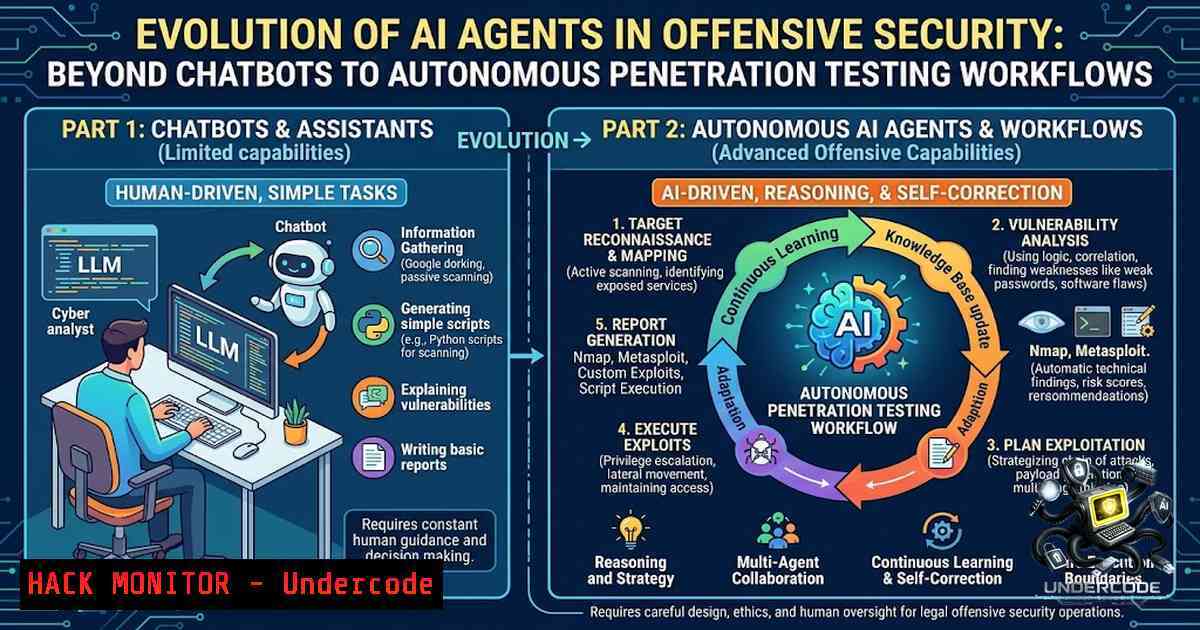
Introduction:
The integration of Artificial Intelligence into offensive security is rapidly evolving from simple chatbot-assisted command generation to sophisticated autonomous agent orchestration. As Rafael Dias recently highlighted through his hands-on exploration of the Offensive Agent AI Course by Red Team Leaders, the true value of AI in penetration testing lies not in the tool itself but in the ability to structure agents, provide adequate context, define operational boundaries, and critically validate results. With 48% of security practitioners now ranking agentic AI as the 1 emerging attack vector—ahead of ransomware and cloud misconfiguration—understanding how to leverage AI agents across reconnaissance, exploitation, and reporting has become essential for modern security professionals.
Learning Objectives & Secrets:
- Objective 1: Master AI Agent Orchestration for Pentest Workflows – Learn to design multi-agent architectures that distribute reconnaissance, vulnerability classification, exploitation, and reporting tasks across specialized AI agents, using frameworks like ReAct reasoning for autonomous decision-making.
-
Objective 2 (Secret Tip): Context Engineering Over Prompt Engineering – The secret to effective AI-assisted pentesting isn’t crafting better prompts—it’s structuring the agent’s context window with precise rules of engagement (ROE), tool definitions, and validation gates. As demonstrated in Active Directory AI agent harnesses, defining eight skill domains and thirteen slash commands with ROE-safe orchestration dramatically improves outcomes.
-
Objective 3 (Secret Tip): MCP as the Security Control Plane – The Model Context Protocol (MCP) serves as the critical trust boundary between AI agents and external tools. Understanding MCP’s architecture—including its vulnerabilities to tool poisoning, cross-server context exfiltration, and indirect prompt injection—is essential for both offensive deployment and defensive monitoring.
You Should Know:
1. AI-Powered Reconnaissance and Attack Surface Mapping
Modern AI agents transform reconnaissance from a manual, time-consuming process into an automated, intelligence-driven workflow. Tools like Pentest Swarm AI orchestrate specialized agents for recon, classification, and exploitation using ReAct reasoning, supporting bug bounty programs and continuous monitoring. The AIRecon framework structures engagements through four automated phases, each with defined objectives and recommended tools, with checkpoints firing every five iterations for phase evaluation and every ten for self-evaluation.
Step-by-Step Guide – Setting Up an AI Reconnaissance Agent:
 Install Pentest Swarm AI (Go-based multi-agent framework)
git clone https://github.com/Armur-Ai/Pentest-Swarm-AI.git
cd Pentest-Swarm-AI
go build -o pentest-swarm ./cmd/swarm

Configure reconnaissance phase with custom scope
./pentest-swarm recon --target example.com --scope ".example.com" --mode bug-bounty

Deploy OSINT agent for secrets discovery in repositories
 Using AI OSINT curated dorks for exposed LLM endpoints and API keys
pip install ai-osint
ai-osint scan --github-org target-org --dorks "api_key,secret,token"

Launch autonomous reconnaissance with MCP integration
agentsploit scan mcp stdio://./vulnerable_mcp/server.py --training
2. OWASP/CWE Mapping and AI-Assisted Vulnerability Analysis
AI agents excel at correlating discovered vulnerabilities with established frameworks like OWASP Top 10 and CWE. Recent empirical studies analyzing 295 GitHub Security Advisories published between January 2025 and January 2026 found that most advisories map to established CWEs, particularly injection and deserialization weaknesses. The OWASP Top 10 for Agentic Applications 2026 provides specific mappings to CWEs including CWE-78, CWE-74, and CWE-20, enabling automated vulnerability classification.
Step-by-Step Guide – Automated CWE Mapping with AI:
 Install agent-bom for AI supply chain scanning with OWASP LLM Top 10 tagging
pip install agent-bom

Scan an MCP server for vulnerabilities with CWE mapping
agent-bom scan mcp stdio://./target_mcp/server.py --owasp-mapping

Generate blast radius analysis with automatic CWE tagging
agent-bom analyze --cve-scan --blast-radius --owasp-tagging

Use BugTraceAI-CLI for multi-persona vulnerability analysis
 Six different AI personas analyze each target (bug bounty hunter, code auditor, pentester)
pip install bugtraceai
bugtraceai scan https://target.com --personas all --cwe-mapping
3. API and Web Pentesting with AI Support
PortSwigger’s introduction of Burp AT (August 2026) and Burp AI represents a significant milestone in AI-assisted web application testing. Burp AT brings agentic AI to human-led pentesting, pursuing testing goals set by the operator using Burp’s own tools while maintaining human control. The Burp MCP integration enables natural language-driven security testing, allowing AI to automatically analyze traffic, read responses, call tools, and load skills.
Step-by-Step Guide – Configuring Burp AI for Web Pentesting:
 Install Burp Suite Professional 2026.7 or later
 Enable Burp AI features in Settings → AI Configuration

Configure Burp AT agent with testing scope
 In Burp Suite: Extensions → Burp AT → New Session
 Set target scope: https://target-api.com/
 Define testing objectives: Authentication bypass, IDOR, SQL injection

Deploy mcpwn as an intercepting proxy for MCP traffic analysis
npm install -g mcpwn
mcpwn proxy --port 8080 --target mcp://target-server

Monitor JSON-RPC messages between agent and tools
 Watch for tool poisoning attempts and context exfiltration
mcpwn watch --verbose
4. Active Directory Pentesting with AI Agents
Active Directory compromise has emerged as a prime use case for agentic AI. Recent demonstrations show complete end-to-end attack chains—from external access to Domain Administrator privileges—executed by agentic attack stacks in controlled AD environments, with the fastest successful full domain admin compromise achieved in just 40 minutes from a single high-level prompt. The claude-active-directory harness provides eight skill domains, thirteen slash commands, and seven agents with validation gates for ROE-safe orchestration.
Step-by-Step Guide – AI-Assisted Active Directory Pentesting:
 Clone the claude-active-directory harness
git clone https://github.com/Evaluris-Solutions/claude-active-directory.git
cd claude-active-directory

Configure ROE (Rules of Engagement) file
cat > roe.yaml << EOF
scope:
- domain: "corp.local"
- targets: ["192.168.1.0/24"]
restrictions:
- no_ransomware
- no_data_exfiltration
- max_duration: 480
EOF

Launch AI agent with ROE validation
./ad-agent.sh --roe roe.yaml --mode reconnaissance

Execute autonomous assumed breach testing
 Using cochise - the first fully autonomous LLM-driven AD penetration testing system
python cochise.py --target-domain corp.local --assumed-breach --auto-exploit
5. OSINT and Secrets Discovery in Repositories
AI-powered OSINT has evolved into a specialized discipline with dedicated tools and MCP servers. The ai_osint repository curates Google dorks, Shodan queries, and GitHub dorks specifically designed to discover exposed LLM endpoints, leaked AI API keys, misconfigured vector databases, and unprotected AI agents. OSINT Agent Skills provides 23 MCP tools for autonomous OSINT investigation, including DNS enumeration, Shodan queries, breach data analysis, geolocation, and crypto tracing—effectively turning any autonomous AI agent into a senior OSINT analyst.
Step-by-Step Guide – Automated Secrets Discovery:
 Install AI OSINT toolkit
git clone https://github.com/7WaySecurity/ai_osint.git
cd ai_osint

Run GitHub dorking for exposed secrets
python github_dorks.py --query "api_key OR secret OR token" --org target-org

Deploy OSINT Agent Skills MCP server
npm install -g @frangelbarrera/osint-agent-skills
osint-agent start --mcp-server

Query the MCP server for autonomous OSINT investigation
osint-agent query --shodan "target-domain.com" --breach-data --dns-enum

Discover exposed AI infrastructure using Censys queries
python censys_scanner.py --query "service.software.product:LLM OR vector-database"
- MCP (Model Context Protocol) Applied to Offensive Security
The Model Context Protocol has become the universal standard for connecting AI agents to tools, but it also introduces significant security considerations. In May 2026, the NSA published a cybersecurity advisory documenting concrete attack techniques against MCP infrastructure, including tool poisoning, cross-server context exfiltration, silent behavior change, and indirect prompt injection. By April 2026, 40% of enterprise applications had embedded AI agents—most via MCP—making MCP security a critical concern. Critical vulnerabilities have been identified, including CVE-2026-39313 in mcp-framework, where a remote unauthenticated attacker can crash any mcp-framework HTTP server by sending a single large POST request.
Step-by-Step Guide – MCP Security Testing and Hardening:
 Deploy mcpwn for offensive MCP testing
npm install -g mcpwn

Intercept MCP JSON-RPC messages between agent and server
mcpwn intercept --target mcp://target-server:8080 --output mcp-traffic.log

Test for tool poisoning vulnerabilities
mcpwn poison --tool malicious-tool --payload "rm -rf /" --target mcp://target-server

Audit MCP server for CVE-2026-39313 (memory exhaustion)
curl -X POST https://target-mcp-server/mcp \
-H "Content-Type: application/json" \
-d "$(python -c 'print("{\"jsonrpc\":\"2.0\",\"method\":\"tools/list\"}" + "A"1000000)')"

Harden MCP server with size limitations (mcp-framework >=0.2.22)
 Configure request body size limits in server configuration
echo "maxRequestBodySize: 1048576" >> mcp-config.yaml
7. Automating Bug Bounty Workflows with AI Agents
Bug bounty hunters are increasingly leveraging AI agents to automate entire workflows from reconnaissance to report generation. PentesterFlow is an open-source, human-in-the-loop AI command-line tool designed specifically for pentesters and bug bounty hunters, automating the entire workflow from information gathering to report generation without sacrificing analyst control. The Pentest Agent Suite includes 50 specialized security agents, 26 slash commands, and 19 CLI tools supporting Claude Code, OpenAI Codex, and other AI coding platforms.
Step-by-Step Guide – Building an AI-Powered Bug Bounty Pipeline:
 Install PentesterFlow
pip install pentesterflow

Initialize a bug bounty engagement
pentesterflow init --target example.com --scope ".example.com" --mode bug-bounty

Run autonomous multi-phase pipeline
 Phase 1: Reconnaissance
pentesterflow run --phase recon --tools "subfinder,amass,httpx"

Phase 2: Vulnerability scanning with AI classification
pentesterflow run --phase scan --ai-assist --owasp-mapping

Phase 3: Automated exploitation validation
pentesterflow run --phase exploit --validate --safe-mode

Phase 4: Report generation with AI-assisted writeup
pentesterflow report --format markdown --include-poc --ai-writeup

Deploy Pentest Swarm AI for continuous monitoring
./pentest-swarm monitor --target example.com --interval 3600 --1otify
What Undercode Say:
- Key Takeaway 1: The differentiator is agent structure, not the AI model itself. Success with AI in offensive security depends on your ability to engineer context, define boundaries, and validate outputs critically—not on which LLM you choose.
-
Key Takeaway 2: MCP is both the enabler and the attack surface. The Model Context Protocol revolutionizes AI-tool integration but introduces new attack vectors including tool poisoning, prompt injection, and context exfiltration that security professionals must understand and mitigate.
Analysis: The convergence of AI agents and offensive security represents a paradigm shift that demands a dual mindset—embracing automation while maintaining rigorous human oversight. The most effective practitioners will be those who treat AI agents as junior analysts requiring clear instructions, defined scope, and constant validation rather than autonomous replacements for human expertise. The emergence of MCP as the connective tissue between agents and tools creates a new security frontier where traditional vulnerability classes (injection, deserialization, memory exhaustion) manifest in novel ways. Organizations must update their threat models to account for agentic AI-specific risks, while security teams must develop new skills in agent orchestration, context engineering, and MCP security auditing. The tools and frameworks emerging in 2026—from Burp AT to Pentest Swarm AI to mcpwn—signal that AI-assisted penetration testing is moving from experimental to essential.
Prediction:
- +1 Accelerated Vulnerability Discovery: AI agents will reduce average penetration testing timelines by 60-80% within 18 months, enabling more frequent and comprehensive security assessments.
-
+1 Democratization of Security Expertise: Agentic AI frameworks will lower the barrier to entry for junior security professionals, allowing them to perform complex assessments with AI guidance.
-
-1 New Attack Surface Emergence: MCP infrastructure will become a prime target for attackers, with tool poisoning and agent hijacking attacks becoming as common as traditional web application attacks by 2027.
-
-1 Skills Gap Widening: Security professionals who fail to develop AI agent orchestration and MCP security skills will find themselves increasingly disadvantaged in the job market.
-
+1 Automated Remediation Pipelines: The same AI agents used for discovery will evolve to suggest and implement automated fixes, closing the loop between detection and remediation.
-
-1 Over-Reliance Risks: Organizations may become overly dependent on AI agents, neglecting traditional manual testing techniques and missing nuanced vulnerabilities that require human intuition.
-
+1 Bug Bounty Transformation: AI-powered bug bounty hunters will submit higher-quality, better-validated reports, reducing triage burden on security teams.
-
-1 Adversarial AI Arms Race: Attackers will deploy their own AI agents to discover and exploit vulnerabilities faster than defenders can patch them, creating a new asymmetric threat dynamic.
▶️ Related Video (84% Match):
https://www.youtube.com/watch?v=6cr1yZ6HrnE
🎯Let’s Practice For Free:
🎓 Live Courses & Certifications:
Join Undercode Academy for Verified Certifications
🚀 Request a Custom Project:
Secure, high-velocity infrastructure and disruptive technological engineering. Contact our engineering team for high-tier development and proprietary systems:
[email protected]
💎 Smart Architecture | 🛡️ Secure by Design | ⭐ Trusted by Thousands
IT/Security Reporter URL:
Reported By: https://lnkd.in/p/eSUCSSM3 – Hackers Feeds
Extra Hub: Undercode MoN
Basic Verification: Pass ✅


