Listen to this Post
Introduction:
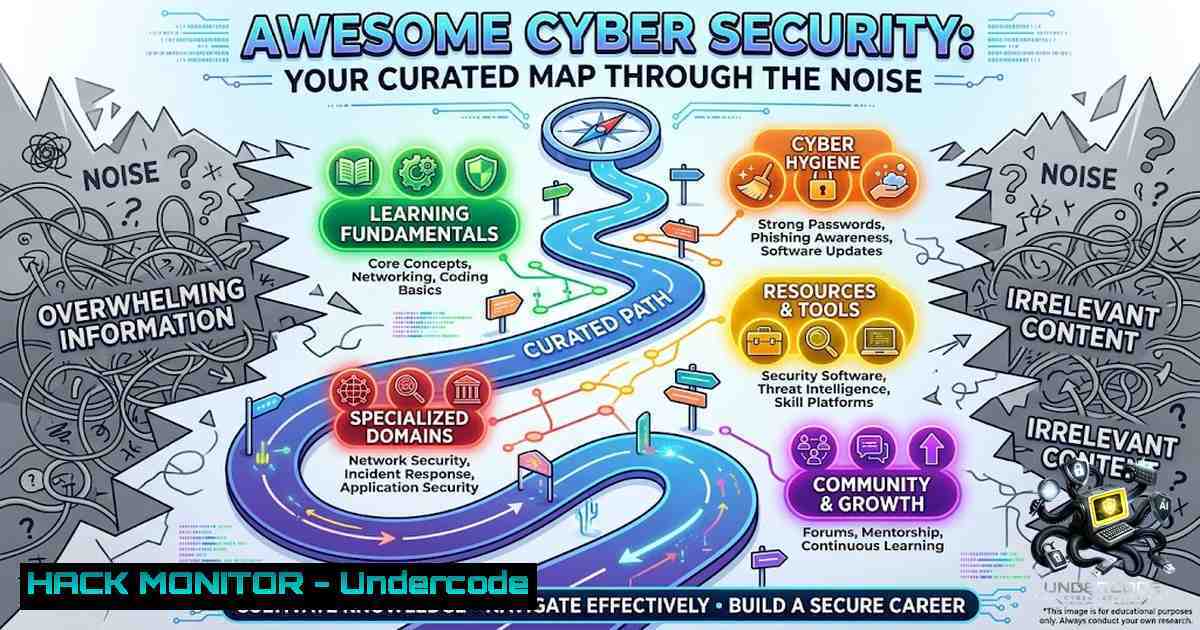
The cybersecurity learning landscape has become overwhelmingly noisy. With thousands of tools, frameworks, and platforms competing for attention, even seasoned practitioners struggle to separate signal from noise. The open-source Awesome Cyber Security repository on GitHub serves as a structured, community-updatable index that maps the entire domain—from threat intelligence and secure development to hands-on labs and certifications—giving developers, security learners, and practitioners a single source of truth to navigate the field efficiently.
Learning Objectives & Secrets:
- Objective 1: Master Threat Intelligence Sources – Gain proficiency in navigating the major vulnerability databases and threat feeds including MITRE ATT&CK, NVD, OSV, GitHub Advisory Database, and Exploit-DB to track and prioritize security vulnerabilities effectively.
-
Objective 2 (Secret Tip): Operationalize OWASP Standards – Move beyond reading OWASP Top 10 lists. Integrate OWASP ASVS, MASVS, and SAMM into your SDLC, and use OWASP ZAP, Dependency-Check, and Juice Shop as active testing and training tools within your CI/CD pipeline.
-
Objective 3 (Secret Tip): Practice Like a Pro – Don’t just watch tutorials. Use a structured learning path: start with TryHackMe for foundational skills, progress to PortSwigger Academy for web-specific expertise, then graduate to Hack The Box for realistic penetration testing scenarios.
You Should Know:
- Threat Databases and Alerts – Your Vulnerability Intelligence Stack
The repository organizes threat intelligence resources into a comprehensive collection that every security team should know. The MITRE ATT&CK framework provides a knowledge base of cyber adversary behavior and taxonomy for adversarial actions across their lifecycle, covering both enterprise IT networks and cloud environments. The National Vulnerability Database (NVD) serves as the U.S. government repository of standards-based vulnerability management data, while OSV provides a vulnerability database and triage infrastructure specifically for open source projects. The GitHub Advisory Database tracks the latest security vulnerabilities from the open source software world, and the Exploit Database maintained by Offensive Security provides a critical resource for understanding real-world exploits.
Step-by-Step Guide – Querying the NVD API for Vulnerability Intelligence:
To programmatically search for CVEs, use the NVD API 2.0 endpoint:
 Query a specific CVE by ID
curl -X GET "https://services.nvd.nist.gov/rest/json/cves/2.0?cveId=CVE-2021-26855" | jq '.'

Search for vulnerabilities affecting a specific product
curl -X GET "https://services.nvd.nist.gov/rest/json/cves/2.0?keywordSearch=Apache+Struts" | jq '.vulnerabilities[] | {id: .cve.id, description: .cve.descriptions[bash].value}'
For Python automation, use the `nvdlib` library:
import nvdlib
 Search for a specific CVE
r = nvdlib.searchCVE(cveId='CVE-2021-26855')[bash]
print(f"ID: {r.id}")
print(f"Description: {r.descriptions[bash].value}")
To query the OSV vulnerability database for open source packages:
 Query a specific package version
curl -X POST https://api.osv.dev/v1/query \
-H "Content-Type: application/json" \
-d '{"package": {"name": "django", "ecosystem": "PyPI"}, "version": "3.2.0"}'
- Secure Software Development – OWASP and Supply Chain Security
The repository dedicates significant attention to secure development practices through OWASP standards and tools. The OWASP Top 10 identifies the most critical security risks to web applications, while the OWASP API Security Top 10 addresses the unique risks facing modern APIs. The Application Security Verification Standard (ASVS) provides a framework for defining security requirements, and the OWASP Cheat Sheet Series offers pragmatic checklists and best practices.
For supply chain security, the repository highlights CycloneDX as an SBOM standard for software supply chain transparency. OWASP Dependency-Check identifies publicly disclosed vulnerabilities in project dependencies, and OWASP VulnReach adds runtime-aware reachability analysis to cut through SCA noise and surface only the vulnerabilities that actually need fixing.
Step-by-Step Guide – Scanning Dependencies with OWASP Dependency-Check:
Download the CLI tool and run a vulnerability scan against your project:
 Linux/macOS - Scan a directory and generate an HTML report
./dependency-check.sh --project "My Application" --scan /path/to/your/project --format HTML --out /path/to/report

Windows
dependency-check.bat --project "My Application" --scan "C:\path\to\your\project" --format HTML --out "C:\path\to\report"
For Maven-based Java projects, integrate directly into your build:
mvn org.owasp:dependency-check-maven:check
To scan using the OWASP ZAP automated security testing tool:
 Quick automated scan
zap.sh -cmd -quickurl http://target.com -quickout /tmp/report.html

Full automated scan with active + passive testing
zap.sh -cmd -quickurl http://target.com -quickout /tmp/full_scan.html -config api.disablekey=true

Run ZAP in daemon mode for API integration
./zap.sh -daemon -port 8080 -host 127.0.0.1
- Hands-On Learning Platforms – From Beginner to Expert
The repository curates an extensive list of practical learning platforms that cater to every skill level. TryHackMe offers a beginner-friendly environment with guided learning paths covering networking, web hacking, Linux, and Red Team basics. Hack The Box provides realistic penetration testing labs with Active Directory attacks, privilege escalation, and real vulnerabilities. PortSwigger Web Security Academy delivers free, comprehensive web application security training. picoCTF, hosted by Carnegie Mellon University, offers educational challenges ideal for beginners and students. For blue team practitioners, Blueteamlabs and LetsDefend provide defensive security training.
Step-by-Step Guide – Building Your Learning Path:
- Start with TryHackMe – Complete the “Pre-Security” and “Introduction to Cyber Security” learning paths to build foundational knowledge.
- Move to OverTheWire – Complete the Bandit wargame to master Linux command-line skills.
- Progress to PortSwigger Academy – Work through the “Server-side topics” and “Client-side topics” modules for deep web security expertise.
- Advance to Hack The Box – Begin with “Starting Point” machines, then progress to “Easy” and “Medium” retired machines.
- Supplement with CTF platforms – Use picoCTF and Root-Me for additional challenge-based practice.
4. AI-Powered Security Tools – The Emerging Frontier
The repository acknowledges the growing intersection of AI and cybersecurity with several notable tools. Cynative is an open-source cybersecurity deep research agent for cloud, runtime, and code—connecting to AWS, GCP, Azure, Kubernetes, GitHub, and GitLab with a read-only CLI built in Go. The OWASP Top 10 for LLM Applications provides critical guidance on risks specific to applications using large language models. NuGuard generates an AI-SBOM (AIBOM) and red-teams agentic AI applications for supply-chain and behavioral risks.
Step-by-Step Guide – Exploring AI Security Tools:
Clone and run Cynative for cloud security assessment:
 Clone the repository
git clone https://github.com/cynative/cynative.git
cd cynative

Build and run the CLI
go build -o cynative ./cmd/cynative
./cynative --help

Connect to AWS and scan for security issues
./cynative scan --provider aws --region us-east-1
5. Web Application Security Tools – Practical Utilities
The repository features practical web application security tools for daily use. DomScan provides domain reconnaissance for DNS, WHOIS/RDAP, TLS, subdomains, and typosquatting. The JWT Decoder allows in-browser decoding of token headers and payload claims without uploading the token. The Nutilz CORS Header Generator generates production-ready CORS configurations for Nginx, Apache, Express.js, Next.js, Fastify, Spring Boot, Go, Cloudflare Workers, and AWS CloudFront.
Step-by-Step Guide – Hardening Web Applications with Security Headers:
Implement security headers in a Next.js application using the Poszo Next.js Security Headers Starter:
// next.config.js
const securityHeaders = [
{
key: 'X-Frame-Options',
value: 'DENY'
},
{
key: 'X-Content-Type-Options',
value: 'nosniff'
},
{
key: 'Referrer-Policy',
value: 'strict-origin-when-cross-origin'
},
{
key: 'Content-Security-Policy',
value: "default-src 'self'; script-src 'self' 'unsafe-inline'; style-src 'self' 'unsafe-inline'"
}
];

module.exports = {
async headers() {
return [
{
source: '/(.)',
headers: securityHeaders,
},
];
},
};
What Undercode Say:
- Key Takeaway 1: The Awesome Cyber Security repository is not just another bookmark list—it’s a structured, living index that transforms information overload into actionable intelligence. The curation of threat databases, OWASP standards, learning platforms, and AI security tools provides a complete ecosystem for anyone serious about cybersecurity.
-
Key Takeaway 2: The most effective way to use this repository is to treat it as a roadmap rather than a destination. Start with the threat intelligence section to understand the landscape, apply OWASP standards to your development workflow, and systematically work through the hands-on learning platforms. The community-updatable nature of the repository means it evolves with the threat landscape—fork it, contribute to it, and make it your own.
Analysis: This repository represents a significant shift in how cybersecurity knowledge is curated and consumed. Rather than relying on scattered blog posts, vendor marketing, or outdated textbooks, practitioners now have a single, community-validated source that spans the entire domain. The inclusion of AI security tools and LLM-specific guidance demonstrates forward-thinking curation that addresses emerging threats. The hands-on learning section is particularly valuable because it bridges the gap between theory and practice—a critical missing piece in traditional cybersecurity education. The MIT license ensures that organizations can freely use and contribute to this resource without licensing concerns. For security teams, this repository serves as a centralized reference that can accelerate incident response, improve secure development practices, and standardize training across the organization.
Prediction:
- +1 The democratization of cybersecurity knowledge through curated open-source repositories like this will continue to lower the barrier to entry for security professionals, accelerating talent development and reducing the global cybersecurity skills gap.
-
+1 The integration of AI-specific security guidance (OWASP Top 10 for LLM, AI-SBOM, AI red-teaming tools) signals that the industry is proactively addressing AI security risks rather than reacting to incidents, which will lead to more secure AI deployments.
-
+1 The emphasis on hands-on platforms (TryHackMe, Hack The Box, PortSwigger) combined with practical tools (ZAP, Dependency-Check, security headers) indicates a maturation of the cybersecurity training industry toward practical, skills-based learning rather than theory-heavy certification programs.
-
-1 The sheer volume of resources in the repository may overwhelm newcomers despite the curation effort, potentially leading to “analysis paralysis” where learners struggle to choose a starting point.
-
-1 The reliance on community contributions for updates means that high-quality curation depends on sustained community engagement, which may wane over time without active maintainership.
-
+1 The inclusion of supply chain security tools (CycloneDX, Dependency-Check, VulnReach) reflects growing industry awareness of software supply chain risks, positioning organizations to better defend against attacks like SolarWinds and Log4j.
-
+1 The repository’s structure—threat intelligence → secure development → hands-on learning → certifications—provides a natural career progression path that aligns with how security professionals actually develop expertise over time.
-
-1 The rapid pace of change in cybersecurity means that even a well-maintained repository may struggle to keep up with emerging threats and tools, requiring users to supplement with additional research.
-
+1 The open-source, community-driven model of this repository fosters knowledge sharing across organizational boundaries, breaking down silos that traditionally hampered cybersecurity collaboration.
-
+1 By providing a single source of vetted resources, this repository reduces the risk of practitioners relying on outdated or insecure tools and practices, ultimately improving the overall security posture of the industry.
▶️ Related Video (90% Match):
https://www.youtube.com/watch?v=bcLrUeu8Ncg
🎯Let’s Practice For Free:
🎓 Live Courses & Certifications:
Join Undercode Academy for Verified Certifications
🚀 Request a Custom Project:
Secure, high-velocity infrastructure and disruptive technological engineering. Contact our engineering team for high-tier development and proprietary systems:
[email protected]
💎 Smart Architecture | 🛡️ Secure by Design | ⭐ Trusted by Thousands
IT/Security Reporter URL:
Reported By: https://lnkd.in/p/evjijiNR – Hackers Feeds
Extra Hub: Undercode MoN
Basic Verification: Pass ✅


