Listen to this Post
Introduction:
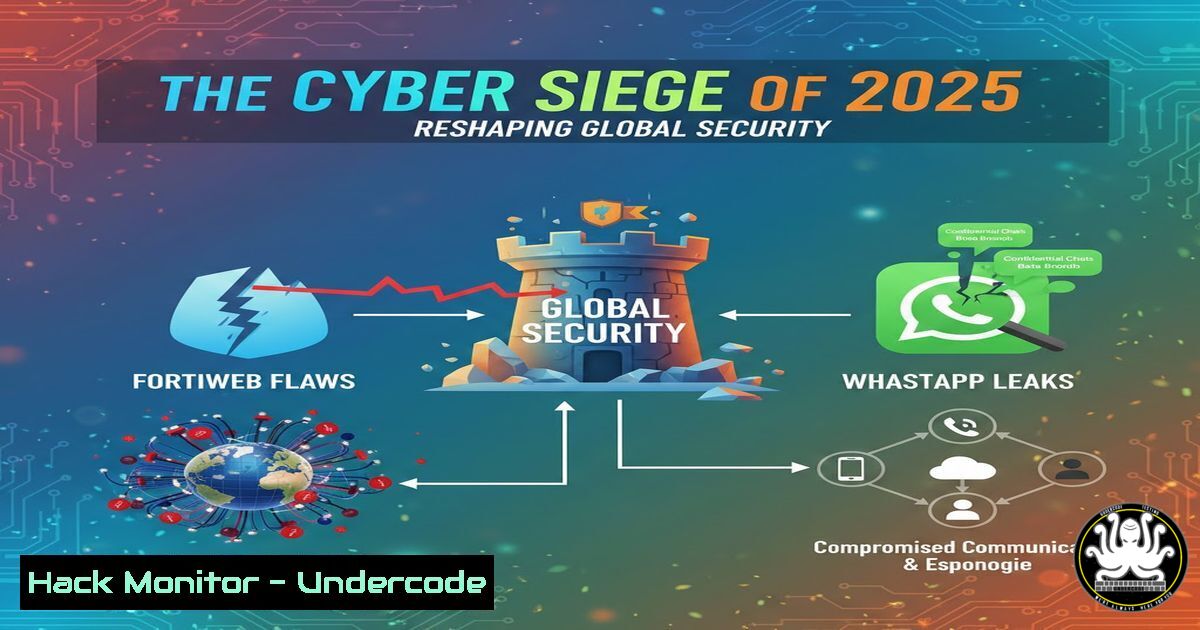
The cybersecurity landscape of late 2025 is defined by a dual-front assault: sophisticated state-level preparations for the quantum computing era and immediate, widespread exploitation of conventional vulnerabilities affecting millions. This week’s incidents, from the active exploitation of a FortiWeb vulnerability to a massive potential data exposure via WhatsApp, underscore the critical need for proactive patch management and a fundamental shift towards Post-Quantum Cryptography (PQC). As institutions like the ENISA centralize vulnerability management, the very fabric of digital trust is being tested, forcing a rapid evolution in both defensive tactics and strategic policy.
Learning Objectives:
- Understand the mechanisms behind the actively exploited FortiWeb CVE and how to implement immediate mitigation.
- Analyze the systemic risk of data exposure in massive platforms like WhatsApp and the principles of secure API design.
- Grasp the fundamentals of Post-Quantum Cryptography and the initial steps for organizational preparedness.
You Should Know:
1. Mitigating the Actively Exploited FortiWeb Manager Vulnerability
The recently disclosed vulnerability in FortiWeb Web Application Firewall managers allows unauthenticated attackers to execute arbitrary code or commands via crafted HTTP requests. This is a critical threat as it bypasses the primary defense layer—the WAF itself—potentially granting attackers control over the security appliance.
Step-by-step guide:
Step 1: Identify Affected Systems. Immediately inventory all FortiWeb deployments. The vulnerability is confirmed in specific versions; check your firmware against Fortinet’s advisory (CVE-2025-).
Step 2: Apply the Patch. Fortinet has released fixed versions. The upgrade process is critical and should be performed during a maintenance window.
Connect to your FortiWeb manager via SSH.
Check the current firmware version: `get system status`
Upload the new firmware image via the web interface (System > Maintenance > Firmware) or via CLI using execute restore image <tftp|scp|ftp> <location>. Always use trusted, internal sources for the firmware file.
Step 3: Implement Compensating Controls. If immediate patching is impossible, isolate the FortiWeb management interface from untrusted networks. Restrict source IP addresses that can access the manager using Local-in Policies.
- The WhatsApp Data Scrape: A Lesson in API Enumeration and Rate Limiting
A “problem of longue date” in WhatsApp potentially exposed 3.5 billion phone numbers. While not a traditional “breach” of Meta’s servers, this likely involved the abuse of WhatsApp’s contact discovery API. Attackers used a technique called enumeration, systematically checking phone numbers against the API to see which were registered, creating a massive, verified database.
Step-by-step guide to understanding and testing your own APIs:
Step 1: Understand the Attack Vector. The attacker script would cycle through phone number ranges, sending a request to the API endpoint for each number. A differing HTTP response code (e.g., 200 OK vs. 404 Not Found) or a slight timing difference would reveal if the number was registered.
Step 2: Test Your Own APIs for Enumeration. Use a tool like Burp Suite Intruder or OWASP ZAP to test your authentication/registration endpoints.
Intercept a legitimate request (e.g., “forgot password” with a valid email).
Send this request to the Intruder tool, replace the email/username parameter with a payload of invalid entries.
Analyze the responses. If invalid and valid entries return consistently different responses (status codes, length, content), you have an enumeration vulnerability.
Step 3: Implement Mitigations. Enforce strict rate limiting per IP and per user account. Use identical, generic error messages for both valid and invalid requests (e.g., “If this email is registered, a reset link has been sent”). Implement CAPTCHAs after a few failed attempts.
- Post-Quantum Cryptography: Getting Started with MISTRAL and OpenQuantumSafe
With France developing its own PQC cipher, MISTRAL, and national initiatives pushing for quantum readiness, organizations must begin their transition. PQC involves migrating from current public-key cryptography (RSA, ECC) to algorithms resistant to attacks from both classical and quantum computers.
Step-by-step guide to initial exploration:
Step 1: Inventory Cryptographic Assets. Use scanning tools to identify where and how cryptography is used. For example, on a Linux server, you can use `nmap –script ssl-cert` to check certificates on your services.
Step 2: Experiment with PQC Libraries. The OpenQuantumSafe (OQS) project provides open-source implementations of PQC algorithms.
Clone the library: git clone https://github.com/open-quantum-safe/liboqs.git`README.md`. This will give you access to PQC-enabled versions of common tools like OpenSSL.
Build and install the library following the provided
Step 3: Generate a PQC Test Certificate. Using the OQS-OpenSSL build, you can generate a certificate using a PQC algorithm like Kyber (a finalist in the NIST standardization process).
`openssl req -x509 -new -newkey dilithium3 -keyout test_pqc_key.pem -out test_pqc_cert.pem -nodes -subj “/CN=Test PQC” -days 365`
This command creates a self-signed certificate using the Dilithium signature algorithm.
- Cloud Hardening in the Wake of Colis Privé and Eurofiber Breaches
Recent data leaks at logistics and fiber operators highlight failures in cloud data storage security. Misconfigured S3 buckets, Blob Storage containers, and public-facing databases are a common root cause.
Step-by-step guide to securing cloud storage:
Step 1: Discover and Classify. Use cloud provider tools (AWS Macie, Azure Information Protection) or third-party scanners to discover all storage repositories and classify the data they contain based on sensitivity.
Step 2: Enforce the Principle of Least Privilege. On AWS S3, ensure bucket policies and ACLs are not set to `”PublicRead”` or "PublicReadWrite".
A secure bucket policy should explicitly deny public access and only allow specific, necessary principals.
Enable Block Public Access settings at the account and bucket level.
Step 3: Encrypt Everything. Enable default encryption on all buckets and containers. Use server-side encryption (SSE-S3, SSE-KMS) as a minimum, and for highly sensitive data, use client-side encryption before upload.
- Leveraging the New ENISA CVE Root for Proactive Defense
The designation of ENISA as a CVE Program Root signifies a major EU effort to streamline and centralize vulnerability management. This provides a more authoritative and localized source for vulnerability intelligence.
Step-by-step guide to integrating this into your security operations:
Step 1: Broaden Your Threat Intelligence Feeds. Subscribe to the official CVE list from `cve.org` and monitor ENISA’s upcoming publications for EU-centric threat analysis and mitigation guidance.
Step 2: Automate CVE Correlation. Use a Vulnerability Management platform that can ingest CVE data and automatically correlate it with the assets in your network. For a DIY approach, you can use the NVD API to query for CVEs affecting your software versions.
Example API call: `https://services.nvd.nist.gov/rest/json/cves/2.0?cpeName=cpe:2.3:a:fortinet:fortiweb:::::::`
Step 3: Prioritize Based on Context. Don’t just patch by CVSS score. Use the context provided by ENISA and other sources to understand which vulnerabilities are being actively exploited in your industry or region, and prioritize those.
What Undercode Say:
- The Perimeter is Now the API. The FortiWeb and WhatsApp incidents are not about firewalls; they are about the logic and security of the application layer and its interfaces. Defense must shift inwards.
- Strategic Regulation is a Double-Edged Sword. While the Franco-German push for harmonized sovereignty and AI rules aims to simplify compliance, it also creates a moving regulatory target that requires continuous legal and technical adaptation.
The convergence of technical exploits and high-level policy shifts reveals a security ecosystem in rapid flux. The active exploitation of core defensive tools like WAFs erodes foundational trust, forcing a zero-trust mindset. Simultaneously, the move towards PQC and centralized CVE management, while positive, adds complexity to an already overburdened security team’s mandate. The key challenge for 2026 and beyond will be balancing the urgent, tactical firefighting of today’s vulnerabilities with the strategic, multi-year investments required for quantum and regulatory readiness. Organizations that fail to allocate resources to both fronts will find themselves perpetually behind the curve.
Prediction:
The successful exploitation of foundational technologies like WAFs and mass-scale platforms will accelerate the adoption of AI-driven, autonomous security response systems. By 2026, we predict that over 40% of medium-to-large enterprises will deploy AI-based systems capable of automatically isolating compromised network segments and applying emergency patches without human intervention. Furthermore, the EU’s regulatory harmonization, coupled with PQC initiatives, will create a de facto “EU Security Standard,” forcing global tech giants to design products that comply with this specific, stringent framework from the outset, effectively balkanizing portions of the global cybersecurity market.
🎯Let’s Practice For Free:
IT/Security Reporter URL:
Reported By: Cyberveille Actu – Hackers Feeds
Extra Hub: Undercode MoN
Basic Verification: Pass ✅


