Listen to this Post
Introduction:
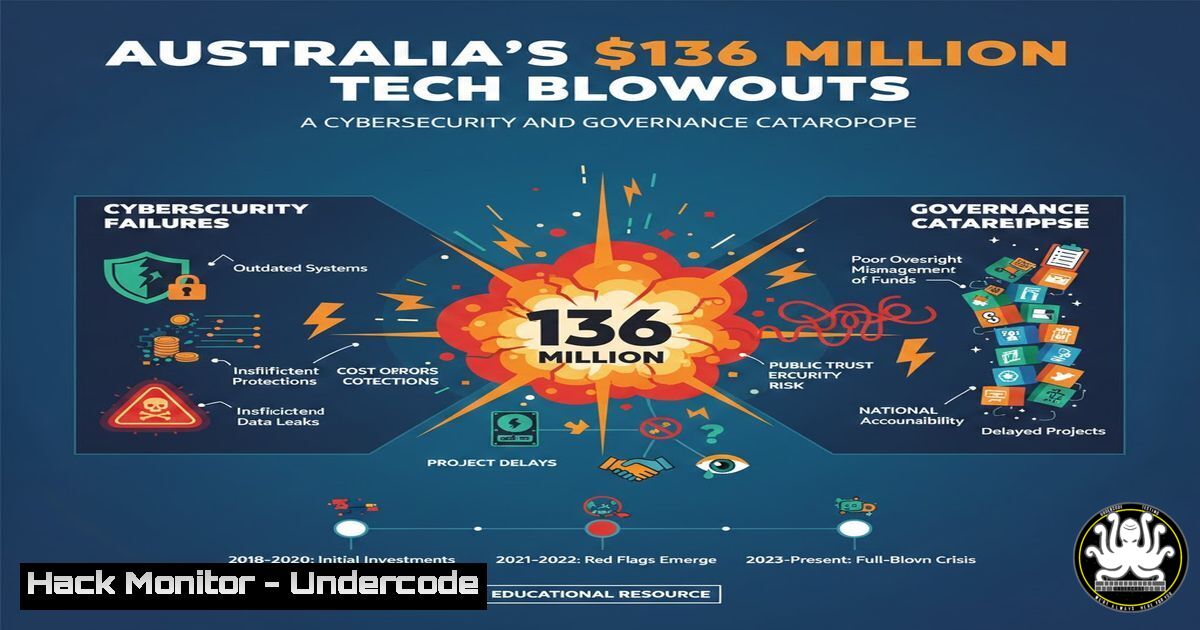
The repeated failure of multi-million-dollar Australian government IT projects, exemplified by the $60+ million Digital Passenger Card and $76 million Bureau of Meteorology website, signals a profound crisis in public sector procurement and digital governance. These blowouts are not merely financial scandals but represent critical vulnerabilities in the nation’s cybersecurity posture and operational integrity. This article deconstructs the systemic flaws enabling these failures and outlines the essential technical and procedural controls needed to prevent them.
Learning Objectives:
- Identify the critical governance and technical control failures in major public sector IT procurements.
- Implement robust cybersecurity and project oversight frameworks to mitigate the risk of project failure and security breaches.
- Understand the role of continuous monitoring, penetration testing, and contractual penalties in ensuring project delivery and security.
You Should Know:
1. The Procurement Black Hole: Where Governance Fails
The core issue begins with a procurement process detached from technical reality and accountability. Vague requirements, a lack of technical expertise among evaluators, and the absence of stringent, penalty-backed Service Level Agreements (SLAs) create an environment ripe for failure. Projects are approved based on vendor promises rather than demonstrable, iterative deliverables.
Step‑by‑step guide explaining what this does and how to use it:
Step 1: Mandate Technical Representation. Procurement panels must include independent cybersecurity architects and senior engineers who can scrutinize vendor technical proposals and architectures.
Step 2: Implement Phased Delivery with Milestone Payments. Adopt an Agile procurement model. Instead of a single large payment, structure contracts around deliverables. For example: 10% upon successful design review, 20% upon passing a security audit of the development environment, 30% upon a successful User Acceptance Test (UAT), etc.
Step 3: Enforce Security-First SLAs. Contracts must include SLAs with teeth, specifying penalties for downtime, security vulnerabilities, and performance degradation. For instance, a penalty of 0.1% of the total contract value per hour of unscheduled downtime.
2. Architectural Oversight and The “Below-Grade” Solution
The term “below-grade solutions” often points to fundamental architectural flaws: monolithic design, lack of scalability, and insecure coding practices. A modern government website should be built on a resilient, scalable, and secure cloud-native architecture.
Step‑by‑step guide explaining what this does and how to use it:
Step 1: Mandate a Threat Model. Before a single line of code is written, the vendor must produce a comprehensive threat model (e.g., using STRIDE) for approval.
Step 2: Enforce Infrastructure-as-Code (IaC). All cloud infrastructure must be defined in code (e.g., Terraform, AWS CloudFormation). This ensures consistency, allows for peer review, and enables automated security scanning.
Example Command (Terraform Scan): `terraform plan -out=tfplan` followed by a scan with `tfsec tfplan` to identify misconfigurations before deployment.
Step 3: Implement Automated Security Scanning. Integrate Static Application Security Testing (SAST) and Software Composition Analysis (SCA) tools directly into the CI/CD pipeline.
Example Command (GitHub Actions with Snyk):
- name: Run Snyk to check for vulnerabilities
uses: snyk/actions/node@master
env:
SNYK_TOKEN: ${{ secrets.SNYK_TOKEN }}
- The $76 Million Website: A Case Study in Performance and Security Failure
A high-cost website that “doesn’t work” typically suffers from performance bottlenecks and security gaps. Common issues include unoptimized databases, ineffective caching, and a web application firewall (WAF) that is either misconfigured or absent.
Step‑by‑step guide explaining what this does and how to use it:
Step 1: Load and Stress Testing. Use tools like Apache JMeter or k6 to simulate high traffic loads and identify breaking points. This should be a prerequisite for UAT.
Example Command (k6): `k6 run –vus 100 –duration 30s script.js` (simulates 100 virtual users for 30 seconds).
Step 2: Harden the Web Server. For an Apache/Nginx server, security headers are non-negotiable.
Example Snippet (Nginx Config):
add_header X-Frame-Options "SAMEORIGIN" always;
add_header X-XSS-Protection "1; mode=block" always;
add_header Strict-Transport-Security "max-age=63072000; includeSubDomains; preload" always;
add_header Content-Security-Policy "default-src 'self';" always;
Step 3: Configure a WAF. Deploy and fine-tune a WAF (e.g., AWS WAF, ModSecurity) to block common OWASP Top 10 attacks like SQL injection and XSS.
- Exploiting the Aftermath: How Attackers Target Failed Projects
A failed or unstable digital service is a high-value target. Attackers exploit the chaos, knowing that security monitoring may be lax and that patches may be applied hastily without proper testing.
Step‑by‑step guide explaining what this does and how to use it:
Step 1: Vulnerability Scanning. Use automated scanners like Nessus or OpenVAS to continuously scan for new vulnerabilities in the production environment, especially after failed deployment attempts.
Example Command (Nessus CLI): `nessuscli scan launch –policy “Basic Network Scan” –targets bom.gov.au`
Step 2: Enhanced Logging and Monitoring. Ensure all application and infrastructure logs are aggregated in a SIEM. Create alerts for suspicious activity, such as repeated failed logins or large data egress.
Step 3: Penetration Testing by Third Parties. Contract independent, certified ethical hackers to perform adversary simulation on the live environment post-failure, providing an unbiased assessment of its security posture.
5. Mitigation and Control: Building a Competent System
To prevent future blowouts, a system of layered technical and contractual controls is essential. This moves beyond mere policy to enforceable, automated governance.
Step‑by‑step guide explaining what this does and how to use it:
Step 1: Implement Cloud Security Posture Management (CSPM). Tools like AWS Security Hub or Azure Policy continuously monitor cloud environments for misconfigurations and compliance deviations, providing a single pane of glass for security status.
Step 2: Enforce Compliance as Code. Use tools that can codify security policies (e.g., using Open Policy Agent – OPA) to automatically reject non-compliant infrastructure deployments.
Step 3: Establish a Dedicated Cyber Governance Board. This board, with powers to halt non-compliant projects, should have oversight over all major digital procurements and must include C-level executives who are held accountable.
What Undercode Say:
- Systemic Incompetence is the Ultimate Vulnerability. The root cause of these failures is not a single technical bug but a systemic lack of accountability and technical governance. This creates a attack surface far more dangerous than any unpatched software.
- Financial Penalties are a Cybersecurity Control. Without severe, contractual financial consequences for non-delivery and security failures, vendors have no incentive to build secure, functional systems. The current model rewards failure.
The analysis of Australia’s tech blowouts reveals a governance model that is fundamentally broken. It operates on hope rather than enforceable, technical controls. The “special skill” is not in the vendor’s delivery, but in their ability to navigate a procurement system designed to spend money, not to deliver value or security. Until the consequences of failure are shifted from the taxpayer to the vendor and the responsible government officials, Australia’s digital estate will remain a high-cost, low-security environment, perpetually vulnerable to both exploitation and incompetence.
Prediction:
If the current governance model persists, Australia will continue to experience catastrophic IT project failures, each one eroding public trust and widening the nation’s cybersecurity gap. The escalating cost and complexity of technology will only magnify these blowouts. However, a significant, public-facing breach originating from one of these failed systems could serve as the necessary catalyst for radical reform, forcing the adoption of financially-penalized, security-first procurement frameworks that are standard in leading digital nations. The alternative is a future where the government is no longer able to reliably deliver or secure its most basic digital services.
🎯Let’s Practice For Free:
IT/Security Reporter URL:
Reported By: Theonejvo Total – Hackers Feeds
Extra Hub: Undercode MoN
Basic Verification: Pass ✅


