Listen to this Post
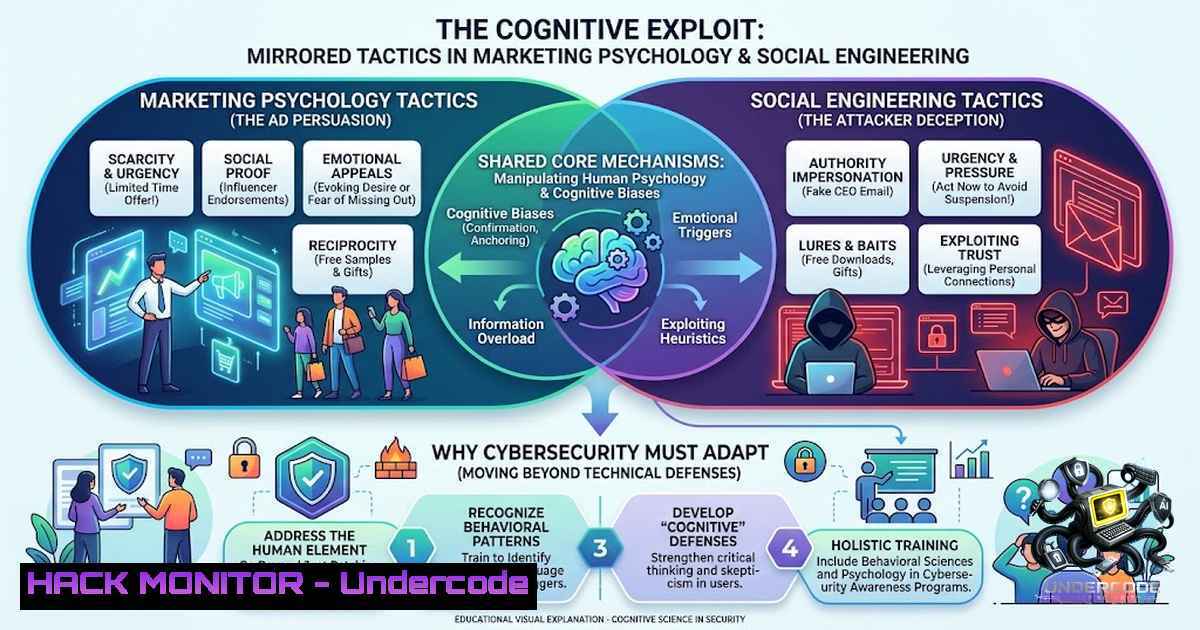
Introduction:
The digital ecosystem is increasingly defined by a battle for attention, where psychological vulnerabilities are systematically exploited to drive engagement and sales. This mirrors the core principles of social engineering in cybersecurity, where attackers manipulate human biases rather than technical vulnerabilities to gain unauthorized access. Understanding these psychological mechanisms is no longer optional for security professionals; it is essential for defending against sophisticated phishing campaigns, credential harvesting, and other forms of cyber deception that leverage cognitive biases to compromise enterprise networks.
Learning Objectives & Secrets:
- Objective 1: Deconstruct the psychological tactics used in viral marketing and map them directly to common social engineering attack vectors.
- Objective 2 Secret Tips: Learn to identify and analyze “Dopamine Loops” in email and web content, enabling you to spot malicious intent hidden within urgency and emotional triggers. A secret is to check the `X-Mailer` header in suspicious emails; inconsistent or generic values like “Microsoft Outlook” from a non-Microsoft domain can be a red flag.
- Objective 3 Secret Tips: Master the analysis of “Scripted Social Proof” by employing OSINT techniques to validate the authenticity of user interactions and reviews on platforms, uncovering potential bot networks or fabricated trust indicators used in spear-phishing campaigns.
You Should Know:
- Mapping Dopamine Loops to Phishing Lures: The Need for Speed
The “3-Second Hook” in marketing is designed to bypass rational thought and trigger a dopamine response. In a cybersecurity context, this translates directly to the subject lines and preview text of modern phishing emails. Attackers use urgent language like “Your account has been compromised” or “Immediate action required” to trigger the same fear-based, impulsive response. The goal is to get the user to click a link before their pre-frontal cortex can engage in logical analysis.
To defend against this, security teams must implement and configure email filtering solutions that go beyond simple keyword detection. For example, in Microsoft Defender for Office 365, you can use a mail flow rule to prepend a warning banner to emails that originate from outside the organization but contain urgency-related keywords.
Step‑by‑step guide for configuring an Anti-Phishing policy in Microsoft 365:
– Navigate to the Microsoft 365 Defender portal > Policies & rules > Threat policies > Anti-phishing.
– Create a new policy.
– Under “Impersonation,” set up protection for your C-suite executives to prevent display-1ame spoofing.
– In the “Thresholds” section, define the actions for low, medium, and high confidence phish (e.g., move to quarantine).
– Use a PowerShell command to verify the policy status: `Get-PhishFilterPolicy -Identity “Executive Protection Policy” | FL`
This configures a foundational defense against simple dopamine-driven attacks.
- Amygdala Hijacking and the Art of the “Scareware” Campaign
Marketing tactics that induce FOMO (Fear Of Missing Out) are a direct parallel to fear-based social engineering attacks. The phrase “Only 10 units left” is the psychological sibling of “Your session will expire in 5 minutes” in a credential harvesting email. This is an Amygdala Hijack, where the fear center of the brain overrides the cortex, driving panic-driven action. In IT security, this often manifests as “scareware”—malicious pop-ups or emails claiming your system is infected and pushing a fake solution or download.
For Windows administrators, configuring Group Policy Objects (GPO) is crucial to mitigate this. You can use GPO to restrict browser notifications and pop-ups, a common vector for these attacks. Additionally, a network-level defense involves blocking known malicious domains at the DNS layer.
Step‑by‑step guide for analyzing suspicious URLs in a Linux sandbox:
– Spin up a Linux VM or container for safe analysis.
– Use `wget –spider –server-response -T 15 [bash]` to retrieve only the server headers and check for redirects without downloading content.
– If you see multiple 302 redirects, it’s a strong indicator of a malicious landing page chain.
– Analyze the source of a suspicious email header. Extract the headers and use `grep -i “received” email.txt` to trace the origin IP and determine if it resolves to a legitimate email provider.
– Combine this with the `whois` command to check the domain’s registration date; domains registered within the last 30 days are often high-risk.
- The Illusion of Instant Transformation in Fraudulent Malware
The “Instant Transformation Illusion” in marketing—showing a dramatic before-and-after—is comparable to the deceptive interfaces of fake virus scanners or “system optimizer” malware. These tools present a fabricated dashboard full of “critical errors” to convince users they need to pay for a worthless “fix.” The transformation is an illusion; the payload is a Trojan.
To defend against this, endpoint detection and response (EDR) solutions are vital. For example, using Sysinternals Autoruns on Windows can help uncover persistence mechanisms that these fraudulent applications often install.
Step‑by‑step guide for detecting malicious persistence using Autoruns:
- Download and run Autoruns.exe as Administrator.
- Select “Hide Microsoft and Windows Entries” to reduce clutter and focus on third-party applications.
- Review all entries, paying close attention to items with a “?” or “Not Verified” status in the Publisher column.
- Right-click an entry and select “Search Online” to quickly check for known malware signatures.
- If you find an entry related to a “system optimizer,” delete it and then run a full scan with your EDR solution.
- Scripted Social Proof as a Supply Chain Attack Vector
Scripted social proof, where fabricated endorsements and paid actors build false trust, is an entry point for sophisticated Business Email Compromise (BEC). An attacker might create a fake executive persona with a strong online presence (built via social proof) to then impersonate that executive in an internal request for a wire transfer. This bypasses technical controls by exploiting the human element of trust.
Security teams can use OSINT (Open Source Intelligence) to validate profiles. For instance, using `theHarvester` on Linux can help map an organization’s email domain and identify public-facing employee profiles. This same tool can be used defensively to audit your own organization’s digital footprint.
Step‑by‑step guide for using theHarvester for footprint analysis:
- Install theHarvester: `sudo apt-get install theharvester` (Kali Linux).
- Run a basic query:
theHarvester -d [yourcompany.com] -b google -l 500. - Analyze the results for any publicly exposed emails or subdomains that could be used as recon data by attackers.
- While this is a reconnaissance tool, using it regularly can help you understand your own attack surface and remove unnecessary disclosures.
- API Security: The Backend of the Psychological Exploit
The modern marketing engine relies heavily on APIs to connect data, automate ad delivery, and track user behavior. This ecosystem is often the real vulnerability. An attacker who compromises a marketing API can manipulate campaigns to redirect users to phishing sites at scale, turning a legitimate ad network into a malicious vector. This is a supply chain attack on psychology.
API security hardening is paramount. This includes strict authentication (OAuth 2.0 with PKCE), rigorous input validation to prevent injection attacks, and rate limiting to prevent brute-force attempts.
Step‑by‑step guide for implementing API security best practices:
- Enforce TLS 1.3 for all API endpoints.
- Implement OAuth 2.0 and use short-lived JWT (JSON Web Tokens) for authentication. A secret tip is to use a private key to sign tokens and a public key to verify them.
- On a Linux API gateway, you can use `openssl s_client -connect api.yourdomain.com:443 -tls1_3` to verify the TLS version.
- For API request logging and monitoring, use `jq` to parse JSON logs. For example, `cat api_access.log | jq ‘.user_id, .timestamp, .ip’` to extract key fields for anomaly detection.
What Undercode Say:
- Key Takeaway 1: The psychological manipulation used in viral marketing is a blueprint for modern social engineering attacks. By understanding these cognitive exploit patterns, security professionals can better predict and mitigate phishing, BEC, and scareware threats.
- Key Takeaway 2: A multi-layered defense is required, combining technology (EDR, DNS filtering, MFA) with human-centric training that goes beyond simple awareness to cognitive conditioning against these triggers.
- Analysis: The line between digital marketing and cyber deception is blurring. Attackers are becoming master psychologists, and defenders must adapt by treating “user behavior” as a primary attack surface. We are no longer just securing machines; we are securing minds. This requires integrating psychological principles into security awareness training, employing zero-trust architectures that limit the damage of any one compromised credential, and using advanced analytics to detect anomalous user behavior that indicates a cognitive compromise (e.g., a user acting out of character under the influence of a high-pressure scam). The future of cybersecurity lies in understanding the human operating system as deeply as the technical one.
Prediction:
- +1: The growing awareness of these psychological exploits will lead to a new wave of “cognitive security” tools that use AI to analyze user behavior in real-time, flagging interactions that fit a high-risk psychological profile.
- -1: As defenses improve, attackers will shift to even more sophisticated AI-driven personalization, creating hyper-targeted lures that are nearly impossible to distinguish from genuine communication, escalating the arms race.
- +1: Security awareness training will evolve, moving from annual check-box exercises to continuous, scenario-based simulations that inoculate employees against cognitive biases.
- -1: The threat landscape for mid-sized businesses will worsen, as they lack the resources to invest in advanced user-behavior analytics or dedicated psychological security research, becoming primary targets.
- -1: The integration of marketing and IT data streams creates a larger, more complex attack surface, making it easier for attackers to pivot from compromised marketing databases to corporate networks.
▶️ Related Video (80% Match):
🎯Let’s Practice For Free:
🎓 Live Courses & Certifications:
Join Undercode Academy for Verified Certifications
🚀 Request a Custom Project:
Secure, high-velocity infrastructure and disruptive technological engineering. Contact our engineering team for high-tier development and proprietary systems:
[email protected]
💎 Smart Architecture | 🛡️ Secure by Design | ⭐ Trusted by Thousands
IT/Security Reporter URL:
Reported By: https://lnkd.in/p/eJw2wFVH – Hackers Feeds
Extra Hub: Undercode MoN
Basic Verification: Pass ✅


