Listen to this Post
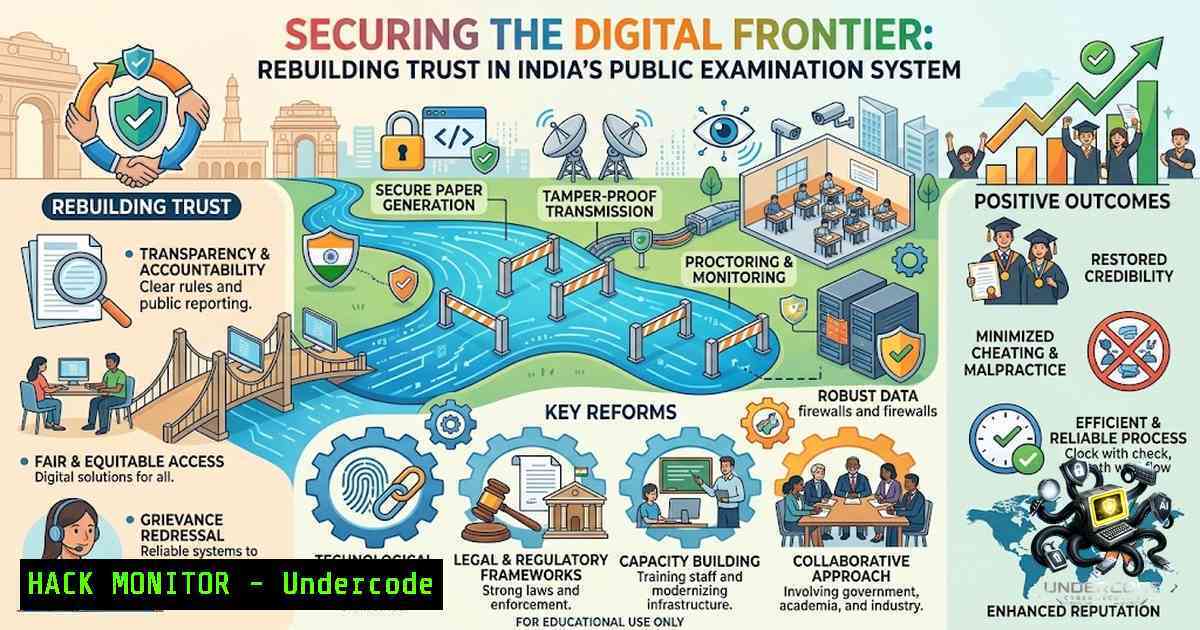
Introduction:
India’s public examination ecosystem, responsible for administering millions of high-stakes tests annually, is confronting a profound crisis of credibility. The recurring cycle of paper leaks, proxy candidates, and systemic vulnerabilities—from remote desktop access in Computer-Based Tests (CBT) to encrypted messaging apps for instant dissemination—has exposed deep flaws in the “chain of custody” of question papers. As the Supreme Court has observed, addressing this requires not just punitive measures but a complete technological and institutional overhaul, treating paper leakage as an insider access problem rather than a mere detection challenge.
Learning Objectives & Secrets:
- Objective 1: Master Air-Gapped System Architecture – Understand how to deploy physically and wirelessly isolated networks (no Wi-Fi, Bluetooth, or wired connections) to make remote cyberattacks nearly impossible. Secret Tip: Combine air-gapping with mandatory device-deposit protocols for all personnel handling confidential information.
- Objective 2: Implement Zero-Trust Digital Delivery – Learn to deploy end-to-end encrypted question paper delivery systems using public-private key infrastructure, where only authorised invigilators can decrypt materials on exam day. Secret Tip: Integrate time-lock mechanisms for scheduled release and blockchain-based audit trails that create tamper-proof records of every access.
- Objective 3: Deploy AI-Driven Forensic Monitoring – Utilise artificial intelligence for real-time video proctoring and post-exam data forensics to identify anomalies such as unnatural localised clusters of high scores or abnormal time-per-question metrics. Secret Tip: Implement hybrid models combining K-Means clustering and Isolation Forest algorithms to achieve over 92% detection accuracy for unknown anomalies.
You Should Know:
1. Hardening CBT Infrastructure Against Network-Level Attacks
Computer-Based Tests are vulnerable to a range of network-level attacks, including remote router manipulation and on-segment exploitation. To secure the infrastructure:
Step-by-Step Guide:
Linux (Server/Endpoint Hardening):
 Block all unnecessary ports and restrict outbound connections
sudo ufw default deny incoming
sudo ufw default deny outgoing
sudo ufw allow out 443/tcp  Only allow HTTPS for exam traffic
sudo ufw enable

Implement strict network isolation using iptables
sudo iptables -A INPUT -i lo -j ACCEPT
sudo iptables -A INPUT -m state --state ESTABLISHED,RELATED -j ACCEPT
sudo iptables -A INPUT -j DROP

Disable unnecessary services
sudo systemctl disable bluetooth.service
sudo systemctl disable NetworkManager-wait-online.service
Windows (Group Policy & Firewall):
 Block all inbound connections and create outbound allow rules
New-1etFirewallRule -DisplayName "Block All Inbound" -Direction Inbound -Action Block
New-1etFirewallRule -DisplayName "Allow HTTPS Outbound" -Direction Outbound -Protocol TCP -LocalPort 443 -Action Allow

Disable remote desktop and unnecessary services
Set-ItemProperty -Path "HKLM:\System\CurrentControlSet\Control\Terminal Server" -1ame "fDenyTSConnections" -Value 1
Stop-Service -1ame "RemoteAccess" -Force
Set-Service -1ame "RemoteAccess" -StartupType Disabled
Key Insight: Client isolation and management-frame protection are critical—absence of these allows on-segment attackers to intercept traffic. Deploy network segmentation using VLANs to isolate exam centre subnets from general traffic.
2. Building End-to-End Encrypted Question Paper Delivery Systems
Traditional physical transport of question papers is a weak link. Digital delivery using end-to-end encryption eliminates physical handling risks.
Step-by-Step Guide:
Implementation Architecture:
- Generate AES-256 encrypted question paper packages with Time-Based One-Time Passwords (TOTP) for access control
- Deploy public-private key infrastructure (PKI) where each examination centre has a unique decryption key
- Implement time-locked delivery preventing any centre from accessing files until the exact scheduled time
- Enable two-factor authentication (2FA) with a single-user model for invigilator access
Verification Commands:
 Generate AES-256 encrypted package (Linux)
openssl enc -aes-256-cbc -salt -in question_paper.pdf -out question_paper.enc -pass pass:[bash]

Decrypt with TOTP-derived key
openssl enc -aes-256-cbc -d -in question_paper.enc -out question_paper.pdf -pass pass:[bash]

Verify file integrity using SHA-256
sha256sum question_paper.pdf > checksum.txt
Windows (PowerShell):
 Encrypt file using AES-256
$secureKey = [System.Convert]::FromBase64String($env:ENCRYPTION_KEY)
$content = [System.IO.File]::ReadAllBytes("question_paper.pdf")
$encrypted = [System.Security.Cryptography.Aes]::Create()
 ... (encryption logic with proper implementation)
3. AI-Powered Real-Time Proctoring and Post-Exam Forensics
AI proctoring systems monitor candidates via webcam and microphone, using computer vision algorithms to track presence and behaviour in real-time. Post-exam forensic analysis detects mass cheating patterns.
Step-by-Step Guide:
Deploying AI Proctoring (Linux-based proctoring server):
 Install Python dependencies for AI proctoring
pip install opencv-python tensorflow scikit-learn

Run real-time gaze tracking and face monitoring
python proctor.py --camera 0 --model gaze_detection_model.h5 --threshold 0.85

Log suspicious events
tail -f /var/log/proctor/events.log | grep "FLAG"
Post-Exam Forensic Analysis (Anomaly Detection):
 Pseudo-code for clustering analysis
from sklearn.cluster import KMeans
from sklearn.ensemble import IsolationForest

Identify unnatural high-score clusters
kmeans = KMeans(n_clusters=5)
clusters = kmeans.fit_predict(exam_scores)

Detect outliers (potential cheating cases)
iso_forest = IsolationForest(contamination=0.05)
anomalies = iso_forest.fit_predict(exam_features)
Windows Proctoring Configuration:
 Enforce browser lockdown and prevent application switching
Set-ItemProperty -Path "HKLM:\SOFTWARE\Policies\Microsoft\Windows\AppCompat" -1ame "DisableUAC" -Value 1
 Log all running processes during exam
Get-Process | Export-Csv -Path "C:\ExamLogs\process_snapshot.csv" -1oTypeInformation
4. Implementing Constitutional and Statutory Safeguards
The Public Examinations (Prevention of Unfair Means) Act, 2024, and its 2026 amendments provide the legal backbone.
Key Provisions to Enforce:
- Enhanced Penalties: Individual offenders face 5–10 years imprisonment with fines up to ₹50 lakh
- Service Provider Accountability: Fines up to ₹5 crore and 8-year bans
- Organised Crime Syndicates: 7–10 years imprisonment with fines up to ₹10 crore
- Time-Bound Investigations: Probes must conclude within 2 months
- Special Fast Track Courts: Trials completed within 3 months on a day-to-day basis
Compliance Checklist:
- Designate a Central Investigating Agency or Special Task Force for each case
- Ensure all examination centres comply with Section 5 (barring disruptive entry)
- Mandate CCTV surveillance and CISF security for paper printing and storage
5. Institutionalising the National Testing Agency (NTA)
The Supreme Court has stressed the need to institutionalise the NTA with secure infrastructure, dedicated testing centres, cybersecurity systems, and institutional expertise.
Reform Implementation Steps:
- Establish Confidential Operations (CONOPS) Architecture with secluded rooms and air-gapped systems
- Shorten Expert Tenures to limit windows of compromise by organised networks
- Stagger Information Access using a “need-to-know” basis even within official circles
- Implement Four-Tier Security: Separate paper-setting functions, layered physical screening, credential verification, and isolated computing
- Deploy CISF for specialised frisking and physical security
Monitoring Commands (Linux Audit):
 Audit system logs for unauthorized access attempts
sudo journalctl -u sshd | grep "Failed password"
sudo ausearch -m USER_LOGIN -ts today

Monitor file integrity for question paper directories
sudo aide --check
6. Building a Unified National Examination Technology Framework
A unified framework with clearly defined cybersecurity standards applicable across all testing agencies is essential.
Implementation Guidelines:
- Mandatory Independent Security Audits and regular penetration testing
- Vendor Compliance with strict certification requirements
- Transparent Grievance Redressal mechanisms for candidates
- Digital Infrastructure eliminating physical paper trails wherever feasible
Recommended Penetration Testing Commands:
 Network vulnerability scan (Linux)
nmap -sV -p- exam_centre_ip_range

Web application security testing
nikto -h https://exam-portal.gov.in

API security testing
python -m unittest discover -s tests/ -p "test_api_security.py"
What Undercode Say:
- Key Takeaway 1: Technology alone cannot solve the trust deficit—institutional accountability must accompany digital reform. Every breach must trigger both criminal investigation and systemic review.
-
Key Takeaway 2: The insider threat is the most critical vulnerability. Treating paper leakage as an insider access problem rather than a detection problem fundamentally changes the security paradigm—from building better alarms to preventing access altogether.
-
Analysis: The recurring paper leaks represent not merely administrative lapses but the theft of countless dreams. Students invest years of effort, families spend substantial savings, and careers hinge on single examinations. When examinations are compromised, faith in meritocracy erodes. The solution demands a multi-layered approach: air-gapped infrastructure for paper creation, end-to-end encrypted digital delivery, AI-powered proctoring and forensics, stringent legal deterrence with enhanced penalties, and institutional reforms including shorter expert tenures and staggered information access. The Nandan Nilekani committee’s emphasis on technologies like AI and blockchain, combined with the Supreme Court’s call for institutionalisation, charts a path forward. However, success hinges on execution—moving from reactive blanket cancellations that penalise honest candidates to surgical identification of culprits. The sanctity of public examinations is a non-1egotiable aspect of the social contract.
Prediction:
- -1: Without rapid implementation of these technical and institutional reforms, India risks a continued erosion of trust in its examination system, potentially transforming its demographic dividend into a demographic disaster as meritocracy is undermined.
- -1: The organised nexus between rogue coaching institutes, corrupt officials, and solver gangs will adapt to new security measures, requiring continuous evolution of defensive technologies and threat intelligence.
- +1: Successful deployment of state-owned, highly secure digital testing grids, as recommended by expert task forces, could eliminate dependence on vulnerable private IT centres.
- +1: AI-driven forensic analysis enabling surgical identification of tainted candidates will allow testing bodies to isolate fraud without blanket cancellations, protecting honest students.
- +1: The Public Examinations (Prevention of Unfair Means) Amendment Bill 2026, with its enhanced penalties and fast-track courts, will serve as a powerful deterrent if rigorously enforced.
- +1: A unified national examination technology framework with mandatory security audits and certified personnel could establish a new gold standard for examination integrity in developing nations.
▶️ Related Video (86% Match):
https://www.youtube.com/watch?v=-qMas37_5v0
🎯Let’s Practice For Free:
🎓 Live Courses & Certifications:
Join Undercode Academy for Verified Certifications
🚀 Request a Custom Project:
Secure, high-velocity infrastructure and disruptive technological engineering. Contact our engineering team for high-tier development and proprietary systems:
[email protected]
💎 Smart Architecture | 🛡️ Secure by Design | ⭐ Trusted by Thousands
IT/Security Reporter URL:
Reported By: https://lnkd.in/p/eXt9WTw4 – Hackers Feeds
Extra Hub: Undercode MoN
Basic Verification: Pass ✅


